
Since the U.S. started measuring average public trust of the government in 1958 it has consistently trended downwards. Peaking at 77% in 1964, it reached an all-time low of 16% in 2023. The key factor in this slide toward distrust is the ever-increasing polarization of American politics.
The entirety of American politics, economy, war, immigration, social norms and everything else under the sun, is tainted by obstinate partisanship. Collective partisan identity politics currently governs election outcomes, so politicians seeking reelection worry more about narratives than actual solutions. The Pew Research Center finds that more than half of citizens believe politicians focus too much on partisan conflict and that 72% of citizens believe they focus too little on important issues facing the country.
Harvard Political Scientist Robert Putnam aptly suggests that the decline in government trust is a symptom of the ‘national divorce.’ The national divorce entails more than simply a separation between left and right. It alludes to a split in cultural morality and the collective consumption of information. He believes the issue lies deeper than politics, and that it is actually a moral divergence or an erosion of morality.
Because of the modern algorithms of social media, echo chambers have emerged-bubbles of homogeneous perspectives, narratives and opinions. Opposing opinions and perspectives are generally only disseminated within one’s echo chambers as selectively framed narratives, rather than directly from the primary source.
As information is increasingly fed to the public through these echo chambers which illicit confirmation biases, perceived reality splits into lenses of red and blue. Each side generally grows in contempt for the other’s perspective over time. Two Americans, both made aware of the same issue at the same time, will hear different narratives that directly inform their opinion going forward. If they were to converse, each already has a preconceived notion of the other’s position and the justification for it, making the conversation a circular disagreement which is likely to do more harm than good.
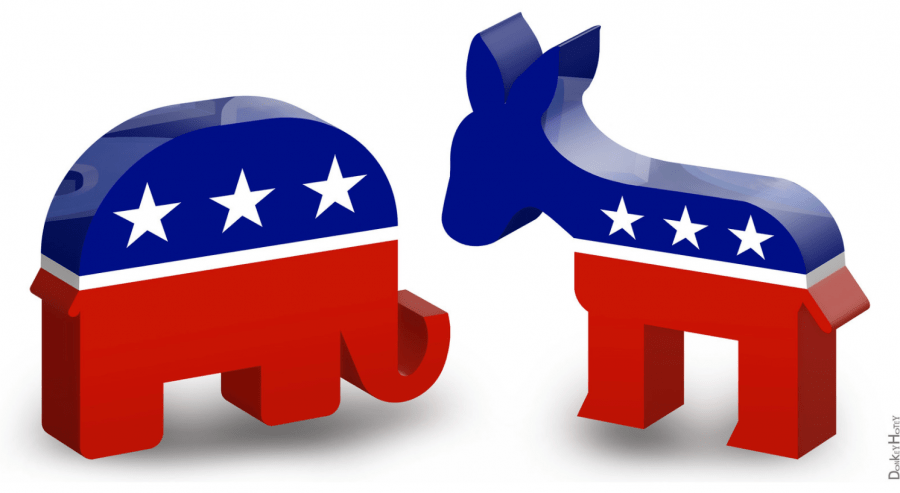
Political discourse is all but dead in the United States because of this. The crippling confirmation bias of echo chambers has formed a sense of moral superiority within each faction. Each party has inverse concepts of an ideal which would not be an issue if an authentic exchange of ideas was truly possible, but it is not so. Both sides are generally incensed with the sentiment of the opposition. Much of this has to do with the defining difference in political philosophy underlying each perspective.
The left believes the desirable course of politics is the progression toward societal equity through government intervention and sectarian legislation. This perspective idealizes the desired outcome of a policy rather than the means it is administered. Affirmative action is a good example of this. Students and employees are selected based on their identity rather than their merit.
Inversely, the right believes the desirable course of politics is fiscal and political freedom for all individuals by reducing government intervention and universally applicable legislation. This perspective idealizes the means of governance over outcomes. An example would be the right’s opposition to affirmative action because it is prejudice against those who do not belong to a collective minority. It is legislation that prevents individual access to opportunity in favor of a collective outcome.
This difference in philosophy is present in nearly all partisan debates. It causes gridlock and mudslinging, rarely leading to a compromise. Each party accuses the other of wrongdoing at every turn, and partisan media is used as a weapon against opponents. All the while Americans drift further from one another. If a citizen cannot trust his or her neighbor, then he or she cannot trust the government.
What is the solution to this issue? How can the nation revive a sense of coherent discourse and a healthy political environment?
The answer lies in neutrality. Not in the sense of denouncing ideology in favor of a positionless outlook but rather to become neutral in one’s observation of narratives, regardless of their partisan association.
Both sides are convinced of their correctness and usually will not yield to evidence that points otherwise. This incessant petulance has for decades corrupted the U.S. from the top down. Neither side is happy even when their party is in power, and voters’ trust in the government only marginally increases.
This toxic partisanship can only end when collective thought is replaced by individual analysis, otherwise the divorce might be final.
The opinions expressed in this article are those of the individual author.
