

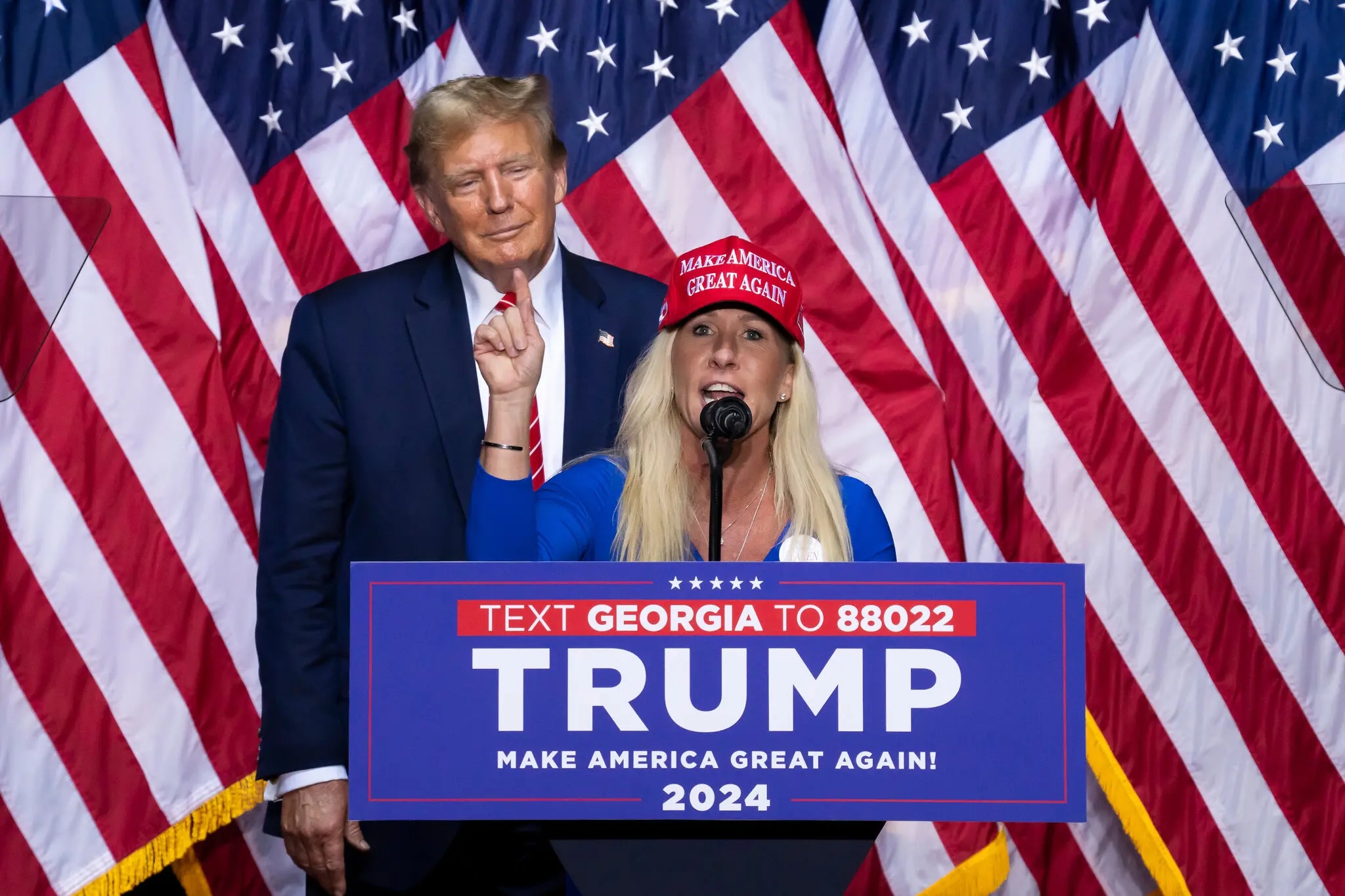
How Greene’s shocking resignation exposes deep fractures in the Republican Party, warns of more departures to come, and reveals the true cost of absolute loyalty in Trump’s Washington.
Remember when getting elected was supposed to be the hard part? Marjorie Taylor Greene just discovered that staying in office under a Trump presidency might actually be harder than winning in Georgia’s ruby-red 14th district. In a move that shocked exactly nobody who’s been paying attention, Greene announced her resignation from Congress, citing what she diplomatically described as irreconcilable differences with the man she once championed as America’s political savior.
Greene’s departure isn’t just another politician heading for the exits. It’s a flashing warning light on the dashboard of the Republican Party, signaling that something fundamental has shifted in the MAGA movement. When one of Trump’s fiercest defenders, someone who stood by him through impeachments, indictments, and everything in between, decides the juice isn’t worth the squeeze, that’s not just news. That’s a political earthquake.
The breaking point, ironically, came over an issue both conservatives and liberals could agree on: transparency regarding Jeffrey Epstein’s connections to the powerful elite. Greene pushed for releasing the Epstein files while Trump initially resisted, calling the effort a “hoax.” When she joined a bipartisan House discharge petition to force the release, Trump branded her a “ranting lunatic” and withdrew his support for her reelection.
But the Epstein controversy was merely the spark that ignited deeper frustrations. Greene’s resignation statement reads like a manifesto from someone who finally realized the revolution she signed up for had been hijacked by “Maga Inc,” replaced by what she calls “Neocons, Big Pharma, Big Tech, Military Industrial War Complex, foreign leaders, and the elite donor class.”
In other words, she’s accusing the populist movement of becoming exactly what it claimed to oppose.
What makes Greene’s exit particularly significant is the timing and the ripple effects. According to Punchbowl News, she’s not alone in her frustrations. Multiple GOP lawmakers are reportedly eyeing the exits, with one senior House Republican describing morale as being at an all-time low. Their grievance? The White House treats them “like garbage,” and Speaker Mike Johnson has done nothing to stop it.
The policy implications are substantial. With Republicans clinging to a 219-213 House majority, every resignation narrows that advantage further. Heading into midterm elections where the president’s party historically loses seats, the GOP can ill afford an exodus of sitting members, particularly those from safe Republican districts who could hold their seats indefinitely if they chose to stay.
Greene’s critique touches on legitimate conservative concerns that transcend personality conflicts. She’s questioned why healthcare subsidies for low-income Americans were allowed to expire, why foreign policy seems prioritized over domestic economic concerns, and why the administration appears disconnected from everyday Americans struggling with affordability.
The uncomfortable truth for Republicans is that Greene identified a tension at the heart of modern conservatism: the gap between populist rhetoric and governing reality. Campaign promises about draining the swamp, fighting the establishment, and putting America first sound great until you actually have to govern—at which point you discover that governing requires working with institutions, making compromises, and often disappointing your base.
Trump’s response to Greene’s departure has been characteristically contradictory. He initially celebrated her resignation as “great news for the country” and reiterated that she “went bad.” Hours later, he softened his tone, calling her a “nice person” and saying he’d “love” to see her return to politics.
But the damage may already be done. Greene’s parting shot about refusing to be a “battered wife” hoping things get better struck a nerve precisely because it validated what many Republicans privately feel but won’t publicly admit: loyalty in Trumpworld flows in only one direction, and disagreement—even from your most devoted allies—is treated as betrayal.
Looking ahead, Greene’s resignation creates more questions than answers. Despite her denials about running for president in 2028, her positioning seems deliberate. By resigning in early January rather than serving out her term, she creates distance between herself and the Republican establishment while maintaining her conservative credentials. She’s positioning herself as someone who stood on principle—a rare commodity in modern politics.
For the Republican Party, Greene’s exit is a canary in the coal mine. If the MAGA movement can’t maintain the loyalty of someone who was once willing to defend Trump through anything, what does that say about the movement’s durability beyond Trump himself? And if multiple Republicans follow Greene out the door, as reports suggest they might, the party could face a serious crisis of confidence heading into consequential midterm elections.
Greene’s resignation ultimately proves a fundamental truth about political movements: they’re easier to build than maintain, and personality-driven coalitions are inherently unstable. The MAGA movement’s challenge isn’t winning elections but rather figuring out how to govern effectively while staying true to its populist roots. Based on Greene’s departure, that reconciliation remains elusive.
As Republicans contemplate their post-Trump future, Greene’s exit offers a preview of coming attractions. The question isn’t whether the party will experience more fractures but how many, and whether the center can hold long enough to avoid a Democratic resurgence in 2026.
Sometimes the most important political stories aren’t about who’s running but about who’s running away, and why. Marjorie Taylor Greene just became that story, and her reasons for leaving should concern every Republican who cares about the party’s future beyond one man’s political career.