

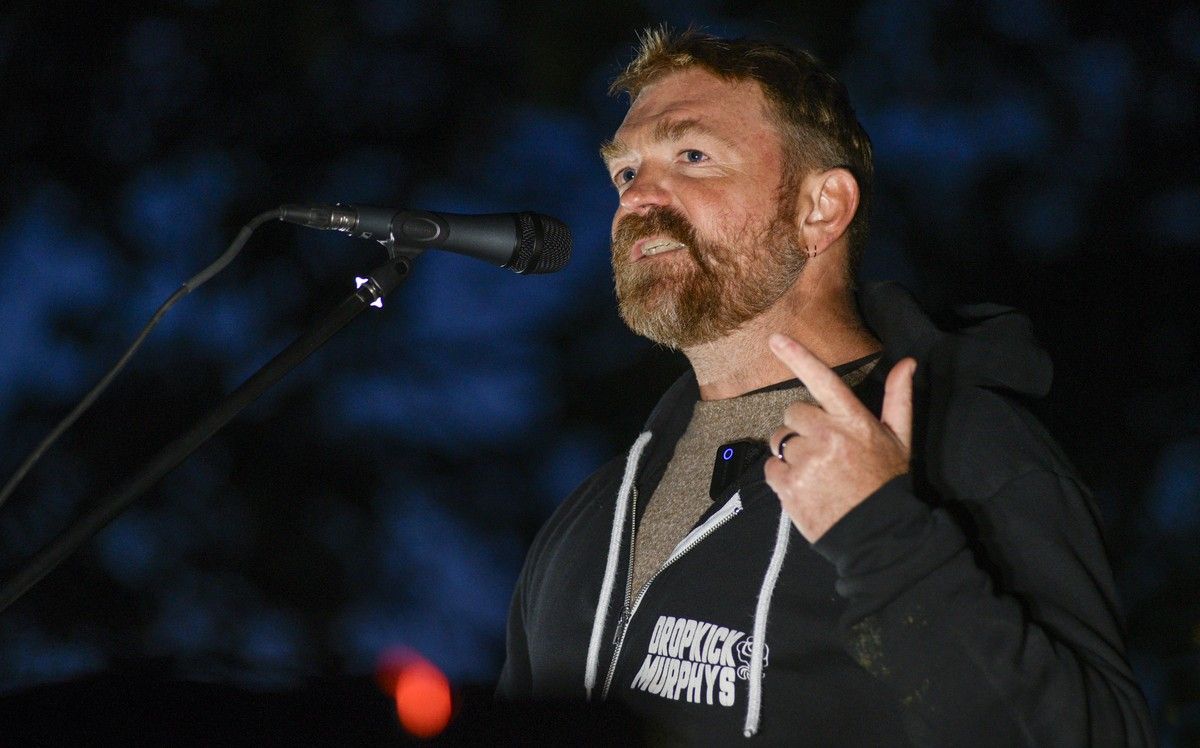
Senate candidate Graham Platner speaking at a food and medicine event.
Maine, that rocky outpost where the Atlantic keeps up its cold percussion against granite cliffs and the pine forests seem to murmur secrets to anyone patient enough to listen, has stumbled into a political drama that manages to feel both trivial and cosmic at once.
It begins, as many modern political morality plays do, with a single image posted online. Out of everything we are presented with a photograph of Graham Platner, Democratic candidate for the U.S. Senate. The symbol, according to anyone with even a slight knowledge of twentieth-century politics, looks suspiciously like the Totenkopf, the skull-and-crossbones insignia of the Nazi SS squads (Kruesi & Whittle).
Platner insists he had no idea. He says the tattoo dates back to 2007 on a drunken night in Croatia with fellow Marines, the sort of youthful misfire that to most would have resulted in a something like a regrettable haircut rather than a career-ending controversy. He describes the design as meaningless decoration, something he chose in a haze and later forgot about. It was only when political opponents unearthed it that he learned, to his horror, what it represented (“‘I’m Not A Secret Nazi’”).
The claim is difficult to digest. Platner has repeatedly described himself as someone with an “extensive knowledge of military history.” He has served both in the Marines and the Army National Guard, helped provide close protection for a U.S. ambassador in Afghanistan, and passed multiple background checks. That such a person could overlook such an infamous symbol is beyond belief. His campaign director, Genevieve McDonald, thought so too and resigned in protest, saying his explanation was “not plausible” (“‘I’m Not A Secret Nazi’”).
Platner has since covered the tattoo with a Celtic knot and small dog motifs which he describes as being more symbolic of his present life with his wife and their pets. He opted not for full laser removal but instead a quick fix at a Maine tattoo shop. “I wanted this thing off my body,” he told reporters (Kruesi & Whittle).
The irony here is almost textbook. The Democratic Party has spent years branding conservatives as fascist sympathizers, treating local school board disputes as potential domestic-terror threats, and painting Donald Trump as a Mussolini in designer ties. Yet here stands a Democrat with a Nazi-linked symbol on his chest, receiving only cautious criticism from the very people who demand ideological purity from others (McFall).
Even Senator Bernie Sanders continues to endorse Platner, describing him as a “stronger candidate” than Governor Janet Mills. This comes even as reporters dig through Platner’s old Reddit posts, uncovering slurs, dismissals of sexual assault in the military, and racially-charged commentary about tipping. Platner blames post-traumatic stress and depression from his service in Afghanistan, saying he regrets those words but asks to be judged by the arc of his growth rather than his past (Kruesi & Whittle).
To understand why this story lands so heavily, it helps to know what the Totenkopf actually was. The symbol, a stylized skull above two crossed bones dates back centuries as a military emblem of valor. Prussians wore it in the eighteenth century, as did some early German divisions in World War I. But under the SS, it became something else entirely: it was stamped onto the uniforms of men who operated the Nazi concentration camps. The symbol’s reappearance, even accidentally, carries a gravity that time has not diluted (“‘I’m Not A Secret Nazi’”).
Online, the reactions range between mockery and disgust. One user on X joked, “I heard Graham Platner has a Stalin tattoo on his buttcheek.” Another wrote, “This is cute coming from the party supporting the Nazi-tattoo guy.” The National Republican Senate Committee has turned the controversy into a fundraising tool, while Democrats like Jake Auchincloss and Platner’s rival Jordan Wood have urged him to withdraw, saying the scandal undermines any claim to moral clarity (Kruesi & Whittle).
And yet, Platner’s campaign events still draw crowds. Young Democrats hug him, tell him they believe in redemption, insist that his service matters more than his skin art. Polls suggest that many younger voters view the controversy as overblown, a relic of an older generation’s obsession with symbols over substance (McFall).
This persistence hints at a deeper pattern. In the age of constant outrage, projection becomes a form of survival. Each side accuses the other of extremism, fascism, and hypocrisy, while quietly excusing its own trespasses as the unfortunate byproducts of a noble cause. Platner’s story, at once tragic and farcical, offers a mirror held up to a political culture that no longer knows how to separate sincerity from theater, remorse from rebranding. Whether he remains in the race or not, the episode forces an uncomfortable reckoning with the question of what redemption looks like in a time when every symbol, every scar, every pixel is subject to public interpretation.
References
‘I’m Not A Secret Nazi’: Maine Democratic Senate Candidate Addresses Tattoo.” The Guardian, 21 Oct. 2025, . https://www.theguardian.com/us-news/2025/oct/21/maine-graham-platner-tattoo-democrat-senate Accessed 27 Oct. 2025
Kruesi, Kimberlee and Patrick Whittle. “Maine Senate Candidate Platner Says Tattoo Recognized as Nazi Symbol Has Been Covered.” Associated Press, 22 Oct. 2025, https://apnews.com/article/maine-platner-senate-trump-mills-tattoo-collins-fa8328a3c8aa5d5e0f34adb379e977b8. Accessed 28 Oct. 2025.
McFall, Marni Rose. “Most Young Democrats Still Back Graham Platner Despite ‘Nazi’ Tattoo: Poll.” Newsweek, 26 Oct. 2025, https://www.newsweek.com/graham-platner-nazi-tattoo-poll-janet-mills-young-voter-support-democrat-10941238. Accessed 28 Oct. 2025.
Acknowledgement: The ideas expressed in this article are those of the individual author
