

Being a “fixer” is a catch-22. Work marked by altruism and advocacy seems admirable and often has a benign beginning. The problem with profiting off recompense is that the relevance of the fixer depends upon the prevalence of the injustice. As the inner workings of the SPLC (Southern Poverty Law Center) came to light in April 2026, we are reminded that reform and corruption can be two sides of the same coin.
The year 2020 is shrouded in infamy, and for good reason, as the world seemed to collectively burst with rage. Burdened with isolation, the online space became an outlet for restless souls deprived of real-life interaction. Among the range of niche communities that emerged on social media platforms, notable uproar came from one domain in particular: racial injustice. From protests surrounding the death of George Floyd to the destruction of historical statues, grievances that had long simmered reached their boiling point.
As a high school senior graduating in 2020, I had a front-row seat to the digitized wrath unleashed across my feed. Peers, creators, celebrities, and institutions alike abandoned their usual content to declare solidarity with racial minorities, proving their allegiance by posting a black square. What was commonly referred to as “wokeism” took on a new form, fueling riots and compiling a catalog of buzzwords such as “systemic racism,” “white privilege,” “cultural appropriation,” and “microaggressions.” Innocent actions were suddenly assumed to be sinister, such as complimenting a minority’s hairstyle or engaging in baseline patriotic acts like waving the American flag on the Fourth of July.
Political discourse had always been contentious. Avoiding politics and religion has long been considered social etiquette due to the historic division both subjects inspire. Yet partisan polarization now seemed to exceed all social norms. Rising with brazen hostility, the public square held little separation between the personal and the political. Those with preexisting leanings found satisfaction in their most extreme forms, and though the novel chaos of 2020 subsided over the last six years, racial tensions have persisted alongside the crusade for reparations. While advocacy for racial equity can be found in online outrage, political jargon, and institutional statements, one nonprofit organization has long been a pillar of civil rights litigation: the Southern Poverty Law Center.
The organization heralds itself as a “defender of racial justice” and claims to combat a multitude of social inequities. Offering resources across Alabama, Florida, Georgia, Louisiana, and Mississippi, the SPLC presents itself as the ultimate advocate for the historically oppressed. Anyone who navigates to the SPLC website will encounter a multitude of related causes, including “dismantling white supremacy” and “ending unjust imprisonment.” Regardless of whether you consider yourself a social justice warrior or align with the conservative skeptic, nothing about this NGO’s existence is shocking, nor is its philosophy novel. But the indictment reportedly charged against the SPLC by a federal grand jury should be buzzworthy across party lines.
The U.S. Department of Justice’s Office of Public Affairs issued a press release on April 21, 2026, detailing charges against the SPLC. The statement cites eleven counts of wire fraud, false statements, and conspiracy to commit money laundering. Beyond enriching itself, the SPLC’s alleged criminality reportedly benefited the most unlikely of parties: Klansmen. The DOJ press release expanded on the investigation’s findings, reporting:
“According to the indictment, starting in the 1980s, the SPLC began operating a covert network of individuals who were either associated with violent and extremist groups, such as the Ku Klux Klan, or who had infiltrated violent extremist groups at the SPLC’s direction. Unbeknownst to donors, some of their donated money was being used to fund the leaders and organizers of racist groups at the same time that the SPLC was denouncing the same groups on its website.”
The SPLC has unsurprisingly pleaded not guilty to the charges, framing them as a vindictive move by the Trump administration. In both the prosecution and the defense, the same insight can be gathered: extremism is not encouraged for the sake of public interest. Grievance culture has paralyzed young adults—more so on the left in decades past—but the “woke right” has stumbled into its own sense of victimhood in recent years. The rationality of political campaign slogans now seems to carry little more substance than conspiratorial influencers such as those featured in the hit Netflix documentary The Manosphere.
The rhetoric propelled by the SPLC is one of victimhood, fatalism, and ever-increasing threat, while the fringe right points fingers at Jewish communities and unidentified pedophile rings supposedly run by the elite. While the subject of blame differs across the political spectrum, both ends identify with deep disillusionment. Consistent on either extreme is the incrimination of “the system,” as well as a widespread urge to distrust the powerful. From millennials to Gen Z, the line between advocacy and identification with the problem itself has become increasingly thin.
Embracing the “victim mindset” has been a popular subject of authorship and research, and cultural terminology like “victim Olympics” speaks to the phenomenon in which suffering is coveted. Author Charles Sykes posits in his book A Nation of Victims: The Decay of the American Character that victim mentalities are partially rooted in an entitled expectation of happiness. But they also emerge at the group level. An article in Scientific American summarizes a key finding from corresponding research: “A strong sense of collective victimhood is associated with a low willingness to forgive and an increased desire for revenge. This finding has been replicated in diverse contexts, including thinking of the Holocaust, the conflict in Northern Ireland and the Israeli-Palestinian conflict”—and arguably in the rhetoric of the SPLC.
The organization, much like individuals who adopt a victim mentality, appears to hinge on the severity of racial injustice rather than the reversal of it. The SPLC’s very existence is threatened if the cause it champions loses relevance. Input from such institutions contributes to the “socialization process,” referring to learned victim beliefs. Drawing again from psychological findings, Scientific American notes the consequences of perpetual victimhood: “Through many different channels—such as education, TV programs and online social media—group members can learn that victimhood can be leveraged as a power play, and that aggressiveness can be legitimate and fair if one party has suffered.” The positional power victimhood offers is no less alluring at the institutional level, especially where profit is concerned. After all, power and money tend to naturally converge.
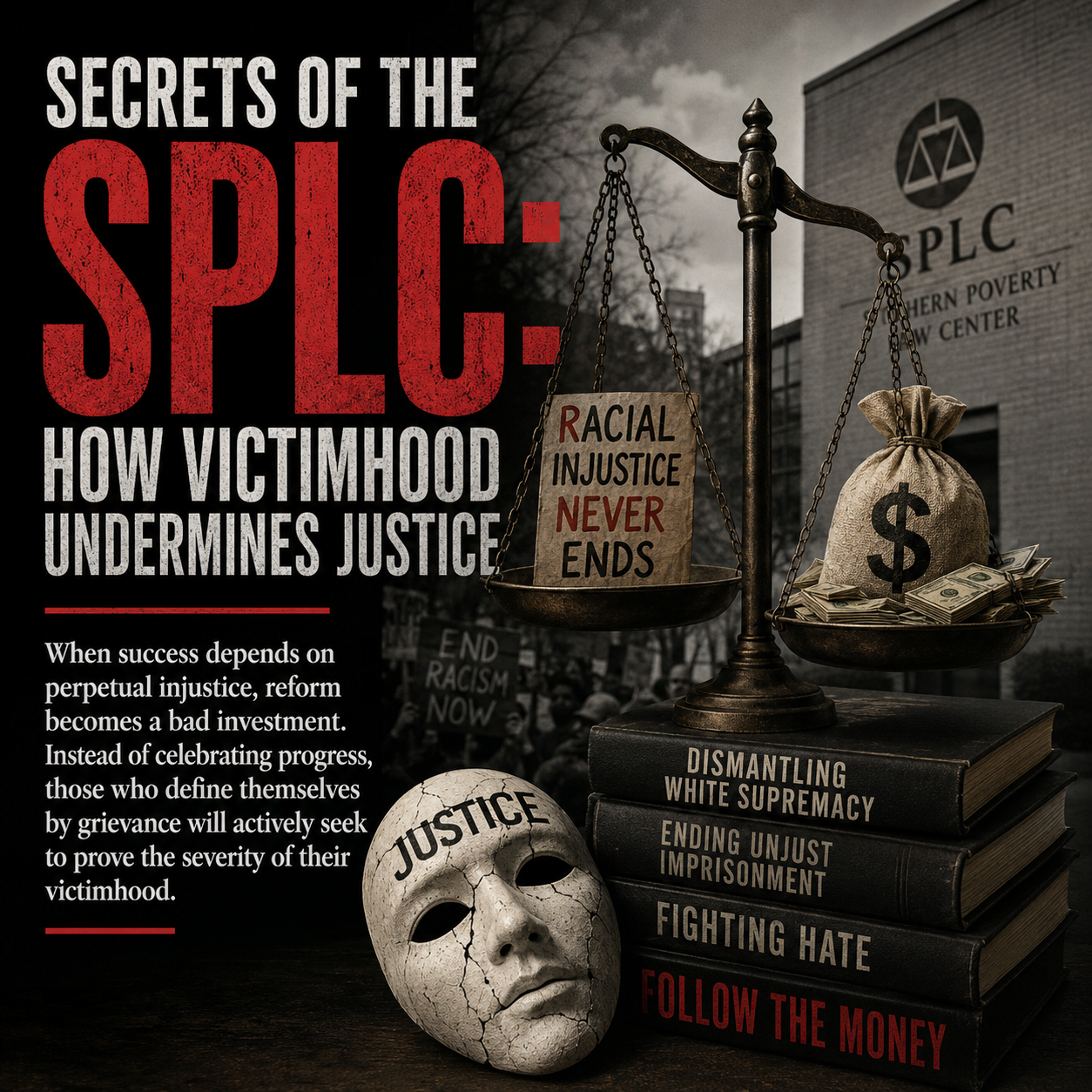
The SPLC is just one example of how the rhetoric of victimhood can create unseen stakeholders. When success and significance depend upon perpetual injustice, reform becomes a bad investment. Instead of celebrating progress, those who define themselves by grievance actively seek to prove the severity of their victimhood. The operations of the SPLC embody the conflict between victimhood and missional progress, including the realization that each undermines the other.
Under the guise of racial justice, the organization allegedly wound up encouraging—and even fabricating—the oppression it claims to abhor. If extreme racism is scarce enough to warrant invention, shouldn’t that be considered a striking success? For those who truly value justice, it surely would be. But for those who depend upon perpetual victimhood as a defining trait, progress becomes a greater threat than the one they claim to fear.
Acknowledgment: The opinions expressed in this article are those of the individual author and do not necessarily reflect the views of Our National Conversation as a whole.