

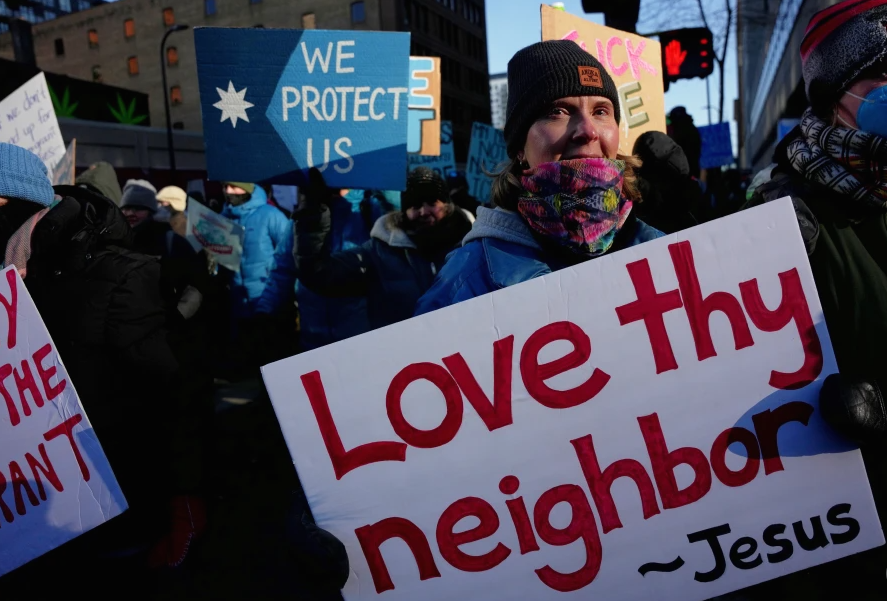
Recently, the issue of protesting in churches arose after anti-ICE campaigners interrupted a service where the pastor was an immigration agent. This has not been an issue for some time, but it is now resurfacing. Previously, major instances of church-based protest include an AIDS protest against the Catholic Church in 1989, other, more finance-related protests in the 1980s, and civil rights protests in the 1960s. Generally, people have respected churches as a buffer zone from protest and politics, but as American populations become more divided over religion, this idea is losing acceptance. This article will discuss how divisions in religion have affected the security of religious populations, with a focus on how Christian churches are being affected by political disagreements.
The actions taken by U.S. Immigration and Customs Enforcement (ICE) are among the many issues affecting churches. Another issue is individuals who are lesbian, gay, bi, trans, or queer. While some churches are in agreement with the concept of gender and sexuality ideologies, others are being threatened for their literalist biblical stances. One church highly affected by LGBTQ arguments is the United Methodist Church, whose vote to affirm a stance against LGBTQ clergy and same-sex marriages prompted more than one-fifth of the church’s 30,000 congregations to split off individually. Additionally, abortion has become an issue amongst churches with 48% of Catholics opposing the Catholic Church’s “no” on the issue. Lastly, women are becoming increasingly less religious with an “exevangelical” movement sprouting from opposition to the traditional viewpoints of many evangelical churches.
Overall, churches are adapting to the new rise in political divisions by setting solidified political stances. In fact, those churches that don’t face criticism. Progressive churches are said to be making more of an effort to promote what the Freedoms Journal Institute calls “political discipleship”, which is when members of the church stand up for political beliefs due to a specific religious and moral calling to do so. For example, the Black Church PAC hosts large numbers of Christian voters into liberal partisanship for reasons affecting African Americans. The F.J.I. exemplifies this to argue that conservative churches are not doing enough to take a political stance for their morals. Still, there is little knowledge of how to solve this issue at the current moment. Many churches have maintained their traditional views, but others have chosen to adapt their beliefs to the rise in liberal concepts. Altogether, those who are seeking the conservation of religion are causing a surge in Orthodox church attendances, while those seeking the more liberal side are taking part in some Protestant churches, such as the Episcopal Church. In the near future, we can likely expect to see more partisanship in religious institutions due to the rise in polarizing politics.
Image taken by Angelina Katsanis of the Associated Press.
