

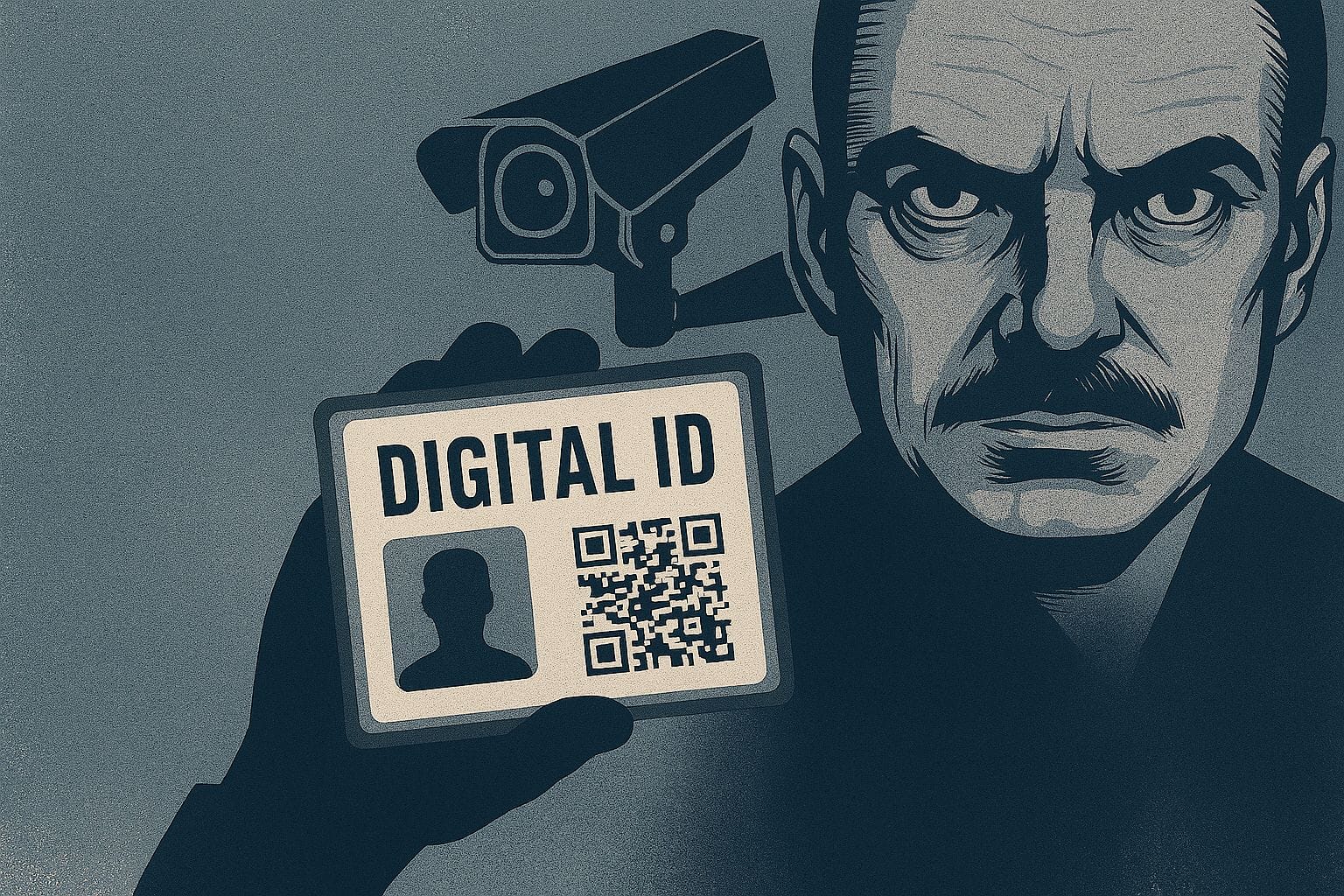
In recent months, there has been growing concern about the digital ID systems governments have been pushing in the West. These fears stem from the risks of violations of personal privacy, mass surveillance, government overreach, and the creation of cybersecurity vulnerabilities. More than anything, people are fearful that after introducing digital IDs into everyday life, the government will expand beyond the IDs original purpose and move to forcibly control its citizens and restrict their freedoms and liberties.
It is not difficult to understand these very real worries people are expressing. Many look to other countries that already implement these policies as examples of what could happen. A 2023 study by the Centre for Intellectual Property and Information Technology Law at Strathmore University discerned that 22 of 27 countries in Africa, the Balkans, Central Asia, Latin America, the Caribbean, and South and Southeast Asia had adopted digital ID systems, with biometric features in many instances. The study observed that when identification systems make it more difficult to seek information or increase the threat of surveillance and harassment, they impede fundamental freedoms.
A report from Africa discloses growing investments in biometric digital ID programs and the collection of personal data. Additionally, the exclusion of key stakeholders from their development has led to heightened public apprehension about privacy risks. In South and Southeast Asia, the regional report revealed “ongoing collaboration between governments and third-party private entities,” as well as governments applying “exclusionary practices observed in traditional ID methods,” to digital ID systems, making traditional ID more difficult to use. Latin America and the Caribbean reports concluded that “ambiguity latent in the ‘digital ID’ concept,” enabled these countries to expand their digital ID databases beyond identification and into broader structures of state surveillance.
Digital-only systems also have a high potential to exclude people without internet access or mobile devices from necessities. Individuals who cannot or will not access said devices may be blocked from essential services, such as purchasing food. The digital system has proven to be a failure in countries like India, whose massive biometric ID system causes people to starve to death. These tragedies were caused after being denied food for either not linking their ID card to their ration card or for not having an ID number in the first place.
On top of everything, there is a serious security risk with implementing digital IDs. Inadequate security measures can lead to major data breaches. And with all of a person’s information stored in one place, it makes it far easier for all of someone’s personal data to be stolen. A regional study of the Balkans found that the region has experienced a surge in data breaches as a “growing reliance on biometrics and digital identity” persists.
There are other manifestations of a digital system seen in the world today, notably in North Korea and China, where the country’s subjects are burdened with extreme surveillance and control over their lives. Videos from China showing its digital ID system have many saying it looks like something out of a dystopian novel. Every time a person uses the ID, the system gets closer to knowing everything about that individual.
However, many Western countries, such as the UK, are moving forward with digital IDs despite public disapproval. Keir Starmer has said that the new digital IDs in the UK will be free of charge and mandatory by 2029, stating, “You will not be able to work in the UK if you do not have a digital ID.” Others also support the new IDs, expressing that there would be more security and public services would run faster.
On the other hand, many warn that when a government begins talking about conveniences and safety, citizens become worried. Despite the UK government’s push, over 2 million people in the country have signed a petition opposing digital IDs. Nevertheless, the government still plans to move forward regardless.
This isn’t even the first time the UK has tried to push for digital IDs, however. In the early 2000s, the prior Labour government under Tony Blair proposed a similar scheme. In 2006, the UK Identity Cards Act was passed into law, which was equally as contentious at the time. In 2010, when the Conservative/Liberal Democrat coalition came to power, they repealed the legislation.
Outside of those calling the IDs Orwellian and dangerous, some are even saying they are the “Mark of the Beast,” referenced in the Book of Revelations in the Bible, and arguing that they are a precursor to the mark. Many have begun to quote the passage from Revelation 13:16-17, which states:
16 And he causeth all, both small and great, rich and poor, free and bond, to receive a mark in their right hand, or in their foreheads: 17 And that no man might buy or sell, save he that had the mark, or the name of the beast, or the number of his name.
There is, admittedly, a connection, as governments are stating that digital IDs are required to work, own a home, or live. This connection has only caused more people to rebel against it.
Digital IDs are also the perfect tool of control, as giving the government the ability to control when you can access your own money and when you don’t will create a barrier to free economic and social expression.
Former Pfizer Vice President, Mike Yeadon, put it bluntly: “If you sign up for Digital ID, it will be the last truly free decision you’ll ever make.” The moment that every document and account is tied to a singular ID, individual freedoms are no longer permissible. Banking, property ownership, travel, and even speech can be controlled and revoked at the push of a button. It is not hard to see how quickly even mere disagreement with the government will result in punishment.
Even without digital IDs, governments around the world have pushed to control and censor the lives of their people. In 2022, the Canadian government froze the bank accounts of hundreds of citizens for making legal donations. Alternatively, just look at how much control the government took during the COVID lockdown, forcing people inside their homes and not allowing some to work or attend school without a vaccine or mask. If given the chance, the government will take control of every aspect of its citizens’ lives.
This was seen in the US in 2005 when Congress passed an unconstitutional law requiring Americans to get national ID cards, or Real ID. The American Association of Motor Vehicle Administrators (AAMVA), which coordinates closely with the DMV, said that once Real ID is fully implemented, it would issue digital IDs on people’s phones to track and control movement, purchases, transactions, etc.
As the digital ID system has become a popular talking point, many have taken to the internet to voice the dangers it poses. People are arguing that it is not about convenience; it is about control. Many also fear the irreversibility if a system like this were to come into place. Gaining or recovering anonymity would be almost impossible to undo once personal data is integrated into a digital system. Some people have even argued that it would be better for people to abandon their country altogether than to fight against a system that has no intention of changing course.
However, governments are not completely evil. They are good things, generally, as they help protect and defend nations, but easily corruptible people still run them. The situation is simple: if money exists only in digital form, the government can shut it off at any time if someone steps out of line. Access to funds can be weaponized to force compliance, and, moreover, the government would not be pushing so hard for a system if it did not already have full control. Many today think that the government already knows everything about its people, but that is not necessarily true. The Western world still has the power to stop this from happening and say no to digital IDs.
1 Comment
Memdeklaro offers a humanitarian and privacy-respecting alternative to Digital ID, allowing people to self-declare their identity without third parties. Learn more at https://memdeklaro.org