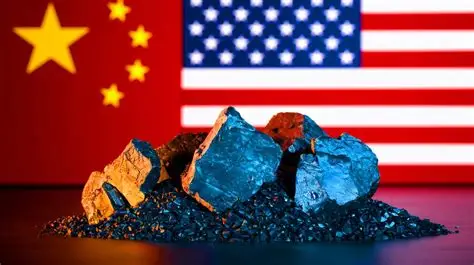

In the year 1992, former Chinese leader Deng Xiaoping famously said “The Middle East has oil, China has rare earths.” Rare-earth elements are metallic elements that are essential for technology, and are used in smartphones, laptops, motors, and defense systems.
However, China would not merely mine and export these rare earths, instead dominating the production, processing, and manufacturing of rare-earth elements. China currently accounts for around 70% of rare-earth mining, and 90% of processing.
China can use this near monopoly to secure concessions regarding market access, technology, or tariffs. We have already seen this happen in June, when China utilized its advantage in rare-earth metals and magnets in the trade war with the U.S.
Beijing agreed to ease its restrictions on these metals in exchange for the U.S. relaxing its restrictions on the sale of jet engines and ethane, as well as Chinese student visas.
The way China was able to successfully leverage its rare earth dominance is a sign that the U.S. and its allies must prioritize developing alternatives.
In his second term, Donald Trump has made rare earths a top priority, telling reporters in October 2025 that “In about a year from now, we’ll have so much critical mineral and rare earths that you won’t know what to do with them.”
While the United States only has one active rare-earths mine, located in California’s Mountain Pass, progress has been made to reduce dependency on China. A Wyoming coal mine operated by Ramaco Resources, known as the Brook Mine, is working to mine and process rare earths by 2028, making it the first rare-earth mine to open in over seven decades.
The Trump Administration has also pursued deals with US’s allies to break China’s dominance over the market. In October, President Trump struck an $8.5 billion deal with Australian Prime Minister Anthony Albanese to increase critical minerals and rare-earths
investment between the U.S. and Australia.
The Pentagon has also partnered with Korea Zinc to build the facilities for processing rare earths in Tennessee.
One such concern related to this development is the environmental harm that comes with it. Mining and processing rare earths is extremely destructive to soil and water supplies, with some parts of China needing 50-100 years to environmentally recover.
However, the move for the U.S. and its partners to de-risk from China’s rare earth dominance does not have to be so destructive. The United Nations proposed a Global Minerals Trust which would promote cooperation and sustainability. If this policy proposal were implemented, deals made between countries would factor in sustainability indicators, such as reducing mining emissions or waste generation.
China not only dominates the mining and processing of rare earths, but also the production of rare-earth magnets. The majority of rare-earth magnets are neodymium magnets, used to make essential technologies such as smartphones, cars, and electronics.
However, they also produce Samarium-cobalt magnets, which are used in defense, automotive, and aerospace motors. In the National Defense Authorization Act of 2024, Congress stipulated that as of January 1, 2027, materials used in the defense industry must be China-free, and China itself has restricted exports of rare earths for military use.
Unfortunately, these mandates are not consistently enforced, and contractors like Lockheed Martin have continued to use materials from China.
This dependence is also concerning as China grows more aggressive in the Indo-Pacific region. Xi Jinping is 72, so if he wants to see his dream of unifying Taiwan with China come to fruition under his rule, there is a possibility that China will move to take the island within the next few years. In case of a massive escalation of conflict between China and our allies in Asia, it is in our interest to have built up our own rare earth capabilities.
The United States currently has the lead in the AI race – but only by months, not years.The data centers that are the very backbone of AI systems are reliant on rare-earth magnets. While the U.S. is making progress in producing these magnets, the quantity just isn’t enough. The lone Texan facility that can produce rare-earth magnets in America will be producing 1,000 tons of neodymium magnets by 2027, whereas China produces around 300,000 tons a year.
While the Trump administration is putting America on the right path and we are seeing real progress, the United States and its allies must continue to accelerate these efforts to secure the critical minerals that will determine our future.