

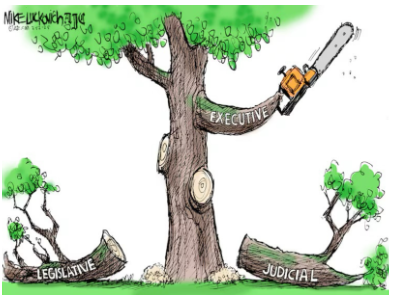
Local legislation allows the state government to interpret jargon towards their preferred ideology. However, when there are discrepancies between protected rights and the court’s interpretation, the Supreme Court of the United States (SCOTUS) must intervene.
In A.J.T. v. Osseo Area Schools, a student with a disability faced discriminatory practices within her in-school accommodations. The initial interpretation by the Eighth Circuit Court, regarding the Rehabilitation Act, and Americans with Disabilities Act (ADA), Title II Individuals with Disabilities Education Act (IDEA), was a loophole interpretation. They favored an unequal implementation of disability rights within in-school disability accommodation, opening up the possibility to not only allow courts to vary their interpretation case by case, but also school’s, student by student.
The family filed a suit of appeal to review “the Eighth Circuit’s ruling, which held discrimination cases in the context of education to a higher legal standard than any other disability discrimination case” (ACLU). SCOTUS (The Supreme Court of the United States) reviewed the appellate case and ruled disabled students “do not need to prove ‘bad faith or gross misjudgment’ to pursue discrimination cases” for in-school accommodations, favoring a victory for the A.J.T family (ACLU). This altered the interpretation of disability discrimination laws, demonstrating that SCOTUS’ precedents delegate clearer definitions of federal jargon.
While SCOTUS’ rulings may not replace the court’s ability to maintain jurisdiction discretion, their rulings are essential in 1) preventing civil rights and liberties from being left to local courts alone and 2) fulfilling the people’s demands for equal and equitable implementation of the law.
Unfortunately, if a change in SCOTUS party control reverses legal precedent, Americans will constantly be caught between expanding and contracting politics. If our government continues to allow legal interpretation to be discretion-based, this will turn back social justice reform, right or left.
Take the overturning of Roe v. Wade. Once the highest court overturned federally protected abortion rights, states were able to impose bans on abortions;, restricting medical treatment and abortion access within clinics and hospitals. This then turned into criminal prosecution of women who received an abortion within state lines, or once they crossed back into state lines. This loose re-interpretation of Roe v. Wade resulted in a nationwide recall of medical reform, reproductive justice, and arguably women’s rights as a whole.
To go further into detail, Petitioner Dobbs represented the state of Mississippi in Dobbs v. Jackson Women’s Health Organization. This State Health Officer argued that if Mississippi law can ban abortion after 15 weeks because there is no clause in the Constitution that confers a right to an abortion, then at any stage of pregnancy abortion, is not constitutionally protected. This overturned abortion rights precedent.
In my review, Dobbs is inherently wrong. Because the Fourteenth Amendment protects the right to “’due process’ against state violations,” this, at any legal level, protects one’s liberty to be free from arbitrary, unreasonable, or unjust government restriction. Not to mention a right to file suit against the denial of a medical abortion, to be heard by a jury of one’s peers, as protected in the Ninth Amendment.
Regardless, despite the multitude of U.S Constitutional rights and the Bill of Rights, which amended civil liberties, which protect a woman’s right to an abortion, and regardless that the constitution is the foundation of our legislature and judiciary, if SCOTUS can undermine evolved evaluations of legal precedent because of outdated politics, this will mobilize a downturn of equal rights.
To prevent this downturn, Americans should require civil participation in addition to SCOTUS intervention. I propose that any case that establishes 1) a) new legal principles, b) profoundly alters existing law, or c) changes the interpretation of the U.S. Constitution; and/or 2) SCOTUS has made a ruling precedent before, it must be voted into law by Congress. In foresight, after being integrated into the legislative-judiciary process, this could be adapted into requiring, if 3.a) more than one state has had conflict implementing precedent, or 3.b) a state has had repeated conflict interpreting precedent.
In my preference, first (because they represent population-based majority politics), the House of Representatives would be required to draft legislation around constituents’ demands, and the Senate would then revise the draft for Congress to vote on. There may be issues with the majority voice causing a “Winner-Takes-All System”, but this would be addressed once the Senate revises The House’s drafted bill; it will be up to the Senate to equally represent legal jargon relevant to each state’s law.
By leaving room for re-interpretation after re-interpretation promotes an impartial judiciary, the judiciary runs into issues in suits against re-interpretation, leading to further re-interpretation. Because SCOTUS must rule on clearly defined rights over up-to-date, holistic interpretations, our current system will only impede the demands of the people. Therefore, we must change checks and balances between SCOTUS and Congress.
In this proposal, in the event that SCOTUS revisits precedent, it must be drafted and voted into law. Here, SCOTUS still rules what is constitutionally protected, but the people’s demands are then included through their elected officials. This will promote non-partisan politics that do not isolate a minority and ensure ideologies are given space to evolve, no matter a one-party trifecta.
Because SCOTUS can expand legal discourse, as seen in A.J.T. v. Osseo Area Schools, but they can also contract legal discourse, as seen in overturning Roe v. Wade, this proposed new system adapts our government’s responsibility to respond to injustice regardless of political affiliation. It is this proposal that aims to make politics ethical, creating a judiciary that isn’t conservative or progressive, but a non-partisan advocate of social justice reform.
Acknowledgement: The opinions expressed in this article are those of the individual author, not necessarily Our National Conversation as a whole.
Bibliography
SCOTUS A. J. T. v. Osseo Area Schools, Independent School Dist. No. 279, 605 U.S. ___ (2025 )https://www.supremecourt.gov/opinions/24pdf/24-249_a86c.pdf