

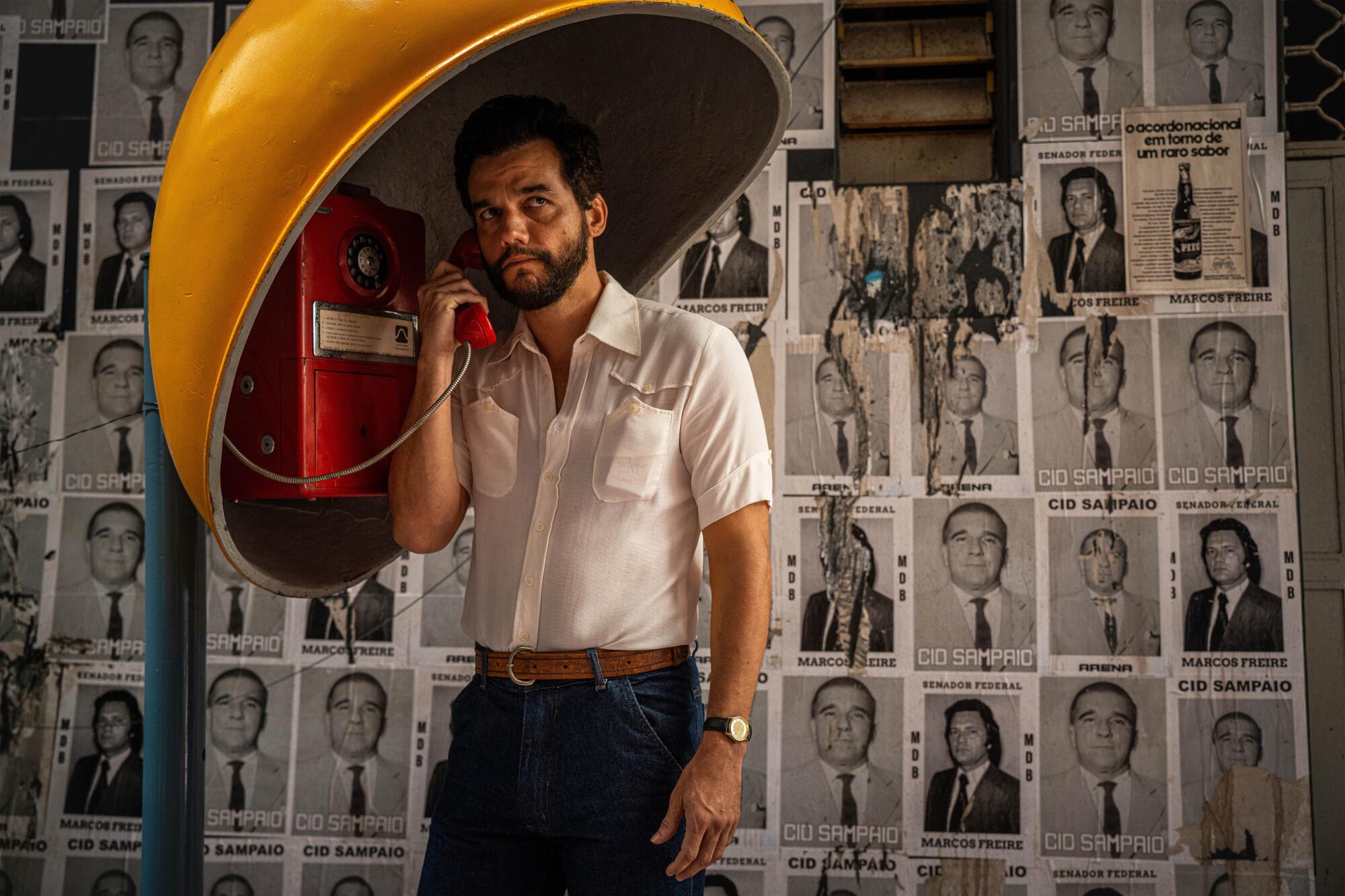
When I was putting together my article about the movies of 2025 a few weeks ago, I knew I was missing one. There were, of course, Marty Supreme, Weapons, and Sinners, three of my favorite movies of last year, which didn’t really fit the criteria of what I was writing about, but I knew that I was leaving out the Brazilian film, The Secret Agent.
Kleber Mendonça Filho’s most recent directorial effort was met with almost universal acclaim last year after it premiered at Cannes, and lost the Palm d’Or to Jafar Panahi’s Iranian film It Was Just An Accident. To the surprise of many, It Was Just An Accident was notably absent from many of the expected Oscar nominations lists, while The Secret Agent garnered a host.
In recent years, the Academy of Motion Picture Arts and Sciences has grown increasingly international, as has the prominence of Brazilian film culture among the greater cinematic conversation. Just last year, this was clear with the success of Walter Salles’s I’m Still Here, a film that, much like The Secret Agent, is set during the Brazilian military dictatorship of the mid-to-later twentieth century.
I unfortunately was unable to see The Secret Agent in time for that 2025 retrospective I wrote, because distribution did not reach any of my local theaters until late January. I was disappointed that I could not include it, but I did not think it would be that big of a deal to miss. I went into the film knowing very little, and to be honest, I found it a bit inscrutable when I finally got the chance to see it. It is a movie that is very deliberate in the information it gives you and when it decides to give it. What stood out most to me, however, was that while I knew Brazilian cinema was a big blind spot for me, what I realized even more, was that Brazilian history in general is a big blind spot for me, especially the military dictatorship – the film begins by establishing the setting as “a period of great mischief”. I felt I was missing a crucial amount of context necessary to appreciate the film, which confused me why it was so well-received by international audiences.
I started the process of writing this article as soon as I got home from seeing the movie nearly two weeks ago. As I was writing, I started to feel unequipped to intelligently and respectfully approach such a Brazilian perspective. So I put my writing aside and dedicated the time since to research. I watched some of Kleber’s other films and read interviews with him. I watched documentaries and read up on history, and even got into the more recent events involving former Brazilian president Jair Bolsonaro. Then I returned to The Secret Agent.
On a rewatch, I felt I had a slightly more informed perspective on the movie, but I got the chance to relax and take in the movie without worrying so much about what I was understanding and what I wasn’t. What was immediately clear to me was how universal the story was.
There is no denying that this movie has a lot of specific things to say about this era of Brazilian history, recent Brazilian history, and even the specific history of Recife, the city where the film is set, as well as where the director grew up and has set many of his other films. However, there is a lot to offer for international audiences. On one hand, one can appreciate The Secret Agent as an entertaining political thriller calling back to the New Hollywood films of the 1970s, but on the other hand, there is a lot being said about living under authoritarianism.
The title “The Secret Agent” implies an espionage thriller that never really comes to be. Here in 1977 Recife, those who are assuming false names, planning clandestine rendezvous by payphone, and evading hitmen are not secret agents; they are civilians. The film’s main character, Armando, played by Wagner Moura, is a former professor who is forced into hiding after speaking up against an influential businessman with connections to the military regime. In hiding, he meets a host of fellow dissidents, such as an elderly former anarchist, a pair of Angolan refugees and a woman and her daughter on the run.
The Secret Agent portrays the insecurity of authority – the weak egos and vindictiveness that fuel the unnatural power of authoritarian regimes. It is also interested in memory.
There is a lot to read about the amnesty laws passed in Brazil in the late ‘70s that nullified many of the crimes committed by the government. Mendonça Filhos has spoken openly about his country’s relationship with memory, and its reluctance to reckon with its past. A big part of this movie centers around what we pass on to the next generation; the cast of characters is composed nearly entirely of father-son pairings– Armando and his son and his father-in-law, a corrupt police chief and his enforcer sons, the vindictive businessman and his son, a stepfather-stepson hitman, even the mother and daughter that Armando befriends in hiding. Similarly, the late German actor Udo Kier makes a single scene-stealing appearance as a Jewish Holocaust survivor mistaken for a German veteran.
History gets forgotten. The generations who experience periods of suffering would rather forget it, because it would be easier to move on that way. But, as Mendonça Filhos asserts by the end of the film, the generations that follow will take interest in the past of their forebears, and perhaps it is up to them to confront the previous generations and reckon with where they came from.