

As the new year begins, resolutions tend to orbit the personal: health, money, maybe a vague commitment to “less screen time” that will quietly die by February. Yet 2026 opens with a resolution that is no longer merely private but infrastructural: how to maintain individual autonomy in an economy increasingly mediated by artificial intelligence (AI).
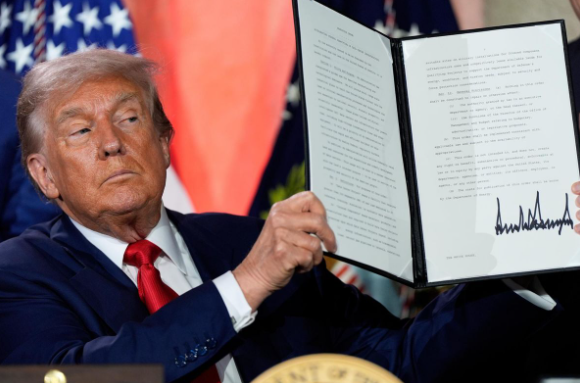
On Dec. 11, 2025, President Donald Trump signed an executive order titled “Ensuring a National Policy Framework for Artificial Intelligence,” aimed at establishing a unified federal approach to AI governance by challenging state-level regulations deemed burdensome to innovation (The White House). The order directs the attorney general to form an AI Litigation Task Force empowered to sue states whose laws conflict with federal priorities and authorizes federal agencies to withhold funding, including broadband grants, from noncompliant jurisdictions (Reuters; NPR). While framed as a bid for competitiveness and regulatory clarity, the move has reignited a familiar American argument about central power, corporate capture, and the meaning of “freedom” in a digitized economy.
The order builds on earlier 2025 actions, including the revocation of Biden-era AI safeguards, and formally declares a national policy of sustaining U.S. AI dominance through minimal regulatory burden (Sidley Austin; Mayer Brown). It instructs the Department of Commerce to identify and publicize “onerous” state AI laws within ninety days, potentially targeting statutes related to algorithmic transparency, bias mitigation, or data governance (CNBC). Supporters argue this avoids a Balkanized regulatory landscape that could stifle innovation and cede advantage to foreign competitors (The Guardian). Critics counter that it represents federal overreach, stripping states of their ability to address local concerns such as discriminatory automated decision-making or mass surveillance (Center for American Progress).
Even among advocates of limited government, the order has exposed a philosophical fault line. While some welcome the rollback of regulatory friction, others warn that centralizing authority in Washington risks entrenching precisely the kind of cronyism libertarians claim to oppose, privileging large technology firms with the legal resources to shape federal standards (NPR). Legal scholars have also questioned the order’s durability, noting that executive action alone lacks the statutory authority to nullify state law outright and may invite prolonged court challenges rather than immediate compliance (Brennan Center for Justice).
This tension reveals a deeper irony: deregulation removes guardrails from centralized actors, while decentralization removes the actors themselves. Against the backdrop of federal preemption, libertarian-leaning developers have accelerated work on decentralized privacy technologies that render regulatory battles increasingly irrelevant.
In 2025, projects leveraging zero-knowledge proofs (ZKPs) gained traction for their ability to verify AI computations without exposing underlying data, allowing systems to prove correctness without surrendering privacy (Bitcoin Ethereum News). Initiatives such as ZkAGI combine ZK techniques with federated machine learning and decentralized physical infrastructure networks (DePIN), enabling privacy-centric AI services ranging from GPU clustering to secure application interfaces (Blockchain Reporter; BitcoinWorld). Broader developments in ZK rollups and proving networks allow sensitive computation to be outsourced without centralized trust, reducing exposure to data breaches and institutional misuse.
Public unease about AI’s trajectory has grown accordingly. A 2025 Gallup poll found that Americans overwhelmingly prioritize safety and data security over speed of deployment in AI systems (Gallup). Stanford’s 2025 AI Index Report documented a 56 percent increase in reported AI-related privacy incidents, underscoring how quickly adoption has outpaced safeguards (Stanford HAI). Concerns now extend beyond abstract fears of automation to concrete anxieties about surveillance, misinformation, and the quiet erosion of personal agency (Searchlight Institute).
Ironically, Trump’s deregulatory posture may accelerate the very outcome it does not explicitly endorse: an exodus from centralized platforms altogether. Open-source, decentralized tools do not lobby Washington or wait for agency guidance. They simply route around it. In doing so, they revive an older, almost unfashionable idea of freedom as something enforced by architecture rather than promises.
For individuals setting goals in 2026, enhancing digital privacy need not involve grand gestures. Begin with a basic audit of applications that collect or resell personal data. Experiment with decentralized browsers and self-custodied wallets. Explore zero-knowledge-based platforms for identity, finance, and communication. These choices, while incremental, materially reduce exposure in an increasingly deregulated AI environment.
In a political climate obsessed with who controls AI policy, libertarian coders are quietly answering a different question: what if no one needs to?
– Bitcoin Ethereum News. “Privacy, AI, and Blockchain Use Cases in 2025.” 26 Nov. 2025, bitcoinethereumnews.com/blockchain/privacy-ai-and-blockchain-use-cases-in-2025/.
– BitcoinWorld. “ZkAGI Launches World’s First Privacy AI DePIN, Transforming AI X Web3 Industry.” 28 Aug. 2025, bitcoinworld.co.in/zkagi-launches-worlds-first-privacy-ai-depin-transforming-ai-x-web3-industry/.
– Blockchain Reporter. “INTO X ZkAGI: A Partnership Pioneering Privacy-Centric AI and Decentralized Systems.” 16 Mar. 2025, blockchainreporter.net/into-x-zkagi-a-partnership-pioneering-privacy-centric-ai-and-decentralized-systems/.
– Brennan Center for Justice. “Trump’s AI Order Is More Bark than Bite.” 16 Dec. 2025, www.brennancenter.org/our-work/analysis-opinion/trumps-ai-order-more-bark-bite.
– Center for American Progress. “President Trump’s AI National Policy Executive Order Is an Unambiguous Threat to States Beyond Just AI.” 12 Dec. 2025, www.americanprogress.org/article/president-trumps-ai-national-policy-executive-order-is-an-unambiguous-threat-to-states-beyond-just-ai/.
– CNBC. “Trump signs executive order for single national AI regulation standard, limiting power of states.” 12 Dec. 2025, www.cnbc.com/2025/12/11/trump-signs-executive-order-for-single-national-ai-regulation-framework.html.
– Gallup. “Americans Prioritize AI Safety and Data Security.” 28 Oct. 2025, news.gallup.com/poll/694685/americans-prioritize-safety-data-security.aspx.
– Mayer Brown. “President Trump Issues Executive Order on ‘Ensuring a National Policy Framework for Artificial Intelligence.’” 22 Dec. 2025, www.mayerbrown.com/en/insights/publications/2025/12/president-trump-issues-executive-order-on-ensuring-a-national-policy-framework-for-artificial-intelligence.
– NPR. “Trump Is Trying to Preempt State AI Laws via an Executive Order. It May Not Be Legal.” 11 Dec. 2025, www.npr.org/2025/12/11/nx-s1-5638562/trump-ai-david-sacks-executive-order.
– Reuters. “Trump Threatens Funding for States Over AI Regulations.” 12 Dec. 2025, www.reuters.com/world/trump-says-he-will-sign-order-curbing-state-ai-laws-2025-12-11/.
– Sidley Austin LLP. “Unpacking the December 11, 2025 Executive Order.” 23 Dec. 2025, www.sidley.com/en/insights/newsupdates/2025/12/unpacking-the-december-11-2025-executive-order.
– Stanford HAI. *The 2025 AI Index Report*. 2025, hai.stanford.edu/ai-index/2025-ai-index-report.
– The Guardian. “Trump signs executive order aimed at preventing states from regulating AI.” 12 Dec. 2025, www.theguardian.com/us-news/2025/dec/11/trump-executive-order-artificial-intelligence.
– The New York Times. “Trump Moves to Stop States From Regulating AI With a New Executive Order.” 11 Dec. 2025, www.nytimes.com/2025/12/11/technology/ai-trump-executive-order.html.
– The White House. Ensuring a National Policy Framework for Artificial Intelligence. 11 Dec. 2025, www.whitehouse.gov/presidential-actions/2025/12/eliminating-state-law-obstruction-of-national-artificial-intelligence-policy/.
