
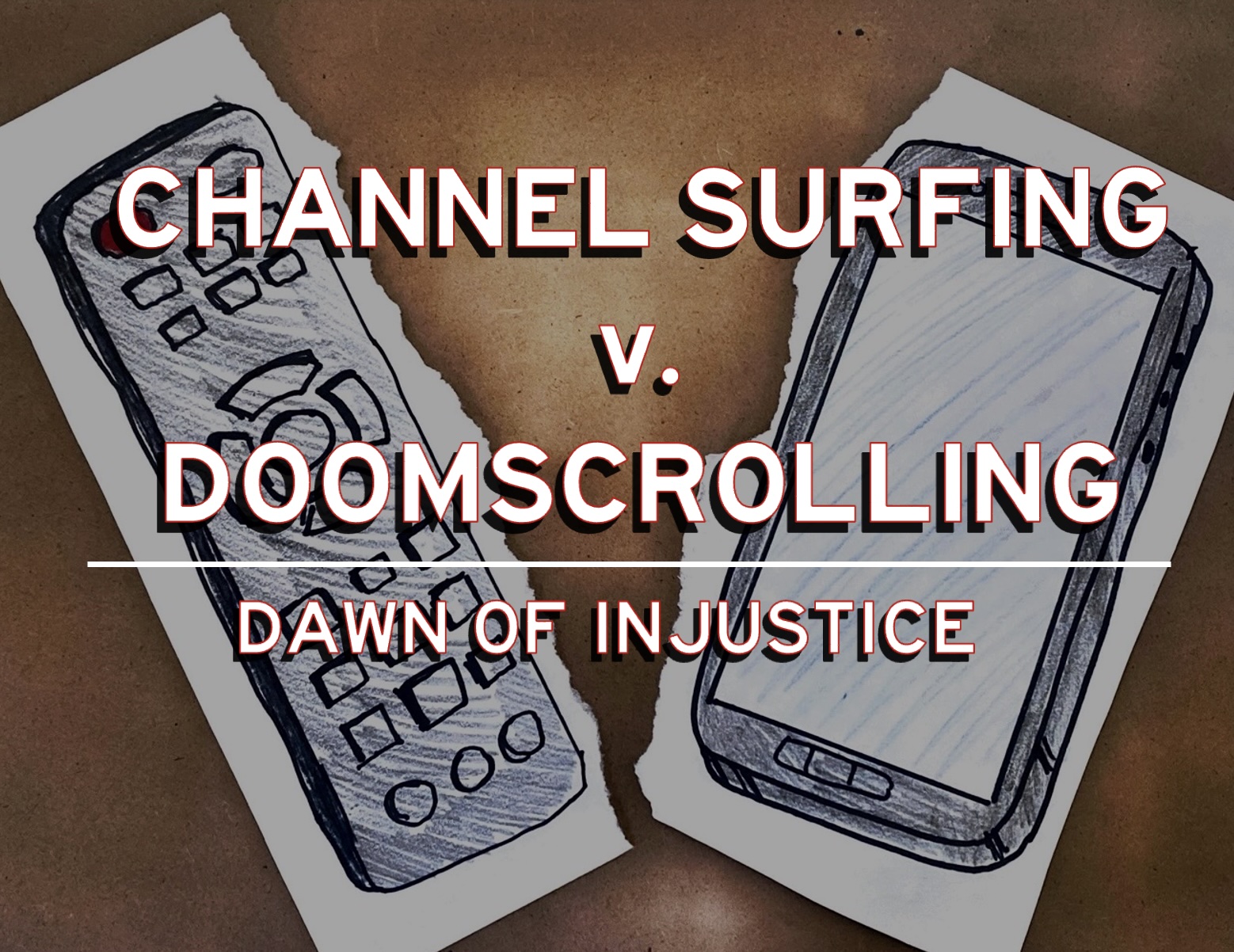
Does anyone remember the days before smartphones? Many of today’s youth have never experienced such a phenomenon, but during the rise of cable TV through the late 2000s, modern society had a prelude to the infamous “doomscrolling.” If you had a television and a remote all to yourself, you likely engaged in the mindless ancestor of the scroll: channel surfing.
Whether your day at school was long or work was more taxing than usual, the routine was the same: you’d get home, grab a snack and the remote, and plop down on the couch. Knowing there was nothing to watch, you’d allow your brain to shut off and just start changing channels. Something might grab your attention — a delicious-looking “do-it-at-home” recipe, a contestant trying to solve a game show puzzle or a straight-A student yet again addicted to caffeine pills on a high school drama. Then, the trance is broken by an even more mindless commercial, and the surfing begins again. Common wisdom always held that too much TV was bad for your eyes and your brain. However, modern research suggests the risks are far more severe than simple eye strain; recent studies have linked excessive viewing — defined as four or more hours daily — to a significantly greater risk of dementia, depression and even Parkinson’s disease (Salamon, 2024).
Channel surfing wasn’t just a pastime; it was an addiction. To preserve our collective mental health, the world had to find more intentional ways to break the cycle of mindless consumption. Enter the smartphone. Now, thanks to Steve Jobs giving the world knowledge that fits in a pants pocket, there was always something to watch, something to learn, and something to read. There was something to feel and something to do that, theoretically, would not turn us into mindless zombies. You no longer had to hit the channel up or down button, hoping something entertaining would come on; you could turn on whatever you wanted and receive immediate intellectual stimulation within the palm of your hands. Our brains would be alive again. Problem solved?
Not quite. Instead of curing the “mindless zombie” effect of channel surfing, the smartphone simply gave us an IV drip of it. The effort of pushing a button on a remote was replaced by the effortless swipe of a thumb on YouTube. Even worse, the “intellectual stimulation” we hoped to achieve through this technological advancement turned into an algorithmic prison of our own creation — and it takes even less work to stay there.
While channel surfing and doomscrolling are both mindless media consumption practices, they differ in their intensity and emotional impact. With doomscrolling, you’re not just passing the time and vegging out; you’re not allowed to just turn your brain off. The algorithm of your very own interests is collected into a database that spits out content curated just for you, creating an obsessive and overly taxing habit. It’s a new drug, and everyone is at a greater risk of addiction, but America may be doing something about it.
A recent lawsuit against Meta and Google ruled in favor of a 20-year-old woman who claimed that using social media platforms — including Facebook, YouTube and Instagram — starting at age six led to an addiction that fueled her anxiety, depression, body image insecurities and thoughts of suicide. The jury agreed that META and Google were negligent in creating the platforms and failed to warn users of the possible risks associated with their use. The 20-year-old woman was awarded $6 million dollars, and just 24 hours prior, a jury in New Mexico leveled an even larger $375 million judgment against Meta for nearly identical practices (Trapanotto, 2026).
While Meta’s own internal investigations found that deactivating Instagram reduced depression and anxiety (Trapanotto, 2026), the blame should not solely be placed on the tech giants. The smartphone is a universe of information confined to a device no larger than a deck of cards; the utility of such vast knowledge is self-evident. However, “With great power comes great responsibility.” We’ll never forget that, Uncle Ben. While tech giants must make users aware of potential risks, users and their legal guardians must also take responsibility by practicing the proper discipline required to utilize these modern marvels safely. If we don’t, we might just find ourselves longing for the “good old days” — when we weren’t depressed, anxious or suicidal, but simply, blissfully braindead. Those were the days.
References:
Salamon, M. (2024, March 1). Too much TV might be bad for your brain. Harvard Health Publishing. https://www.health.harvard.edu/mind-and-mood/too-much-tv-might-be-bad-for-your-brainTrapanotto, C. (2026, March 27). Is this the beginning of the end of big social media? The Daily Wire. https://www.dailywire.com/news/is-this-the-beginning-of-the-end-of-big-social-media
