

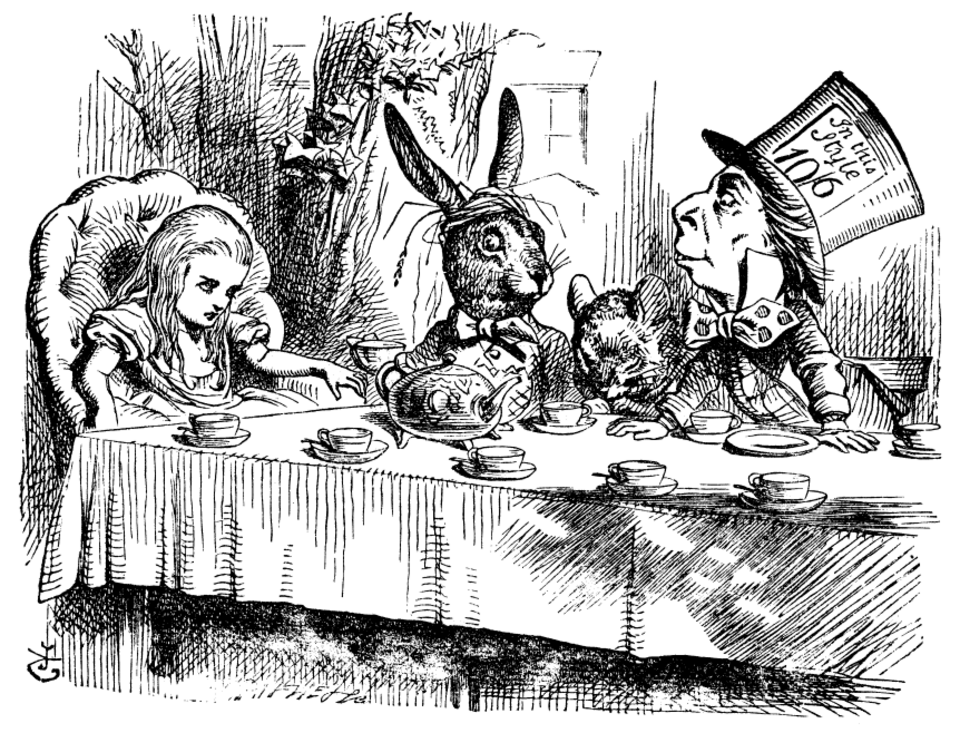
‘The question is’, said Alice, ‘whether you can make words mean so many different things.’ – Lewis Carroll, Through the Looking Glass
For decades, politicians alike have done what Alice discussed above: making words mean different things to different people. In other words, utilizing dogwhistling to attract specific voters while keeping others confused rather than angry.
In politics, dogwhistling refers to the use of suggestive, subtle messaging to convey an often-controversial message to a particular audience. Politicians do this all while appearing innocuous to the masses, maintaining plausible deniability if called out. The figurative definition of dog-whistling has its roots in a more literal definition. A literal dog whistle is a device that emits a sound at ultra-high frequency. Humans are unable to hear this sound, but dogs can. Dog-whistling is, simply put, an evasion of accountability, and that corrodes the foundation of American democracy. A flourishing democracy rests on efficient communication between citizens and the government: voters must be able to understand what their leaders mean, and leaders must be willing to stand by what they say.
The late strategist Lee Atwater, adviser to President Ronald Reagan, put it frankly in a 1981 interview, explaining the evolution of the Republican “Southern Strategy”:
You start out in 1954 by saying, [n-word] [n-word] [n-word]’. By 1968, you can’t say ‘[n-word]’ – that hurts you. Backfires. So, you say stuff like forced busing, states’ rights . . . cutting taxes. And all these things you’re talking about are totally economic things, and a by-product of them is [that] blacks get hurt worse than whites . . . ‘We want to cut this’, is much more abstract than even the busing thing, and a hell of a lot more abstract than ‘[n-word].’
Here, overtly racist appeals were systematically replaced by tamer language to achieve the same political and economic goals without an extreme wave of backlash.
Case Study: “Law and Order”
On the surface, Law and Order sounds harmless: who opposes safety and peace? While it calls for protecting its citizens, the usage of this term is linked to conservatives who tried to downplay change. By using the term “law and order,” politicians were able to sideline and target communities of color, as well as radicals, by claiming that they were responsible for violent uprisings and crime. The phrase gained political traction in the late 1960s, when politicians like Richard Nixon utilized it in their campaigns. Nixon, according to Leonidas K Cheliotis, “capitalized on fear.” Nixon’s campaign did not need to mention race explicitly. Instead, images of urban protests and danger, combined with the phrase “law and order,” activated white suburban anxieties without a single overtly racial word. “Law and order” was also used to undermine Martin Luther King Jr’s demonstrations in Birmingham. Eight Alabama clergymen published an open statement in The Birmingham News on April 12, 1963. In it, they critiqued King’s nonviolent protests, calling them “unwise and untimely.” The clergymen also called for issues to be settled only in the courts rather than on the streets. In doing so, the clergymen were protecting the American status quo, that is, the racial hierarchy. Thereby, their appeal to “law and order” was (whether intended or not) a dog whistle to white moderates who preferred peace over justice. Furthermore, President Ronald Reagan, in his campaign, “restored” the slogan, Law and Order, in the wake of violence: the Watts Riots and Berkeley campus riots. Reagan assured white voters that he would restore a social order they felt was slipping away. This “social order” was essentially a desire to return to traditionalist and conservative American values – one that was threatened by a rise of Black power, youth counterculture, and anti-war activism. “Law and Order”, to Reagan, was never just about fighting crime and violence.
In a healthy democracy, language would serve as a bridge between leader and citizen. But how possible is this with the prevalence of dog-whistling? As Alice stated, “the question is whether you can make words mean so many different things.” But another question is whether you should.
Acknowledgement: The opinions expressed in this article are those of the individual author, not necessarily Our National Conversation as a whole