

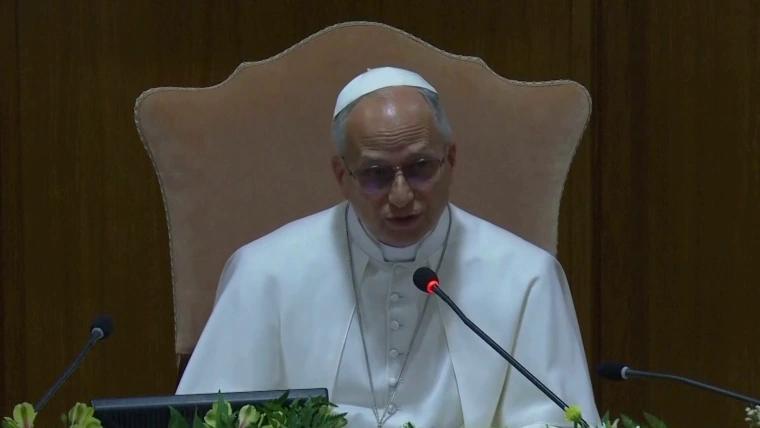
On Monday, Pope Leo XIV issued a roughly 42,300-word encyclical, “Magnifica Humanitas,” warning of the rise of artificial intelligence and calling for greater regulation and stronger protections for workers.
As more people are facing societal and economic disruptions due to unreliable AI-generated information, environmentally hazardous data centers, and a decrease in job opportunities for the next generation, the Pope has criticized the new technology. He warns about “the growing ease with which autonomous weapons systems can be deployed.” His statements are proving to be very popular with the public, as 57% of voters believe the risks of AI outweigh its benefits.
The encyclical implores the defense of humanity in an increasingly automated world. It emphasizes that although the Pope is not opposed to innovation, “technology should not be considered, in itself, as a force antagonistic to humanity.” He urged for stronger safeguards to prevent human agency from being corroded.
Interestingly, Pope Leo XIV’s statements mirror a similar warning issued by his predecessor, Pope Leo XIII, in 1891. Pope Leo XIII’s encyclical “Rerum Novarum” addressed the consequences of the Industrial Revolution and its impact on people’s livelihoods at the time. Many have made direct comparisons between the two eras, as many now call the rise of AI a “new industrial revolution.”
Pope Leo’s call for AI to be “disarmed” has also sparked some Catholics to argue that they can now object to the implementation of AI in their work for religious reasons. However, it has yet to be proven if that argument holds any water.
However, the general public’s perception of AI is widely negative, and the Pope’s comments only further dissuade people from the upcoming technology. It is unclear what the future holds for artificial intelligence and the people who use it, but what is clear is that if the world is to be more receptive to AI, there must be a major change in how it is implemented.