

As a recent graduate and a young professional, I have read many alarmist reports about how AI is impacting the labor market. The forecasts suggest a gloomy, apoplectic picture on the one hand, and an optimistic, utopian future on the other. The truth likely sits somewhere in the middle. Indeed, a recent report suggests that entry-level jobs have declined by 35 percent since January of 2023. The bigger threat is that by cutting these jobs, the pipeline for early-career professionals weakens because these are the jobs that can jumpstart careers. When you take away this pipeline, it becomes much harder to bring in new professionals in various industries, and job-seekers will look elsewhere.
On the contrary, those dismissing the issue as a temporary period before an AI boom have no way of guaranteeing this success. The pain exists now, and so when former Google CEO, Eric Schmidt, spoke to graduating students about the boons of AI, he was booed because he was perceived as out of touch with reality. Even if his arguments on the innovative benefits of AI have their merits, it was made without properly acknowledging the pain that those students are facing. Arguing that the pain is “temporary”, as part of a transition, does not help.
Thus, the question worth asking is not whether AI will help boost economic growth, for it surely will, but rather what kind of disruption it will bring, at what cost, and who bears the brunt of that cost? Then, we can answer what an intelligent response looks like.
The Double-Edged Sword – Why More Output Can Mean Less Value
AI, like with any technology that disrupts the market, can act like a double-edged sword. If used correctly, the tool should be a complement to existing tasks, allowing workers to boost productivity. If I can use AI to do a task that normally takes a week in one day, now I’ve saved 6 days to do other tasks. In this sense, AI serves to boost the speed of content, setting aside quality for a moment.
The skeptic, of course, can point to how quantity cheapens quality. In a sense, this may be true, but only subjectively. Scarcity increases the value of goods. By the inverse logic, when you use technology to mass produce those same goods, their value goes down, and so does their perceived “quality”. In general, value in economic terms can be defined by the utility of a good plus scarcity. If we keep utility constant, value goes up and down depending on how rare the good is.
To use a concrete example, let’s say the good you are providing is a business report for a boss. In the world before AI, let us say it took 7 hours of work to make this report and send it to the boss. Every week, you provide such a report, with data and reasoning on what the business should consider.
Now consider the world with AI. That same report now takes 1 hour to make with the right prompts and AI system. You have decreased the work time by a factor of 7. Now, the boss demands a report once a day, rather than once a week. The scarcity of this product has gone down significantly. In this case, even if the quality of the data and analysis of each of the 7 reports matches the reports from before AI use, the value of each of these reports goes down.
Why? The data is similar, the same process and analysis is used, and for all intents and purposes, you are generating the same product, just 7 times as frequently. Well, the issue is that when you have more of a good in a given timeframe, the marginal value – or additional value of it – goes down. The first report hits hardest for the boss, because it presents the most new data for the week. By the time the boss reads the fourth or fifth report of the week, it still feels useful, but less so, as it feels more like a variation of what was already provided in the first report. Each additional report will no longer feel original, and thus, the additional value of the good goes down.
This process of eventual stagnation, despite added productivity, is what economists call the Law of Diminishing Marginal Utility. Another way to understand this rule is by using chocolates. The first bite of chocolate may taste delicious, and the second one may taste good, but the added value of moving from your 19th bite to the 20th is far less than the added value of moving from 0 bites to 1 bite. This is because by the time you reach your 20th bite, you already have a sense for the taste, an expectation, so the additional bite adds little value.
Eventually, we enter a stabilized state where the additional good that is produced adds little value to you.
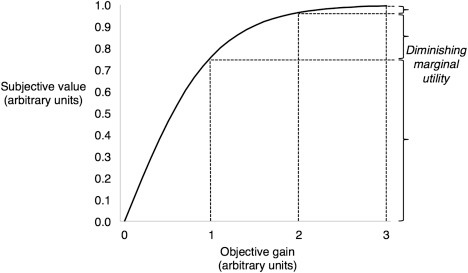
(Source: Berkman et al.)
In this same vein, going back to the earlier analogy, if AI lets us generate more products, such as business reports that your boss wants, paradoxically, the very fact that he or she can get more reports in a given week means that each report has less value. This is not because the quality of the goods drops per se, but rather because of decreased scarcity and the increased pace of diminishing marginal returns.
In other words, AI benefits the economy by helping us create more goods in less time, but with that comes reduced scarcity, and thus lower value for said goods. This adjustment is not new, for it’s a cycle we face with any production-enhancing technology, and the same is true for AI.
Cheaper For The Consumer, But Costlier For The Worker
With AI increasing the abundance of certain goods, there are economic implications that come with this situation. Driving down scarcity, as established earlier, drives down the value of each good produced. When you can create more of product x in less time, the cost of production goes down. When the cost of production goes down, the price also goes down.
Using the analogy from earlier, if generating a business report costs your boss $70 without AI, and now, with AI, you can generate that report in 1/7th of the time, the effective cost of generating the report is now just $10. In this case, the employee is the producer and the boss is the consumer, and the consumer has gotten a cheaper deal.
We can apply this to any good where AI increases the rate of production. Good x takes less time and effort to produce, and therefore, the prices consumers pay get cut. This is a benefit of production-enhancing technology, from a consumer’s perspective.
However, reduced value, coming in the form of reduced prices, also hurts workers. Workers are effectively sellers of their labor, but if AI devalues that labor by making the products they produce cheaper, then wages get depressed. If a manager is paying an employee $35 an hour to generate business reports, but AI makes this work easier to produce, now the price of that work could become worth $15 an hour. However, the cut comes not from reduced wages, but rather from job cuts.
Let’s say a manager wishes to make weekly reports, and they have two choices: the manager has 3 entry-level workers do the task, or the manager has 1 entry-level worker do the task using AI to enhance productivity. Which choice would he or she make? It makes rational sense for the manager to choose the latter if the nature of the task is such that AI tools can do the job well with little oversight. It saves money, which ultimately is the bottom line that businesses look at.
Therefore, it should not be surprising that a Stanford study by Erik Brynjolfsson et al. found a 13% relative decline in employment for workers aged 22 to 25 in the occupations most exposed to AI, even as employment for experienced workers held steady. Tellingly, the authors note that “adjustments occur primarily via employment rather than compensation,” which is to say the disruption shows up not as lower wages but as jobs that are never offered in the first place. Unlike highly specialized jobs, where more oversight is needed, for any white-collar jobs that are done with an entry-level skill, AI cheapens the value of that labor to the point where those jobs get cut down.
The externality that businesses are not taking into account when cutting entry-level jobs, however, is that entry-level jobs are often the pipeline young professionals use to climb the career ladder and become future leaders in the industry. The long-term implication of cutting these jobs is not only cutting jobs but also creating an overreliance on AI.
If firms do not invest in those with less work experience, they will run out of the experts they need for tasks that AI cannot replace. And in this realm, I argue that the potential consequence of AI, or an overreliance on AI, is the destruction of human capital and human skill. Currently, the economics reward using AI tools as a cheap alternative, but the long-term effect could be devastating.
Fixing the Market Failure – A Two-Pronged Approach
The government needs to account for the impending market failure. If businesses are not providing the pipelines for less experienced workers to get a foothold in the economy, the government must incentivize them to do so.
For this reason, I propose a two-pronged approach.
The first prong is an incentive: a tax credit for firms that maintain and expand entry-level roles during the AI transition for at least 10 years, conditioned on net new junior hiring and opportunities to rise to more senior roles. This keeps the pipeline open, so that graduates can still gain the experience that turns them into the experienced workers every firm claims to want; the credit should reward jobs that would not otherwise exist, not subsidize hires a firm would have made anyway.
The second prong is broad public investment in teaching people to use AI well, available not only to the entry-level cohort but to workers at every stage, so that the complementary skills the new economy rewards stay within reach of those who need them most.
Protect the jobs pipeline, protect human capital, and ensure that workers are skilled at using AI so that they are not left behind as the technology gets more and more integrated in the economy.
None of this requires us to fear AI, nor to pretend that the disruption it brings is painless. The technology will make us more productive, and that is worth celebrating. The danger lies not in the abundance itself, but in allowing it to hollow out the entry-level jobs that turn today’s graduates into tomorrow’s leaders. However, if we act now, while the transition is still young, we can capture the gains of AI without sacrificing the future of our workforce.
Acknowledgement: The opinions expressed in this article are those of the individual author, not necessarily Our National Conversation as a whole
1 Comment
I think everyone — especially young people — need to deal in reality. Is there any time in history when an advance in technology has been blocked by those opposed to it? Not that I can recall. So why think this time will be different?
Every new technology creates a new industry. Young people would be very smart to stop booing and start learning AI. Don’t be threatened by AI; master it.