
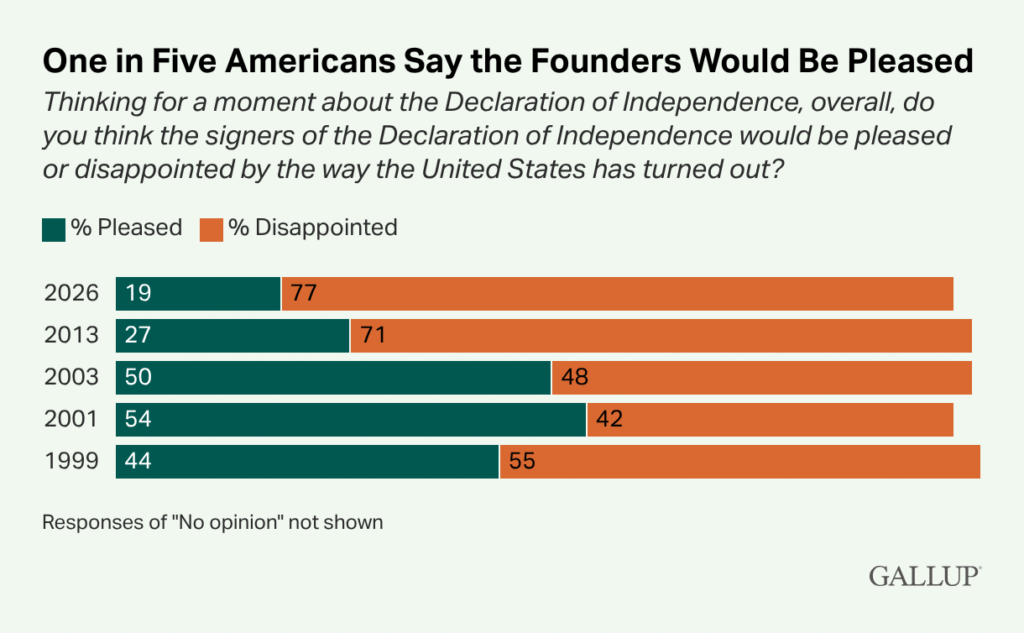
According to a new Gallup Poll, 77% of Americans today say our founders would be disappointed with America, versus 42% in 2001. While the number of Americans who believe this has fluctuated throughout the years, 2026 shows the highest level of disappointment in decades. On its face, it looks like America is a nation that has lost faith in itself.
The Dividing Lines
Much of this disappointment can be explained by partisan politics.
According to the same Gallup poll, Republicans are more likely than Democrats to say that the founders would be pleased with America. 25 percent of Republicans say the founders would be pleased, versus just 13 percent of Democrats. These are the figures under President Donald Trump, a Republican President.
However, under President Barack Obama, a Democrat, the numbers are flipped. In 2013, only 12% of Republicans said the founders would be pleased, compared to 42% of Democrats.
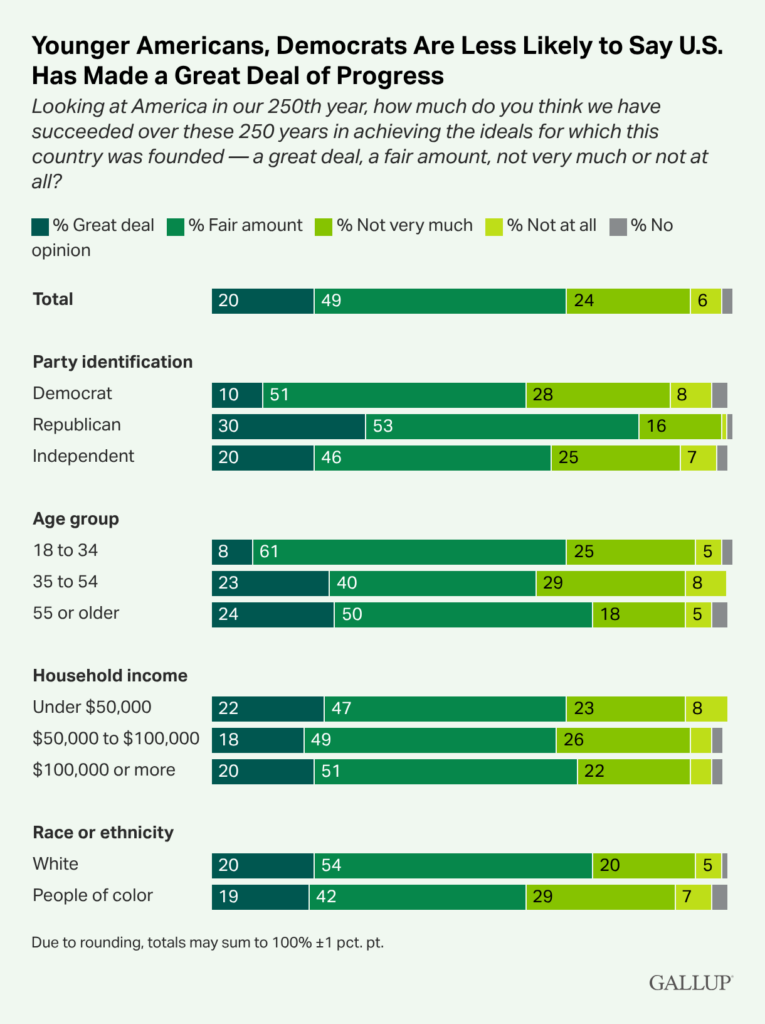
Furthermore, in the current 2026 Gallup poll, only 10% of Democrats believe that the U.S. has succeeded a great deal, compared with 30% of Republicans and 20% of independents.
While party politics can explain differences in skepticism or optimism in America, so can age. Only 8% of adults aged 18 to 34 say the country has succeeded “a great deal.” Compare this to those aged 35 or older, of whom 23-24% say the same.
Interestingly, we do not see the same divides when looking at income levels, as those with an income of less than $50k have the same views as those with more than $100k on whether America has made a great deal of progress in its history.
The partisan and generational divide is real; however, it is also true that in recent years, the pessimism felt by Americans is greater across the board, regardless of differences between groups.
The Way Forward – Understanding The Other
Beneath all the pessimism, a majority of Americans across various demographics still feel that the country has made progress by at least a “fair amount”.
As Americans, we have things to celebrate, such as the Declaration of Independence, the right to free speech, and the right to vote, which have been earned by minorities over time. Women gained suffrage, people of color gained rights through the hard-fought Civil Rights Act of 1964, and same sex marriage is now legal. Furthermore, America has become the commercial capital, hosting top companies like Google, Microsoft, Apple, and Amazon. America is also the host of Hollywood, using it to export our culture globally.
However, if the boons of such successes are not shared with the average American, who struggles to realize the American dream, then pessimism will only grow.
If the United States is to stay united, its people must establish a shared understanding. That is where good-faith conversations come into play. It is why, in my view, the First Amendment — the right to free speech — is valuable and worth preserving. The right to vote and the right to express oneself freely are what should unite Americans, if nothing else.
Therefore, in the spirit of America’s 250th birthday, let us celebrate honest, civil debate. Let us not describe different viewpoints through the lens of a “culture war,” but rather as an opportunity to explore different ideas. Whether we are Republicans or Democrats, young or old, rich or poor, we must not isolate ourselves in our respective camps and instead seek to understand those with whom we disagree.
This is where organizations like Our National Conversation play a vital role. At a time of increased fracturing, having a forum that encourages honest, cross-partisan dialogue is a must.
Indeed, we do not need to share the same opinions on America to have a conversation about it. As long as we devote ourselves to keeping that conversation alive, the next 250 years are still ours to write.