Photo Credit: PR NEWS
On October 31, 2026, Sen. Chris Murphy (D-Conn.) suffered a stroke after experiencing numbness in his arm while attending his son’s hockey game. He was subsequently transferred to Johns Hopkins Hospital for treatment. Although Murphy was not running for reelection during the 2026 midterm election cycle, he had been traveling across the country campaigning for other Democratic candidates, including Connecticut Gov. Ned Lamont and Minnesota Lt. Gov. Peggy Flanagan, before his stroke interrupted those activities, according to the Associated Press.
His absence illustrates how a medical emergency can affect a politician’s involvement in elections, including beyond their own candidacy.
This is not the first time a politician’s campaign activities have been interrupted by a medical crisis. On May 13, 2022, Sen. John Fetterman (D-Pa.) suffered a near-fatal stroke just four days before Pennsylvania’s Democratic Senate primary. His hospitalization prevented him from participating in campaign appearances during the primary period. He subsequently underwent surgery to implant a pacemaker and defibrillator to regulate his heartbeat. After nearly three months away from the campaign trail, Fetterman returned to public campaigning on August 12, 2022, as he prepared to face Republican opponent Mehmet Oz in the November general election.
A more recent example occurred during the 2026 Texas Senate race. Democratic nominee James Talarico was diagnosed with the flu and stayed away from in-person campaign appearances for nine days. His absence attracted criticism from Republican opponent Ken Paxton, whose campaign questioned his whereabouts and demanded proof that Talarico was still actively campaigning. President Donald Trump also criticized Talarico’s absence during a rally in San Antonio. Talarico explained that he was recovering from the flu and working remotely with his campaign team. He returned to public appearances on October 9, 2026, at the Austin City Limits music festival.
These examples demonstrate how an illness can temporarily limit a politician’s visibility, interrupt campaign activities, and provide political opponents with opportunities to attract media attention. However, the effects vary depending on the candidate’s circumstances, the length of the absence, and the campaign’s ability to maintain communication with voters.
A good example is Joe Biden, who contracted COVID-19 during the 2024 presidential campaign. After Biden was diagnosed on July 17th, 2024, he canceled his scheduled campaign appearance in Las Vegas. He returned to Delaware to quarantine in his home. On July 21st, 2024, Biden announced he was withdrawing his presidential candidacy after facing mounting pressure from the Democratic Party to do so. Kamala Harris announced her candidacy instead and would run against Donald Trump.
On July 18, 2024, Donald Trump gave his Republican National Convention speech as the Republican presidential nominee at the Republican National Convention in Milwaukee, Wisconsin. This media coverage boost did a favor for Trump. In November 2024, Trump won the presidential election for a second time, becoming the 45th and 47th president of the United States.
When a candidate is forced to shift away from the spotlight and suspend campaign appearances, this can dampen chances for a candidate among voters. The coverage becomes focused on the rival candidate, who can frame the debate on how the absent candidate should be perceived.
Although a candidate’s illness can create opportunities for political opponents to gain media attention, it does not necessarily result in a loss of voter support. John Fetterman’s 2022 Senate campaign demonstrated that social media and digital advertising can help maintain a candidate’s visibility while recovering from a serious medical condition. Despite spending nearly three months away from major campaign events following his stroke, Fetterman defeated Mehmet Oz in the November 2022 election. This suggests that a candidate’s ability to maintain communication with voters may be just as important as their physical presence on the campaign trail.
A similar example occurred during the 2026 Texas U.S. Senate race, when Democratic candidate James Talarico spent nine days away from the campaign trail while recovering from the flu. His absence prompted criticism from President Donald Trump and Republican opponent Ken Paxton, who questioned his whereabouts and used his absence to attack his campaign. Despite the criticism and time away from public appearances, Talarico defeated Paxton by approximately 12 percentage points in the 2026 Midterm elections. His victory demonstrated that a candidate’s temporary absence from the campaign trail does not necessarily prevent them from maintaining voter support and winning an election.
A candidate’s absence from the campaign trail still creates opportunities for political opponents to receive greater media attention and influence the public conversation. However, maintaining visibility is not limited to traditional campaign appearances. Social media, televised interviews, and direct communication with voters allow politicians to remain part of the political conversation even when they are unable to attend public events.
President Donald Trump provides an example of how politicians use social media to maintain a consistent presence in the news cycle. Trump frequently makes headlines for his political decisions and outspoken criticism of his opponents. He also responds to media coverage through his Truth Social account, where he regularly challenges unfavorable reporting and criticizes members of the press. This demonstrates how political figures use direct communication platforms to respond to news coverage and maintain their public presence outside traditional media appearances.
For candidates recovering from medical emergencies, these alternative communication channels help maintain visibility and keep voters informed while they are away from the campaign trail. Ultimately, an interruption in public appearances does not necessarily mean a candidate loses voter support, particularly when their campaign can continue communicating with the electorate.
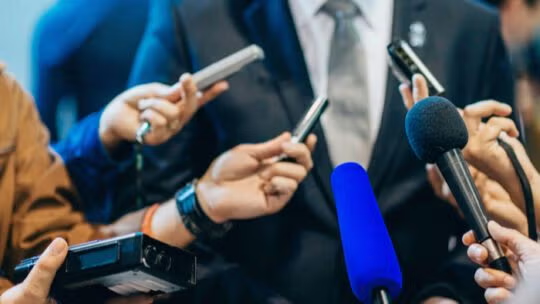
This interaction between political figures and the press becomes particularly important when a candidate experiences a medical crisis that limits their public appearances. When a politician steps away from the campaign trail, media attention could shift toward their opponent, creating opportunities to shape the public narrative. As the examples of John Fetterman, James Talarico, and other politicians demonstrate, an extended absence may affect how voters perceive a candidate and how their campaign maintains public visibility. However, reduced media exposure does not necessarily translate into lost voter support.
Acknowledgement: The opinions expressed in this article are those of the individual author, not necessarily Our National Conversation as a whole