


Is economic growth a goal or a means? If a policy raised human wellbeing while lowering GDP (Gross Domestic Product), would that be good economic policy?
The general argument in favor of policies that boost the GDP is that when you make the pie bigger, there is a bigger slice for everyone to enjoy. The other metaphor that is often used is that a rising tide lifts all boats. Effective economic policy, thus, is one that creates economic growth, so that everyone within a nation can benefit from that new economic activity.
However, the pie getting bigger does not guarantee that your share will change for the better. America’s GDP grew by 2.2 percent in 2025, but how was that growth divided amongst the American people? Well, here is a breakdown by the Center on Budget and Policy Priorities:
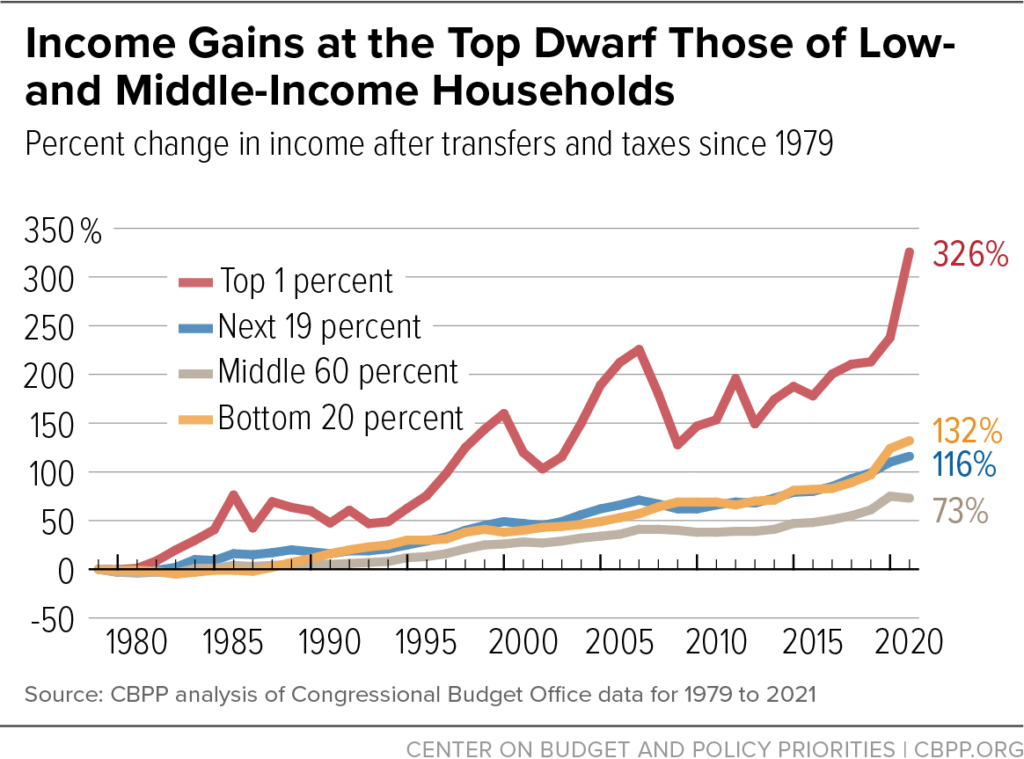
What we find is that, since roughly the last 50 years, the distribution of new growth is mixed. On the income side, we see some growth for those in the bottom 20 percent, but it is dwarfed by the huge gains of the top 1 percent of income earners. The middle portion, so income earners who are between the 20th and 80th percentile, had the slowest growth, at a mere 73 percent increase since 1979, much lower than the other groups.
What does this data tell us? It tells us that when GDP increases, the growth mainly consolidates at the top. And this data is not even considering wealth accumulation, where the differences between the various income classes are even more stark.
Right now, I am not making a value-based assessment on whether this is a good or bad thing. Growth, even if unequal, can benefit everyone — just not at the same levels. However, how the pie is divided matters for those who are experiencing the economy. If you are a middle-class American and you see the economy grow, but none of those benefits trickle in for you in the form of wage growth or wealth, then are you really better off?
As prices rise, are wages keeping up in a manner where middle-class Americans feel that they can afford the basic necessities of life? The answer to this question is subjective.
Absolute poverty is measured in dollar terms. It asks how much money you have, and whether, objectively, you are poor or not with that amount. The World Bank, for example, defines absolute poverty as living on less than $3 a day.
Relative poverty asks something different; it asks, given the society you are part of, do you have the ability to enjoy the things that the median person around you can? Thus, according to this definition, the greatest poverty is found in the relative difference between your wealth levels versus your peers.
Let us use an example. Say you had $50,000 a year to live on, and you lived on a tight budget in an urban area like New York City, Chicago, or Washington, D.C. Given the cost of living and rent, perhaps what you have is enough to live in the city, if you budget well. But going to Broadway shows, the cinema, the bar, or other fun events is difficult because you don’t have much free time or room in your budget to do these things. Your friends, coworkers, and acquaintances, however, are richer. They earn upwards of $150,000 a year, and they often go to these social events, which you cannot attend because of your budget and time constraints. Thus, you find it difficult to interact with your friends because you are left out of key social gatherings or fun things to do. Now you feel like you are in an isolated bubble. You earn enough to live, but not enough to thrive, and it feels — even if it may not be reality — like everyone around you is having more fun. How would that impact your well-being?
I would argue that this form of relative poverty can have negative impacts on people’s lives. It creates an in-group and out-group system, and as such, a sense that we cannot enjoy the things in life that others can so easily take part in. Poverty, therefore, should not just be defined by whether you can survive, but by the choices you have before you, and your relative connection with those around you.
Take this same $50,000 salary, and live in an area where everyone is earning the same amount as you or less, and the equation changes. Because now there is parity, the cost of living is lower, and you and your friends can enjoy things together, even if the things you enjoy are “cheaper” in terms of financial costs. It could be as simple as sharing a meal with a friend, playing sports together, or other activities.
Put simply, the cost of economic inequality is not necessarily financial. It is the social isolation that comes with it.
The data backs this up:
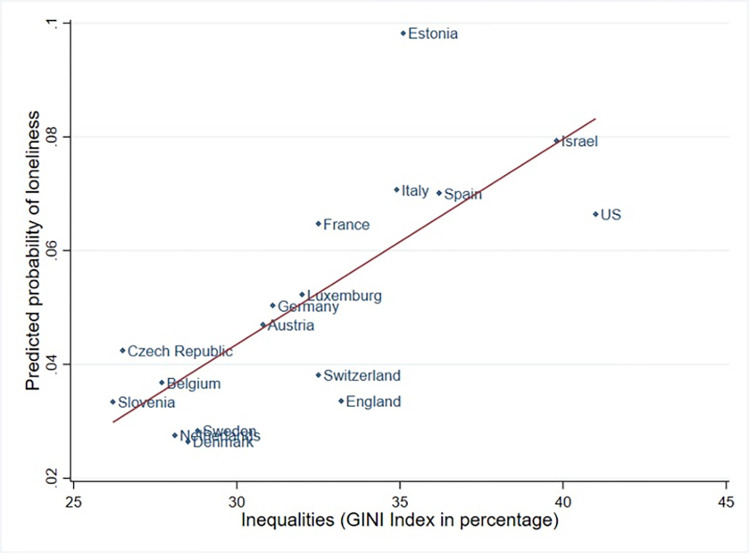
(Source: Thamara Tapia-Muñoz et al.)
An analysis by Tapia-Muñoz et al shows that older adults aged 50+ “living in countries with higher income inequality were more likely to report loneliness”. The U.S. is one of the worst high-income countries performing at this scale, as shown by the above chart, measuring inequality — using the well-known Gini index — against predicted loneliness probability.
All this to say that the effect of inequality, and an exacerbated level of relative poverty, has adverse social effects. And so, the question remains: If a policy raised human wellbeing while lowering GDP, would that be good economic policy?
I would argue that theoretically the answer is yes. There could be a framework where you provide some benefits to the poor and middle class, even reducing GDP growth, that could still boost long-term wellbeing. What matters is whether you care about absolute or relative poverty. GDP growth is an excellent way to address absolute poverty over time, and we see this when comparing wealthy versus poorer countries.
However, if we care about the social effects of relative poverty, growing the economy alone is not an adequate solution. How that metaphorical pie is divided is just as important. Even more important is how the people within society feel valued relative to those around them. That is a part of the policy debate that is part of the puzzle.