


In early September, Dario Amodei of Anthropic published an essay to urge the slowdown of AI development. As the CEO of one of the leading AI companies, his call for more regulation is telling. Within days, competitors in the AI industry, such as Sam Altman of OpenAI and Elon Musk of xAI had endorsed his views.
Soon after, on September 13th, House Speaker Mike Johnson argued that “If Congress just races in and does some sort of emergency session to try to regulate AI, we will lose the race to China, and that is a threat to every single American. So, we’ve got to have balance.”
President Trump, meanwhile, dismissed the call for a slowdown, arguing on Truth Social, “We already have tremendous CRIMINAL and REGULATORY power over these companies!” He went on to say: “There is a SICK conspiracy going on against AI and Data Centers, and the only one that is happy about it is China.”
It was a strange spectacle: the builders of a technology asking for restraint, and the government that could impose it refusing. If the companies building the most powerful AI systems want someone to set limits, who can?
The EU has set out a framework on AI regulation; in America, its industry leaders are calling for regulation, only for federal lawmakers to rebuff such attempts.
Two Philosophies on AI Regulation
The European Union wrote the AI Act, which came into force in August 2024. The law applies to all 27 member states and divides AI by the different risks it poses. At the top of the hierarchy are AI uses that are banned, including social scoring by governments. Next, we have “high-risk” AI uses, such as systems that help to decide who gets hired, whether a customer is eligible for a loan, or whether a student should be offered admission into university. These systems are allowed, under certain rules and conditions, including transparency regarding how these AI programs are used.
AI-generated content, like Chatbots and LLMs (Large Language Models), carries lighter regulations to disclose what these tools are and how they are used.
For the U.S., there is no equivalent federal law that governs AI. AI is still governed by older statutes on technology use, consumer protection, and copyright law. There is, however, a body of state law that is putting further scrutiny on how AI is used.
Europe: The Rulebook & Slowdown
Europe was first to regulate via the EU AI Act. However, making rules is one thing; implementing them effectively is another.
Part of the problem is effective enforcement. By 2025, companies simply did not have the technology or set of standards needed to enforce key provisions. As a result, it became clear that key regulations, particularly for “high-risk” AI — which had greater reporting standards — would not be enforced on time.
A second problem is the structure of the EU. Under Article 70 of the act, each member state had until August 2nd, 2025, to establish standards and enforce the law. However, that deadline was not met, and each of the 27 member states moved at different speeds. Each member state also has its own limits and ability to effectively implement complex regulations. This is a common issue with EU regulatory frameworks, and the problem is also prevalent here.
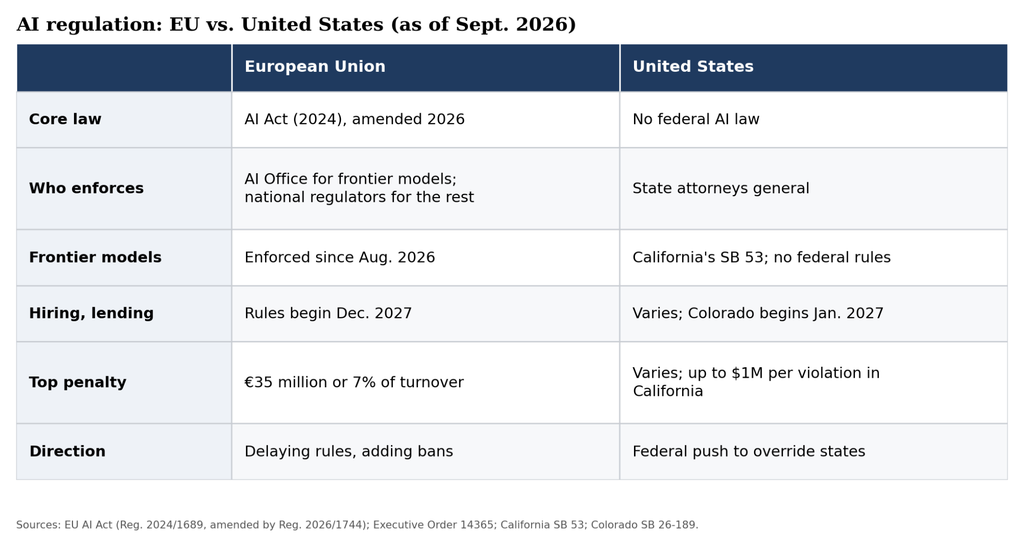
Because of this issue, later in 2026, the European Commission made an amendment to the AI law, called the Digital Omnibus on AI. This law came into force in July of this year, as Regulation (EU) 2026/1744. The new timeline pushes obligations for stand-alone high-risk systems to Dec. 2, 2027.
It would be easy to read this as Europe losing its willingness to regulate AI; however, that misses a few things.
Firstly, the omnibus also tightened the law. It added a ban on AI practices that generate non-consensual sexual imagery, including child sexual material.
Second, the delay left the rules for general-purpose models untouched. These are the large systems, like ChatGPT and Claude, that sit under other products. Their providers have carried obligations since August 2025, and those whose models may pose “systemic risk” must notify the European AI Office. Using a banned practice can still cost a company up to 35 million euros or 7 percent of worldwide annual turnover.
Third, Brussels has already started to use these regulations. On Aug. 29, the AI Office sent its first formal requests for information: one set to developers of some of the most advanced models, and another to more than 30 companies on how they disclose their training data.
How much further it will go is unknown, but the regulatory powers are real, and they are being used
America: Rulebooks Under Development
In December 2025, President Trump signed Executive Order 14365, which makes it federal policy to pursue global AI dominance through a “minimally burdensome” national framework and to check state laws the administration considers excessive. The order directs the attorney general to create an AI Litigation Task Force to challenge them in court.
In July 2025, the Senate voted 99 to 1 to strip a 10-year moratorium on state AI laws from the president’s signature tax-and-spending bill. Opposition had come from both parties; Congress is not yet willing to federally regulate AI, but does not support stopping states from issuing their own.
With that vacuum, some states have decided to act. California’s SB 53, signed in September 2025 and in effect since January of this year, is aimed squarely at frontier AI like ChatGPT and Claude. It requires developers of the largest models to publish safety frameworks, report critical safety incidents to the state, and protect whistleblowers, with civil penalties of up to $1 million per violation. Colorado, on the other hand, targeted algorithmic discrimination in decisions about employment, housing, health care, lending, and education.
Colorado is also where the federal-state conflict became a lawsuit. In April of this year, Musk’s xAI sued to block the law, and the Justice Department joined the case on the company’s side, arguing that the law’s carve-out for diversity efforts violated equal protection. It was the first time this department had intervened in a case against a state AI law, and a court soon paused enforcement. In May, Colorado repealed and replaced the statute with a narrower one built on notice and recourse. People must be told when automated tools shape a decision about them, receive an explanation of an adverse outcome within 30 days, and then have a path to human review. The new law takes effect Jan. 1, 2027.
The result looks like a strange paradox: the binding American rules that exist were written at the state level, not in Washington D.C., and the federal government’s most visible effort has been to limit them. But supporters of the state-led approach see the system working roughly as designed. As part of the federalist design, a single state could serve as a laboratory for the rest of the country. California is now testing transparency rules for the largest models, and Colorado, after one false start, is testing notice and appeal rights for ordinary consumers.
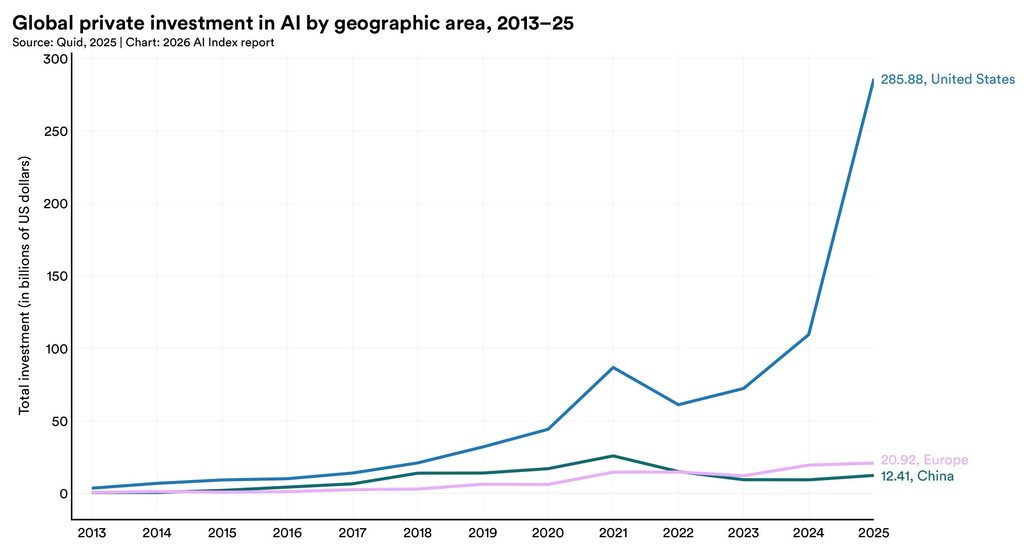
Washington’s caution also reflects a real stake; American AI companies drew $285.9 billion in private investment in 2025, more than 20 times China’s total, according to Stanford’s AI Index. Those wary of regulation argue that lead is the country’s most important asset, and that rules written in haste could squander it:
Side-by-Side Comparison
How the two systems differ:
What This Moment Reveals
Several tests are coming. Brussels must decide how far to take its first inquiries, and whether its talks with the labs produce anything binding. Congress must decide whether any safety bill can move before the election. And Europe’s high-risk rules arrive in December 2027, unless they are delayed again.
None of this settles which model is better.
Europe is ahead on paper, but its delay and its uneven national rollout show how hard it is to turn a rulebook into practice across 27 countries, for a technology that moves faster than the standards which are meant to measure it.
America is behind at the federal level, but some of its states are running experiments that the nation can learn from, in a market that leads the world in AI investment.
What September exposed is a gap in readiness. When the people building AI asked for limits, Europe had some form of a regulatory system with jurisdiction, one that has begun to use its powers. America is still having a debate at the federal level, while states act to implement their own solutions.
Of course, this is an apples-to-oranges comparison. The U.S. is a nation, built under the framework of federalism, while the EU is a supranational organization, with 27 nation-states that have their own approach to regulation.
Thus, comparing America to the EU might seem futile. The exercise, however, points to a larger divergence of approaches. We will see what approach lands best.