

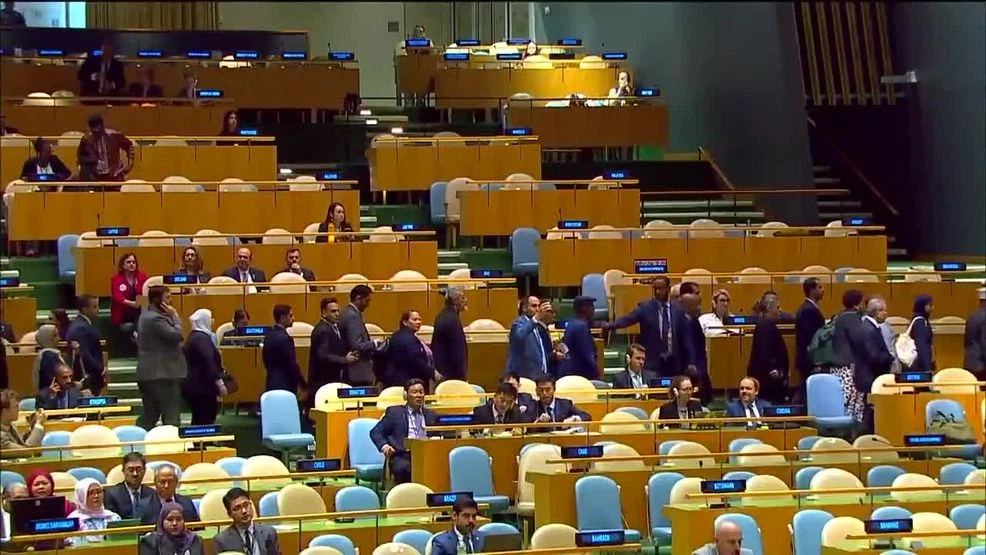
The recent walkouts during speeches at the United Nations raise an uncomfortable question: Is the world’s response to state violence becoming selective?
Israel’s military operation in Gaza, launched after the Hamas attack of October 7, 2023, has become one of the most controversial conflicts of the modern era. According to Israeli authorities, Hamas killed around 1,200 people in Israel and took 251 hostages. Subsequently, Israel launched a massive air and ground campaign in Gaza, saying its objective was to dismantle Hamas and rescue the hostages. According to Gaza health officials, by September 2026, more than 73,000 Palestinians have reportedly been killed. This figure that does not distinguish between civilians and combatants.
The scale of destruction and civilian suffering in Gaza has generated international condemnation and allegations of violations of international humanitarian law. The International Criminal Court issued an arrest warrant for Israeli Prime Minister Benjamin Netanyahu in November 2024, alleging responsibility for war crimes and crimes against humanity. The warrant is an ICC judicial action, not a UN arrest order, and Israel has rejected the court’s jurisdiction and allegations.
The controversy over Netanyahu’s international travel is also complicated. Canada, for example, has previously said it would respect its obligations under the ICC framework. However, Canadian officials said separately that overflight policy is not automatically linked to law-enforcement objectives, unless there is an imminent security risk.
But there is another side to this debate that we simply cannot ignore.
Iran, under the Islamic Republic, has a long record of suppressing political dissent. The country has witnessed mass executions, violent crackdowns on protesters, arbitrary arrests, and severe restrictions on civil liberties. Amnesty International estimates that thousands of political prisoners were executed in 1988, while Human Rights Watch has described those executions as crimes against humanity.
The repression has not remained a single chapter in history. During the 2022 “Woman, Life, Freedom” protests, hundreds of people were killed. The crackdown following the nationwide protests of late 2025 and early 2026 was even more severe.
Amnesty International reported that the UN Special Rapporteur on Iran had cited an estimate of at least 5,000 people killed. Further information suggesting the number could have been as high as 50,000. Iranian authorities themselves acknowledged thousands of deaths, although the exact figure remains disputed.
Likewise, Human Rights Watch reported that Iranian security forces carried out mass killings of protesters and bystanders during the January 2026 crackdown, with the death toll reaching the thousands.
So the question becomes unavoidable: Where was the same level of international outrage when Iranian authorities were killing protesters inside Iran?
More specifically, why does the world watch walkouts and diplomatic gestures surrounding Israeli speeches, while Iranian leaders continue to appear on the same international stage without protest?
There is, of course, an important distinction. A walkout does not measure whether the United Nations condemns a government for its actions. The UN and its human-rights mechanisms have repeatedly criticized Iran’s executions and repression. In 2025, the UN Human Rights Office reported that Iranian authorities had executed at least 841 people by August 28th alone.
However, public perception matters. When diplomats physically leave the hall during one leader’s speech, while another leader representing a government accused of similar, severe human-rights abuses receives an international platform, people naturally question whether the standards are consistent.
The United Nations was created to uphold principles that should apply beyond geography, religion, political alliances, or military power. Palestinian lives matter. Israeli lives matter. Iranian lives matter. The victims of Hamas matter. The victims of state repression in Iran matter.
Condemning one government does not require silence about another’s actions. Opposing Hamas terrorism should not mean ignoring Palestinian civilian suffering. Supporting Iranian protesters should not mean casting aside the suffering of Israelis.
The real question, therefore, is not simply “Who walked out?”
It is: “Does the international community apply the same moral and legal standards to every government, or do geopolitics decide whose suffering receives the loudest response?”
If the United Nations is truly an institution for all peoples, its credibility ultimately depends on whether it defends human rights consistently—even when doing so is politically inconvenient.

1 Comment
I found your last three paragraphs to be super impactful. It’s fascinating to question why Israel’s human rights violations have gotten more attention than Iran’s. I think a major reason is that Iran has always held a reputation, at least from an American perspective, of being a violent country. It’s almost expected by people, and change is seen as meaningless. That being said, the UN is consistently unfair in how it persecutes countries. I question the impact of the United Nations. Though I think it’s important, I can be frustrated with the lack of actual results it creates.