American politics has since departed into the realm of personality politics. Increasingly, political figures are required not to advocate for policies or constitutional rights, but rather perform an identity in ways that are marketable and pocket-heavy. A facade that doesn’t have to earn respect, but earns a platform to influence. The emergence of figures like Erika Kirk illustrates how the face of politics is changing and personifies this shift with particular clarity.
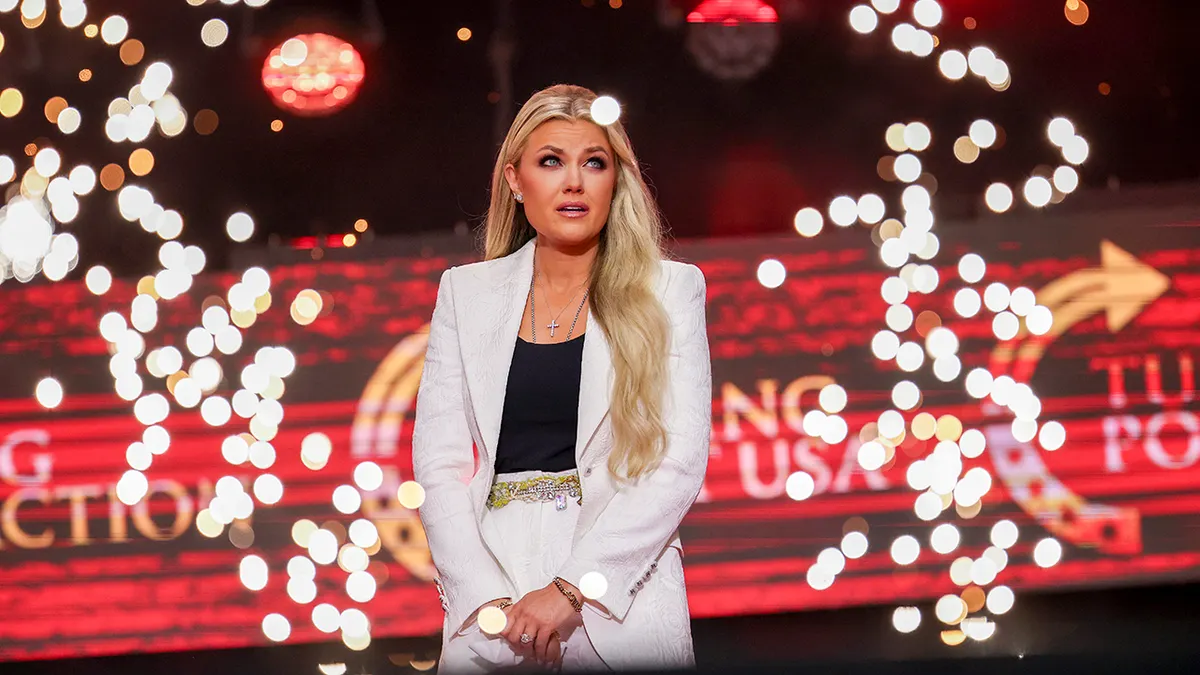
Erika Kirk is not significant because she represents coherent, revolutionary thought. Her platform was not bestowed upon her for anything remarkable, for she is just another conservative white woman proclaiming inequality. Instead, she embodies something larger than an easy jeer on social media. She displays, in full form, the transformation within American political culture: the gradual displacement of pragmatic politics to performative politics.
She stands not as a policymaker, completely unassociated with legislation or prevalent in any category of defined intellectual, and yet she has a hand in Trump’s speeches and appears on every archaic conservative podcast. She is not, by any typical standard, a central figure in American political life. However, through her reach and platform, from which she spews her dated thoughts, she becomes a viral sensation almost weekly.
It’s easy to blame technology. Political communication is no longer mediated primarily through filtered institutions like parties, unions or legacy media. Instead, it is disseminated through platforms that reward immediacy, polarisation and sensationalist mandates. Erika Kirk, even if not purposefully, ticks every box. Her views are widely humoured and disrespected by most of the digital sphere, and yet she persists in being circulated more as a laughing stock than a serious political voice.
However, this is no reason to dismiss her influence as a mere source of humour.
In this newly founded environment, influence doesn’t require institutional backing or even dignity. It requires visibility. According to research from the Pew Research Centre, a growing proportion of Americans get their news from social media platforms over traditional news outlets, something figures like Kirk are benefiting from.
Circulation, in turn, rewards a recognisable identity and emotional resonance.
But just visibility is not enough to cement your place next to the president at a rally. It must be attached to something recognisable, something savoury to the public.
What, then, does Kirk offer that is so enticing?
Part of the answer lies in her engagement with claims of “white male inequality”. At first glance, her framing appears to invert the established analyses of widespread inequality in the United States. Historically, this imbalance has been understood to cross racial and economic dimensions, heavily supported by empirical research and centuries of legislative disadvantage towards certain demographics. Data from the U.S. Census Bureau and the Federal Reserve consistently paint a picture of immense disparities in wealth, income and job opportunities along racial lines, with Black and Hispanic households holding substantially less wealth than that of white ones.
Given this, it’s shocking that one may ask why it is so blasphemous to speak of “white inequality”?
Is it just an attempt to highlight genuine economic hardship among certain white populations? Or for a stab to bury the disadvantaged further out of public discussion? There is no debate that the majority of Americans are feeling the heat of inflation or the wrath of immigration wars. Further, there are demographics across all races who are suffering from wage stagnation and job losses.
But Erika Kirk taps into this reality with a twisted conceptual shift. Instead of treating these conditions as primarily the outcomes of failing economic structures, she reframes them in racial terms.
This is where her rhetoric becomes politically significant. By centring this shared experience of country-wide economic distress as a mantle that disproportionately affects white people, she utilises this racialised framework to push the tiresome conservative narrative that white families are the majority facing this consequence.
That tension is what gives her claim traction, but also what makes it analytically unstable. Her rhetoric stands not to merely describe inequality but participates in an attempt to centralise it to a race that has and still does hold power over other minorities in government positions within America.
This is where her influence becomes clearer. She is not powerful because she controls institutions. She is influential because she antagonises fact, something social media can’t get enough of.
As Jürgen Habermas suggests, democratic discourse depends on shared standards of argument and evidence. When this discourse fragments across platforms and audiences, those standards are disputed and thus weakened. Under such conditions, figures like Kirk do not need to persuade everyone. She just has to resonate with specific communities and generate the tension required to thrust her digital image into circulation.
She is not exceptional; she is indicative.
For her, as much as any political figure or commentator, there is no such thing as bad press.