

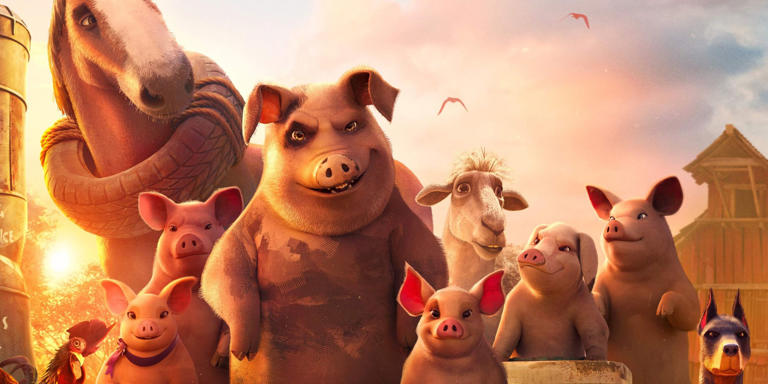
A new adaptation of George Orwell’s 1945 novella “Animal Farm” has been released, sparking massive backlash and criticism from commentators on both the right and the left.
The original novel was a critique of communism and Soviet Russia, with the story serving as an allegory of the Russian Revolution and the rise of Stalinism. Farm animals grew disgruntled with their current situation and overthrew their farmer to build a utopia, which ultimately devolved into a corrupt power structure in which “all animals are equal, but some animals are more equal than others.” The messaging of the book became world-famous, with the CIA even using it as propaganda during the Cold War to ward off communism in America.
However, the new movie is taking the opposite stance and is specifically targeting capitalism, creating a film that is less of an adaptation of Orwell’s work and instead a promotion of having a communist revolution with tacked-on fart jokes and potty humor.
The movie was directed by Andy Serkis and published by Angel Studios, a company that built its brand on faith-based and conservative ideologies, becoming well known after releasing their most famous film, “Sound of Freedom.” Angel Studios picked up the film’s North American distribution rights after it premiered at the Annecy International Animated Film Festival last year.
Serkis reportedly approached the adaptation by asking himself what Orwell would write about if he were to write “Animal Farm” in the modern day. He stated that he did not want the story to be about Stalinist Russia; rather, it would center on themes of capitalism, wealth, and overconsumption.
The new villain of the story, instead of farmer Jones, is billionaire antagonist Pilkington, an Elon Musk allegory who closely resembles his mother and drives what appears to be a Cybertruck.
The narrative is also fundamentally altered, as in the book, it was the animals’ choice to push out farmer Jones and enter into communism, whereas in the film, the animals did not have a choice and were forced to revolt as they were about to be sold to a slaughterhouse after Manor Farm failed to make payments. The movie makes communism look like a better alternative to capitalism, as the finale shows the animals revolting to stage a communist revolution after the pigs go into credit card debt. This change is completely altering the story, as it was at the beginning of the book that the animals entered communism and then found themselves stuck in an oppressive, tyrannical system.
“Animal Farm” is a story without a happy ending; however, Serkis chose to alter the novel’s haunting conclusion to one that is more hopeful and offers closure. The movie added a third act in which Lucky and the other animals take down Napoleon and the evil capitalist Pilkington, spreading the message that animals should help one another and that freedom comes from working hard, “not because we have to, but because we choose to.” The film paints the message that a society should kill its oppressors and all live in a commune together, where things will be better. This flies in the face of the entire point of the original story. Ironically, this kind of thinking was the beginning of the animals’ downfall in the original book.
The pigs in the story exploited their moral betters, using their suicidal empathy to manipulate and destroy them, taking all of their labor and goods, claiming it was in the farm’s best interests. The book was not about celebrating equality or the power of the collective; it was a warning about the dangers of both. The story went to great lengths to show how the animals were not of equal intelligence and how the pigs used that to their advantage to gain allegiances. The story pointed out the lie of equality, showing that there will always be someone smarter and more power-hungry to make a society based on equal wealth distribution fail. The book was not about how power corrupts and turns someone evil; it showed that, when the pigs gained power, they were able to inflict evil on others. To put it plainly, it was a warning about the lie of communism.
Whereas the movie has been dumbed down to the point that many are mocking it as childish and lowbrow. In between the clunky critiques of capitalism and contemporary American politics is a narrative riddled with fart jokes and immature humor, which dilutes the message even further by turning it into goofy children’s entertainment, rather than a very real warning.
George Orwell was a firm believer that literary fiction was a better way to explain the realities of the world, as he viewed political journalism as often being compromised by propaganda, staleness, and euphemism. However, stripping a story down to make it comprehensible to children was, ironically, exactly what the book warned against. A society should not stoop down to the lowest common denominator of comprehension so everyone can equally understand the message. This is the exact tactic the pigs used to oppress the other animals. Children inherently don’t understand everything about the world, but as they grow, they will learn to appreciate the story more, especially one that doesn’t assume its own audience’s stupidity is set in stone.
Anyone who preaches total communist equality is ignorant at best and evil at worst. The animals on the farm who barely contributed did not deserve the labor of the animals who toiled, and that was the point. Ironically, the new movie’s attempt to alter the history and morals of Orwell’s work to make it into something executives and figureheads want is itself extremely Orwellian.
The film has also led many on the right to claim that Angel Studios is falling back on the values it preaches after Laverne Cox, a transgender actor, voices Snowball, one of the story’s central characters. The casting decision stirred up backlash from Angel Studio’s largely Christian audience, who were disappointed that the studio, promoting itself as a family-friendly alternative to Hollywood, is backing a film featuring a trans actor.
There has also been massive speculation that right-wing political commentators are being paid off to promote the film, with many suggesting that they never actually watched it, as if they had, they surely would not support the new message of the movie. For instance, Riley Gains, a right-wing advocate for women’s rights in sports, has been theorized as being paid to promote the movie.
On the flip side, there are some who outwardly denounce the movie, such as Tim Pool, who stated on his YouTube channel, Timcast, that he rejected a paid promotion from Angel Studios, as he remarked that the movie was overtly anti-capitalist and could not support it on one principle. He was also set to debate someone from Angel Studios, with the possibility of it being Andy Serkis himself, about the new messaging; however, Angel Studios canceled it at the last minute, making the studio look even worse to many former supporters.
Overall, people on both the right and the left are not thrilled with this movie, saying it is not a good adaptation, and the box office scores are resembling that sentiment as well. Butchering timeless classics for an individual’s own personal agenda is a mockery not only of the original work but also of its creator. If you want to appreciate “Animal Farm” as it was actually intended, just read the book.