
Big Picture:
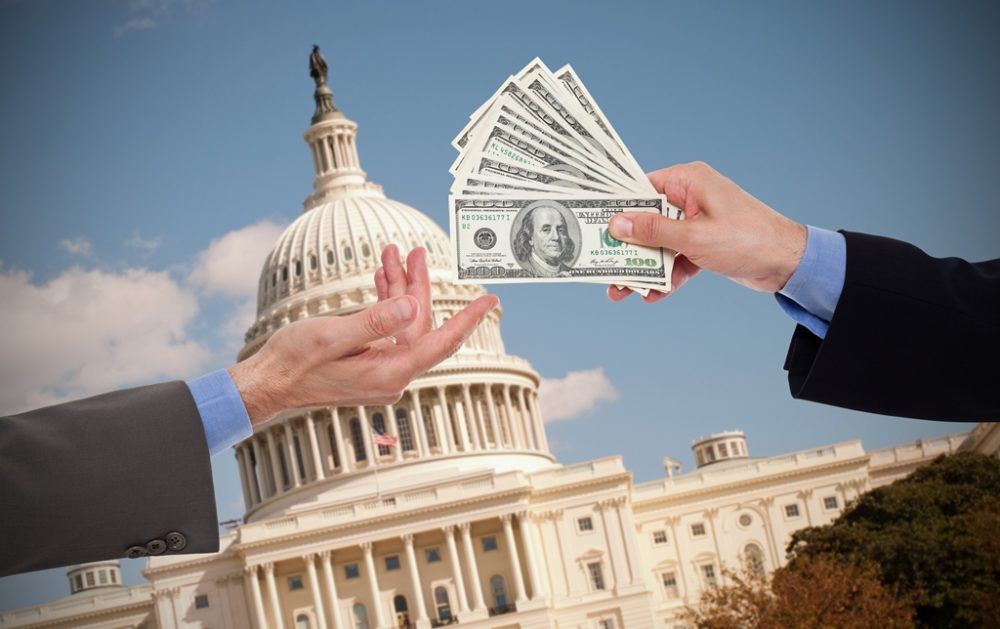
The United States is a nation of the people, by the people, for the people. Our democratic republic is supposed to be run by elected representatives who are accountable to the will of American voters above all else. However, both political parties are increasingly influenced by and reliant on the funding of lobbies. Lobbies, also known as special interest groups, send paid agents to advocate for government officials to make specific decisions or support a given legislation. Many lobbyists are former government employees and vice versa. This organized form of influence has distorted the legislative and political decision-making processes to the point that government policy is often incongruent with the opinion of the voters.
Operative Definitions:
- Lobby/ Special interest groups: An organization representing a business, social or political interest that sends paid representatives to advocate specific legislation or government decisions. These representatives, also known as lobbyists, are usually well-connected former politicians, lawyers, or both.
- PAC: An acronym for Political Action Committee. PACs are specialized interest groups. They are committee-based organizations that raise money to support a specific cause or candidate. They operate within the legal loopholes of the limits on individual donations to politicians, circumventing them through collectivization.
- The revolving door: A metaphor for the prevalent occurrence of former lobbyists entering the political scene and retired politicians becoming lobbyists. This pattern generates informal loyalties between lobbyists and politicians and their respective causes.
- Citizens United v. FEC: A landmark case in 2010 when the Supreme Court ruled the First Amendment prevents the government from regulating political spending by organizations. This led to an intensification of political financing by corporations, unions and special interest groups. This proliferation has done much to reduce the democratic function of the United States despite the ruling being ‘constitutional.’
- SCOTUS: An acronym for the Supreme Court of the United States.
- Amicus Curiae: An impartial advisor to the court who offers information that bears on the case’s outcome. In this case, it would be an expert on the data regarding the effects of organized finances on American politics.
Important Facts and Statistics:
- According to the Pew Research Center, 70% of Americans want limits on political spending.
- In 2023, lobbies spent $4.26 billion in Washington DC.
- Lobbyists and special interest groups represent many different corporations and causes. Generally, they advocate for business interests, however some advocate for specific political, social or religious positions.
- Many of these organizations possess disproportionate levels of influence and financial resources. These entities leverage their monetary influence to incentivize government officials to support specific legislation or make certain decisions they may not have otherwise.
- One of the most egregious examples is AIPAC (American Israel Public Affairs Committee). It is the highest spender of the non-corporate special interest. This PAC is specifically focused on garnering US support for Israel, a foreign nation. It does so, like all lobbies do, through the financial influence of U.S. politicians. Their funding of American politics is nonpartisan, giving millions annually to both Republicans and Democrats. The stipulation for these politicians to receive AIPAC financial backing is unfettered support for Israel in Congress. AIPAC’s website has a list of the 354 members of Congress that it supports, including a majority of the House of Representatives and nearly half of the Senate. This means that a majority of Congress is incentivized to support a foreign nation to which they owe no allegiance, no matter the opinion of voters.
- The function of the above-mentioned example is by no means unique to AIPAC, that is the nature of all special interest groups in DC.
- Lobbies and PACs are largely composed of lawyers, many of them work specifically on writing the desired legislation their lobby advocates for. Often, these drafts appear word for word in the law, instead of the democratically elected lawmakers who are intended to draft it.
- These groups leverage outsized influence on lawmakers while advocating for legislation that benefits the specific corporate, political, or social cause they represent.
2 Point Plan
1. Submit a bipartisan-backed bill to Congress that limits the direct involvement and influence of lobbies and special interest groups.
The bill must: First, be written in its entirety exclusively by congressional representatives and their staff. Second, make clear the anti-democratic nature of money is equal to speech and therefore the infringement of lobbies on the intended function of Congress. Third, disallow former and current members of PACs, lobby or any other special interest from running for political office within a decade of their employment in said organization, this limitation is justified by the previously mentioned conflict of interest. Lastly, we must disallow special interest groups from financial influence on both legislation and governmental decision-making as a whole via legal penalty.
This bill will contradict the precedent Supreme Court ruling on political spending being protected under the First Amendment in the case Citizens United v. FEC (2010). This will undoubtedly result in a SCOTUS review of the law’s constitutionality immediately.
2. If the bill is passed and becomes law, submit an amicus curiae to the SCOTUS immediately upon the court’s review of the constitutionality of its legislation. The brief will feature examples of legislation written by special interest groups, data on financial contributions and a detailed breakdown of the effect of the revolving door on American politics, particularly in Congress. The amicus will offer information that does not directly pertain to the constitutionality of the case but will instead serve to clarify the legislative intent of Congress. That is a nullification of the non-democratic and disproportionate influence of special interest groups via finance and the conflict of interest they impose via the revolving door.
Why This Initiative is Important
Nullifying the influence of money in politics is essential to repairing the American system. Their natural function as well as the revolving door incentivizes government officials to stretch their loyalties beyond that of the state and the electorate. This undermines democracy and distorts the intended function of the legislative branch. Instead of policies being made to cater to the electorate, whom representatives are empowered by, they are aimed at pleasing special interest groups and lobbies who inject billions annually into both American political parties, thereby reducing the leverage of the great majority of American voters.
Acknowledgment: The opinions expressed in this article are those of the individual author.
Sources
Cerda, Andy. “7 Facts about Americans’ Views of Money in Politics.” Pew Research Center,
Pew Research Center, 23 Oct. 2023,
www.pewresearch.org/short-reads/2023/10/23/7-facts-about-americans- views-of-money-in-politics/.
Chang, Ailsa. “When Lobbyists Literally Write the Bill.” NPR, NPR, 11 Nov. 2013,
www.npr.org/sections/itsallpolitics/2013/11/11/243973620/when-lobbyists- literally-write-
the-bill.
“Citizens United v. FEC.” FEC.Gov,
www.fec.gov/legal-resources/court-cases/citizens-united-v-fec/. Accessed 13 May 2024.
“Lobbying for the Faithful.” Pew Research Center, Pew Research Center, 21 Nov.
2011, www.pewresearch.org/religion/2011/11/21/lobbying-for-the-faithful-exec/.
“Support Pro-Israel Candidates.” – AIPAC Political Portal,
candidates.aipacpac.org/page/featured/. Accessed 13 May 2024.
