

“All it would take is to stand firm just once, and I can change my whole destiny in a single hour,” the protagonist in The Gambler says. Or something close to that, depending on the translation.
The exact wording almost does not matter. What hits you is the feeling behind it: that small, tight twist in your chest, the quiet ash of recognition before you can even put it into words. These days, especially among young men, gambling is no longer just an activity. It has become something more like background noise in life, always present just beneath the surface. You do not even have to look for it.
Scroll through your feed, watch a game, or stand in line with your mind half elsewhere, and there it is again: polished ads promising big winnings, instant cashouts, and Lamborghinis lined up next to roulette wheels that no longer need a real casino to exert their pull. What strikes me most is how little resistance so many of us seem to have developed.
We grew up in a culture that does not simply value money. It treats money as the only real measure of anything that matters. Success, worth, even identity gets translated into dollars, credits, and glowing balances on a screen. Capital stopped being one way to keep score. It became the only scoreboard — the grammar through which everything else is understood. The only thing that still reliably answers. This whole thing feels like a worn-out, cracked copy of the American Dream. The outline remains, but the heart has been hollowed out.
Happiness, love, peace of mind — they all get reduced to numbers you can chase. It is fabricated value chasing fabricated transcendence. And saying the word transcendence out loud these days can feel almost embarrassing unless you soften it with a joke.
I have been noticing a quiet but real sorting happening among younger people. Nothing loud or dramatic. Just a slow drift in different directions. On one side are those who are beginning, sometimes cautiously, to turn toward things that cannot easily be priced: deep family ties, real community, faith, and acts of care that do not come with a receipt. On the other side are those who stay inside the loop — working, scrolling, betting, and chasing the next hit while something important inside quietly grows thinner. The numbers, messy as they often are, still point in the same direction.
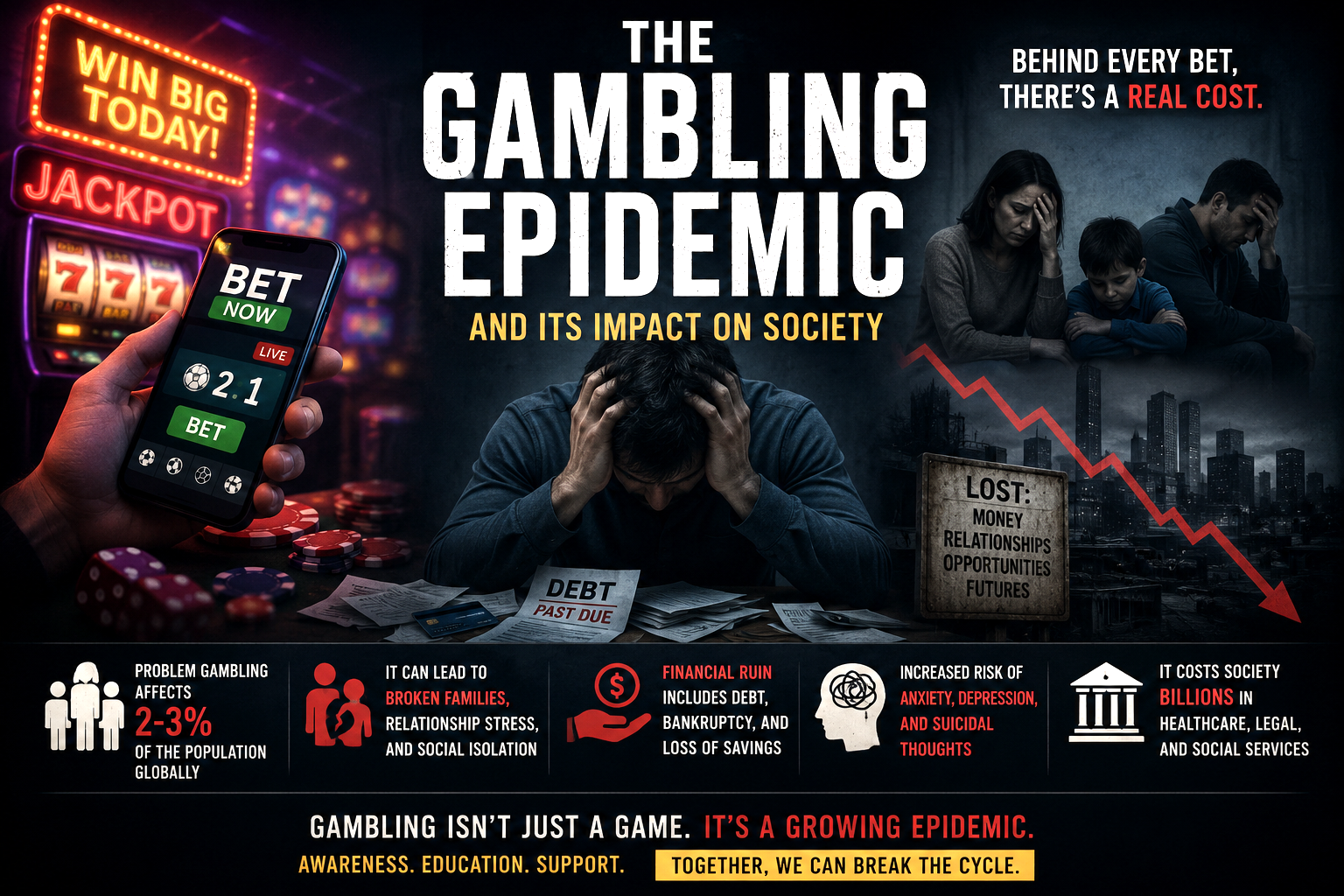
Research from the National Council on Problem Gambling shows that young men between 18 and 30 experience gambling-related problems at roughly three times the rate of the general population. Some estimates suggest that 8 to 10 percent fall into at-risk or problematic patterns.
Globally, the National Institutes of Health and other public health sources estimate that somewhere between 15 and 20 percent of adolescents report having gambled in the past year. Here in the United States, younger generations are encountering sports betting and casino-style games much earlier and with far less friction than previous generations did — a shift reflected in behavioral data compiled by the Pew Research Center. Online sports betting did not create this problem, but it has intensified it dramatically.
After the Supreme Court decision in Murphy v. NCAA, the apps made wagering continuous, portable, and almost completely frictionless. A large number of young and middle-aged men now keep active betting accounts, and the numbers continue climbing steadily. In several states, calls to gambling hotlines and requests for treatment have increased noticeably after legalization. Young men in particular tend to move fluidly between sports betting, online casinos, daily fantasy, and back again. Participation trends are tracked by Statista.
The mental health consequences often stay hidden at rest, and that makes them even more dangerous. Gambling issues rarely travel alone. They tend to appear alongside depression, anxiety, substance use, and a significantly higher risk of suicide. Both the Centers for Disease Control and Prevention and the American Psychiatric Association have documented these connections clearly.
Many people struggling with gambling disorder report ongoing depressive symptoms and persistent anxiety. Among adolescents, the effects often spill into school problems and difficult relationships — the kind of quiet distress that is easy to dismiss as something else. So what exactly are we chasing every time we tap “spin” or place a wager?
A brief feeling of control? A short escape from whatever feels stuck in the rest of life? Or that very human hope — the one Fyodor Dostoevsky understood so well — that this time things will finally break in our favor? The platforms are engineered with remarkable precision to keep that hope alive through variable rewards, near misses, personalized prompts, and seamless integration with the sports you are already watching.
At this point, it has gone far beyond simple entertainment. It has become a behavioral environment designed to keep you inside it. Fyodor Dostoevsky knew this world from painful personal experience. He fought a serious roulette addiction, lost heavily, and wrote The Gambler under intense pressure just to pay off his debts.
The novel captures the psychology in a way that still feels disturbingly current: the clever rationalizations, the sudden rush of confidence, and the inevitable crash that follows. The core mechanics have not changed at all. What has changed is the accessibility.
Your smartphone now places that same psychological trap in your pocket any time of day or night. The house edge stays exactly the same, but the human costs spread out quietly in the form of debt, distraction, and a persistent low-grade dissatisfaction that is difficult to shake.
The result is a subtle cultural divide that many people feel even if they cannot always name it. Some are stepping away, or at least trying to, and searching for meaning in relationships, faith, or ways of living that exist outside the constant need to quantify everything.
Others remain caught in the cycle, chasing wins that almost never come while slowly normalizing debt, distraction, and the nagging sense that something essential is missing. Overcoming this will require more than individual willpower alone, because willpower is a limited resource for most of us.
It will likely demand a broader cultural response: stricter limits on advertising, closer examination of how these apps are designed, better access to mental health support, and perhaps most importantly, a real conversation about what we truly value in life. Fyodor Dostoevsky eventually walked away from the tables and poured his energy into work that continues to matter today.
Most of us will not get such a clean, storybook ending. For the majority, the first step is simpler and quieter. It is simply recognizing that the big promise being sold to us is not quite real.
Standing firm may not transform your entire destiny in a single hour. But it can begin the slower, steadier work of reclaiming a life measured by something deeper than the next spin.
