

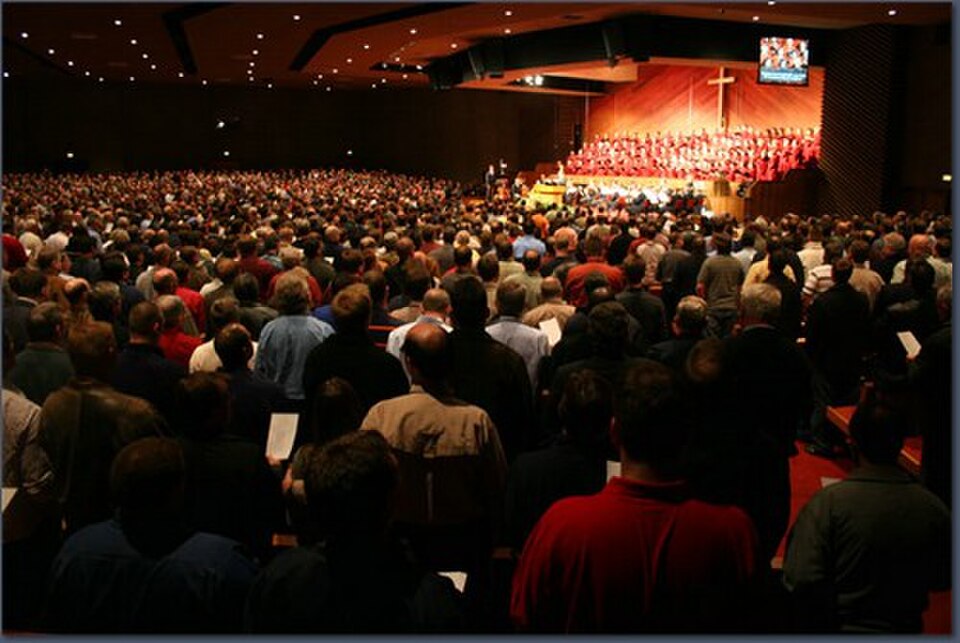
Joel Osteen fills a 16,800-seat former basketball arena in Houston on most Sundays. He is one face of a broader movement. This is commonly called the prosperity gospel, and has become one of the most contested intersections of faith and economics in American life. Its core claim, as summarised by Britannica, is straightforward: God wants believers to experience financial prosperity, physical health, and overall success in this life, achievable through positive confessions, faithful tithing, and unfaltering belief. Depending on who’s describing it, that claim is either liberating good news or a theology built to serve capital. Both sides present real arguments, but fundamentally, this disagreement says as much about America’s relationship to markets as it does about theology.
The Case Against
The most systematic critique comes from academic political economics, and does not offer dull opposition. A 2019 study in the Journal of Economic Issues argues the prosperity gospel functions as a kind of spiritual infrastructure for neoliberalism. It provides believers shelter from the pressures of the market while reinforcing the idea that an individual’s decisions alone are responsible for their outcomes. This same academic paper draws a direct structural parallel between the two belief systems: both the market and the divine promise function on a cemented meritocracy where guaranteed, efficient, and fair rewards are offered for the faithful or the diligent. If poverty is a faith problem rather than a structural one, as hypothesised in this philosophy, there’s no need to organise, unionise, or vote for redistribution. The answer is just believing harder.
The socialist magazine Jacobin makes the class argument more bluntly, remarking that most megachurch pastors adopted their organisational model straight from the corporate world, coming to see themselves as businessmen rather than clergy. This critique is reminiscent of how Marx framed religion as being less about truth or falsehood, but instead a social product shaped by, and shaping, material conditions. A piece from Freethinkers International pushes this idea into electoral politics, arguing the same pastors who preach wealth as divine favour also conveniently preach that God wants people to vote for tax cuts, deregulation, and cuts to social programs; a closed loop in which reliance on the church is preserved by opposing the public alternatives to it.
Christian critics ultimately arrive at overlapping conclusions from a different direction. As summarised by EBSCO Research Starters, evangelical pastor Rick Warren has argued prosperity theology is flawed because it favours the wealthy when many people of strong faith remain poor or ill, and therefore it risks turning wealth and happiness into false idols. The Vatican has taken a similar line, with Pope Francis explicitly criticising what La Civiltà Cattolica calls prosperity theology’s “different gospel.”
Follow the Money
Let us set theology aside for a moment and ask a blunter, more material question: where does the money actually go? Legal scholarship gives an uncomfortable response. Research cited by Sojourners found that megachurches on average spend less than a quarter of their income on missions and programs, with some spending less than three per cent. Unlike secular nonprofits, Britannica’s overview of the church-tax debate notes, churches are automatically exempt from federal income tax and aren’t required to file the Form 990 that discloses finances to the public, a legal disclosure all other charities must provide. A staffing study reported by the Christian Post found roughly half of megachurch budgets go toward salaries, and at most churches, specific salary figures are known only to the board or senior staff. When Senator Chuck Grassley investigated six prosperity ministries in 2007, only four of the six ever turned over their books.
None of this proves fraud, but it highlights the need for transparency. If the prosperity gospel really is, as critics describe, capitalism wearing a preacher’s designer suit, the lack of financial transparency is the tell. A genuinely charitable institution built around collective gain would have no reason to leave such information undisclosed. The interrogation worth pressing isn’t only “is this theology true?” but “who is accountable for the money that theology generates, and to whom?” So far, the honest answer is: almost no one, and not the public.
The Case for and the Complication
Defenders don’t concede the ground easily. Britannica’s summary of the debate notes that supporters point to supportive Bible verses, individual success stories, and the hope the theology inspires, citing passages like 3 John 1:2’s blessing of prosperity and good health. Theologian and pastor Richard Beck complicates the picture further with an on-the-ground account: he describes a colleague and formerly incarcerated man who found Joel Osteen’s message genuinely helpful, since spiritualized self-help boosts self-efficacy, sustains motivation, and staves off demoralisation for people rebuilding their lives with few resources. Beck’s description is pointed: elite critique of the prosperity gospel often comes from people who have never needed the hope it supplies.
That’s the tension a purely economic critique can miss. The Marxist reading treats prosperity theology as ideology serving capital, and the institutional evidence for that (corporate-modelled megachurches, political alignment with deregulation, undisclosed finances) is substantial. But reducing it entirely to false consciousness risks flattening why tens of millions of people, many in genuinely precarious circumstances, find it meaningful rather than merely useful to the system. If the theology is purely manipulation, why does it work on people who have every reason to distrust institutions that have failed them before? That question doesn’t have a clean answer from either side, and it’s worth sitting with rather than resolving too quickly.
What’s Actually at Stake
The prosperity gospel isn’t just a theological dispute; it’s a live test case for how Americans metabolise the relationship between faith and market logic. The Marxist critique offers a coherent account of why this particular theology flourished when it did, as the postwar boom made prosperity feel inevitable. Pastors began, as one commentator in RELEVANT put it, to resemble CEOs. But the movement’s staying power, especially among people with the least structural power, suggests it’s doing more than manufacturing consent. It’s also doing the work religion has always done: offering meaning, agency, and hope under conditions people didn’t choose. Whether that hope emancipates or pacifies may depend less on the theology itself than on what alternatives political, economic, communal are actually available to the people holding it, and on whether the institutions profiting from that hope are ever made to answer for it.