

February 24th, 2022 permanently changed the lives of so many Ukrainians and Russians. Vladimir Putin reared his ugly head to once again mobilize his disastrous and aggressive foreign policy. He violated sovereignty in Ukraine as he had done with Georgia and Crimea in the years building up to the full-scale invasion.
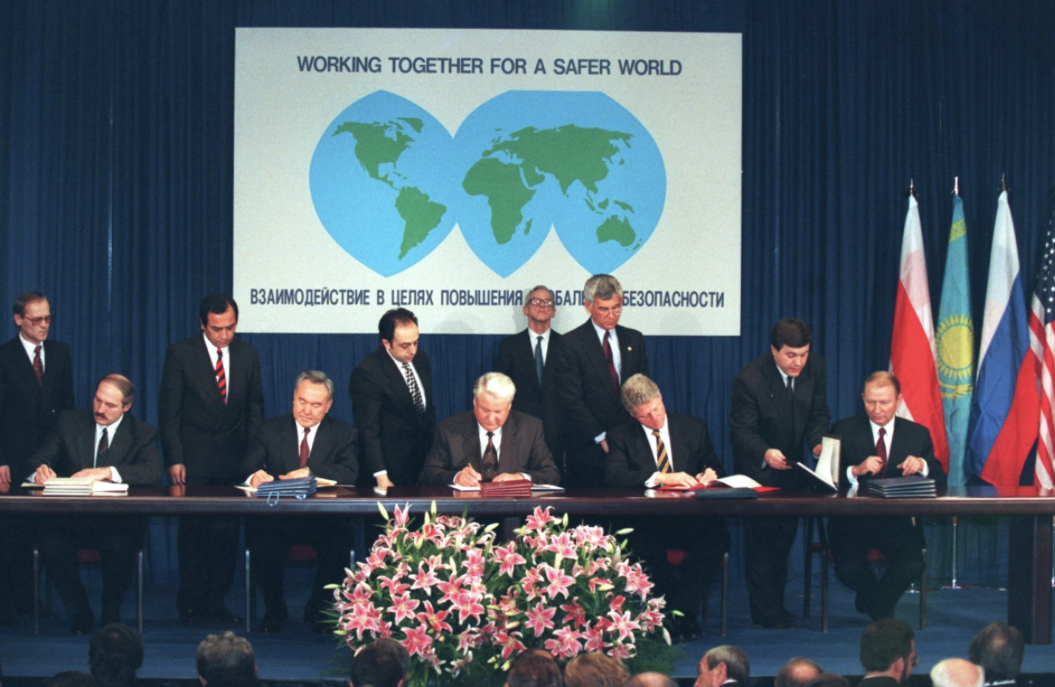
The 24th was not, however, the event that sealed Ukraine’s fate. The real cause takes us back in time to the Clinton era, specifically the 1994 Budapest Memorandum. This memorandum was an agreement signed by Ukraine, the United States, Russia, and the United Kingdom in which Ukraine agreed to surrender its inherited Soviet nuclear arsenal and join the Nuclear Non-Proliferation Treaty (NPT) as a non-nuclear state.
In exchange, the three nuclear and world powers pledged to respect Ukraine’s sovereignty and outlined a zero tolerance policy for the threat or use of force against it. It was signed under President Bill Clinton and his administration in hopes of post-Soviet reconciliation and improved relations. However, it only provided support assurances rather than a legally binding defense guarantee, which is something that became particularly significant following the Russian annexation of the Ukrainian peninsula, Crimea, in 2014 and its full-scale invasion of the country in 2022.
The war cannot simply be blamed on Clinton and his administration. They could not have possibly anticipated the geopolitical climate of the 2010s. Regardless, his administration’s pursuit of NATO expansion, despite repeated Russian objections, aided in solidifying Moscow’s altered perception that the West intended to exploit its vulnerability after the 1991 Soviet collapse. Rather than pursuing a more equitable and inclusive European arrangement, Clinton ensured that The United States fostered a completely Western-dominated framework that left Russia excluded and antagonized.
The most important development of the memorandum, which ultimately changed how Ukraine could have responded to the invasion in 2022, was the securing of Ukraine’s nuclear disarmament in exchange for security assurances that ultimately proved insufficient to protect its sovereignty. There also lies the inherent change in presidential administrations, which will often split in ideology between successors and predecessors.
What Clinton missed was not that each administration after him would in fact have obligations and membership to the treaty, but that each would have different interpretations of how to uphold the assurances of support. Even though Vladimir Putin clearly bears direct responsibility for the act of invading Ukraine, it was ultimately Clinton’s foreign policy agenda that helped lay the groundwork for the conditions that led to the war.
The Ukrainian disarmament left it dependent on other nations rather than an independent nuclear deterrent with bargaining and negotiation power. Although the United States, Russia, and the United Kingdom pledged to respect Ukraine’s sovereignty and territorial integrity, the agreement did not provide an effective means of maintaining the peace and Ukraine’s border. The world saw this with the Crimean annexation and later invasion.
Instead, the agreement exposed the limitations and failures of the promises made by major nuclear powers. As a result, it left Ukraine without the proper provisions it arguably expected and deserved in exchange for giving up its most powerful bargaining chip.
Even when accounting for the turmoil and unpredictability of the future and the deterioration of the geopolitical climate in Eastern Europe and the Eurasian circle, President Clinton did not perform his due diligence in the accommodation of Russian, Ukrainian, American interests going into the 21st century.
“Acknowledgement: The opinions expressed in this article are those of the individual author, not necessarily Our National Conversation as a whole.”