

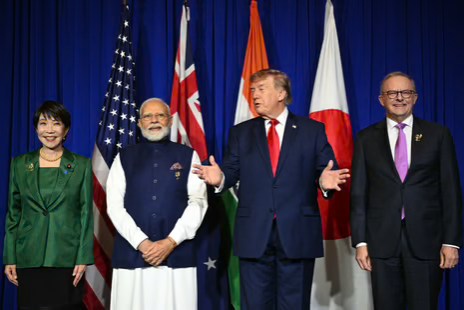
President Donald Trump departed to Asia with a high-stakes summit meeting on the agenda. He’ll be attending the Association of Southeast Asian Nations summit (ASEAN) and the Asia-Pacific Economic Cooperation (APEC). The summits are a year-end annual event that reunites many politicians and leaders from around the world.
Trump is scheduled to join key discussions, including a special summit with the ASEAN and the APEC leaders over cocktails and a meeting of the Quadrilateral Security Dialogue (Quad). He will take part in both summits in efforts to talk trade and national security with the goal of bringing closer ties in terms of economic goals.
For someone like Trump, it’s important to talk things out for the sake of improving American businesses and for the benefit of workers.
Trump arrived in Manila, the Philippines today first as part of the two-country stop. Afterward, he’ll visit China on Thursday as Southeast Asian leaders gather for their year-end summit. On that day, Trump is scheduled to have a trilateral meeting with Xi and Russian President Vladimir Putin.
This is Trump’s seventh meeting with Putin, while with Xi it will be their ninth one face-to-face.
Diplomacy should not come at the expense of American interests. American leadership will not be measured simply by how many world leaders sit around the negotiating table but by what these discussions actually accomplish.
The trip also comes at a challenging moment for Trump at home following the November midterm elections, as he will have to find common ground without giving away too much in return.
Technology is also a major talking point during the summit that’s set to take place on Thursday. U.S. officials remain concerned with China’s access to advanced technology that could potentially strengthen its military and technological capabilities. There’s controversy in NVIDIA due to the rise of AI chips in the United States raising concerns for U.S. national security and market stability risks because of concerns for potential technology leakage to China.
This is an important test of the Trump administration’s foreign policy. Both countries rely heavily on each other for trade, but disagreements over tariffs have continued to create tension. Trump will likely want to make sure American businesses are getting a fair deal while protecting jobs and industries at home.
One of the biggest concerns for Washington is its economic relationship with China. Both countries depend heavily on each other for trade, but disagreements over tariffs and manufacturing have continued to create tension. The United States cannot afford to ignore its economic relationship with Beijing, but it must also avoid becoming too dependent on a country that competes with American industries.
The presence of Putin adds another layer to the discussions. Relations between Washington and Moscow remain strained, especially over international security and nuclear weapons. Mainly, their talks will revolve around possibly ending the full-scale Russian-Ukrainian war invasion that is still ongoing and is coming up to last for five years now in February 2027. Trump has an opportunity to push for meaningful discussions about reducing nuclear threats, but any agreement must be backed by commitments rather than political promises.
American leadership will not be measured simply by how many world leaders sit around the negotiating table but by what these discussions actually accomplish.
Trump is a president who puts America’s interests first, while also having to negotiate deals with two other countries that have their own political interests.
Acknowledgement: The opinions expressed in this article are those of the individual author, not necessarily Our National Conversation as a whole.