
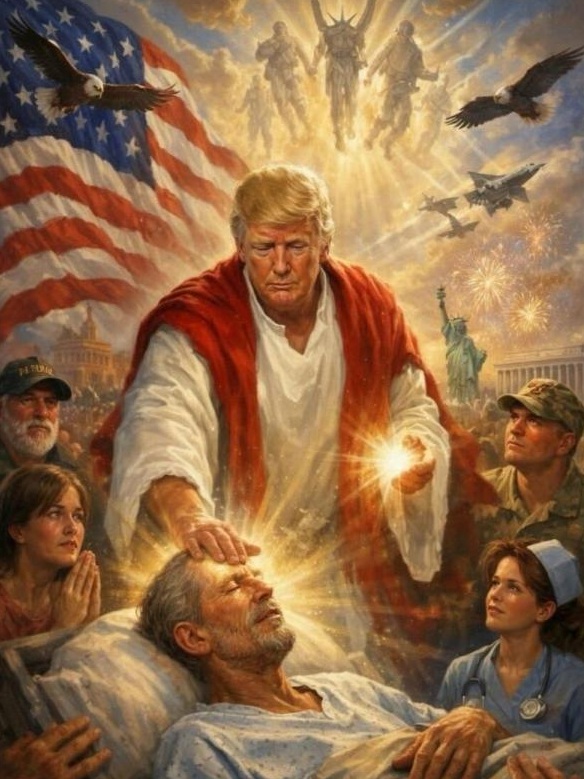
In today’s digital landscape, a single post can quickly move beyond its original intent and spark a national conversation. That was the case following a recent social media post by President Donald Trump, which drew widespread attention after he shared an AI-generated image that appeared to depict him in a Christ-like manner. Trump is facing backlash for posting an AI-generated image depicting him as Jesus Christ
According to reporting highlighted by NBC News, the image was taken down shortly after being posted, but not before it generated strong reactions across social media and political circles. The response was not limited to political opponents’ criticism, but also came from some religious conservatives and supporters, who viewed the imagery as inappropriate or disrespectful. At the same time, others defended the post or dismissed the backlash as an overreaction, pointing to the broader culture of internet satire and exaggeration. This range of responses reflects a deeper dynamic in modern political communication: how meaning is shaped not only by what is posted, but by how it is interpreted.
A Question of Interpretation
One of the most significant aspects of this moment is how differently audiences understood the same image. While some saw a clear religious parallel, others argued the intent may have been symbolic, humorous, or misunderstood. Trump himself suggested at one point that the image was meant to depict him as a healer or doctor, not a religious figure.
This gap between intention and interpretation is not uncommon in digital spaces. Social media allows content to spread rapidly, often without context, leaving room for audiences to assign their own meaning. In politically charged environments, that process can happen even faster.
The Role of Social Media
This moment also reflects the increasing role of social media and now artificial intelligence in shaping political messaging. AI-generated images are becoming more common in online communication, allowing for more stylized and symbolic portrayals of public figures.
However, as these tools become more widely used, they also introduce new challenges. Images that blur the line between satire, symbolism, and realism can be interpreted differently across audiences, especially when they involve culturally or religiously significant themes.
In many cases, the conversation that follows a post can become just as influential as the post itself, shaping how it is remembered and understood.
Faith, Identity, and Leadership
The reaction to the image also highlights the sensitive role religion continues to play in public life. For many Americans, faith is deeply personal, and its association with political figures can carry significant weight.
In this case, criticism came not only from those who oppose Trump politically, but also from individuals within religious communities who expressed concern about the use of Christian imagery.
At the same time, others viewed the backlash as part of a broader pattern in which public figures are closely scrutinized and quickly criticized online. These differing responses illustrate how the intersection of faith and politics can be interpreted in multiple ways depending on personal belief, values, and perspective.
Policy and Responsibility
Beyond public reaction, situations like this raise broader questions about responsibility, particularly for public figures with large platforms. While social media allows for more direct communication, it also increases the potential impact of how messages are interpreted.
Political leaders often operate under a different level of scrutiny because their words and actions can influence public trust, civic discourse, and cultural understanding. When messaging intersects with sensitive topics like religion, that responsibility can become even more complex.
At the same time, audiences also play a role. In a fast-moving digital environment, reactions are often immediate, and content is quickly shared without full context. This can amplify misunderstandings and deepen division before clarity is established.
Rather than pointing to a single rule or solution, moments like this highlight the ongoing challenge of balancing expression with awareness, especially in a space where communication is both instant and far-reaching.
Why This Matters Now
The rapid spread of this image and the response it generated reflect a larger shift in how political communication is experienced today. Social media has made it possible for messages to reach millions instantly, but it has also made interpretation more fragmented and immediate.
As political figures continue to use digital platforms and increasingly, tools like artificial intelligence, the line between message, meaning, and reaction becomes less clear. What might be intended one way can quickly be understood in another, especially when it touches on deeply held beliefs.
These developments raise important questions moving forward:
- How should public figures navigate the use of religious symbolism in political messaging?
- What responsibility do leaders have in anticipating how their content may be interpreted?
- How can audiences engage more thoughtfully before reacting or sharing content?
- What role should platforms play in moderating or contextualizing AI-generated political media?
As digital communication continues to redefine political discourse, the challenge moving forward may not be to eliminate disagreement, but to better understand it, creating space for dialogue in a landscape where reactions often come first.
Sources
Trump facing backlash for posting AI-generated image depicting him as Jesus Christ
