

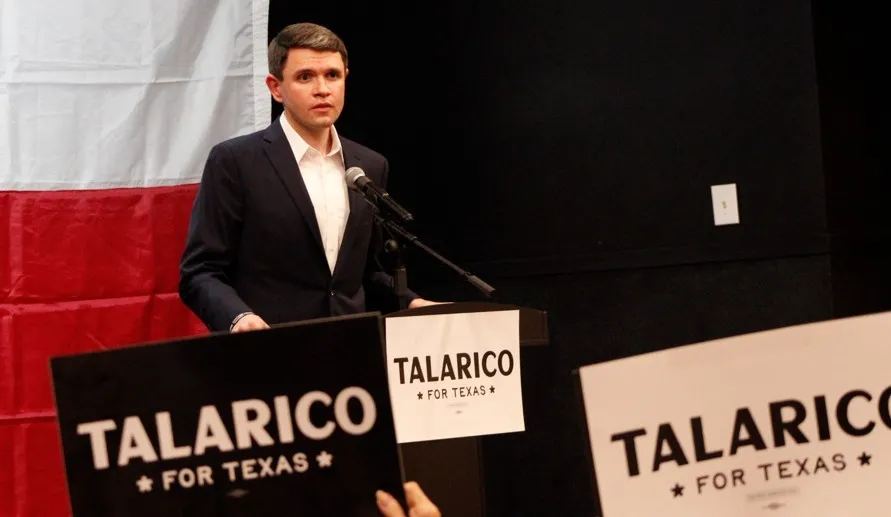
On May 26th, incumbent Senator John Cornyn (R-TX) lost re-election to challenger Ken Paxton in a runoff of March’s Texas primaries. This news delighted nobody more than James Talarico, the Democratic nominee for Cornyn’s seat. Paxton is a scandal-plagued Texas Attorney General who, in 2023, was impeached on 20 articles by a Republican-controlled Texas State House . Though his approval ratings have since recovered to his pre-impeachment levels, which are still quite low (his current approval is a mere 34%), he has an unshakable reputation of corruption. Paxton is a political liability, and Talarico, a Democrat trying to win in a red state, should feel much better about his chances against Paxton than against Cornyn. Immediately after Paxton was officially called the winner, Cook Political Report shifted the Senate race’s marker from “Likely Republican” to “Lean Republican.” Though this still positions Talarico as an underdog, he now finds himself in striking distance of the Republicans, energizing Democratic donors in their effort to flip the Senate blue.
More interesting than how Talarico’s numbers responded in the immediate aftermath of Paxton’s victory is how Talarico himself responded. Before saying anything about Paxton, he posted this to his X page:
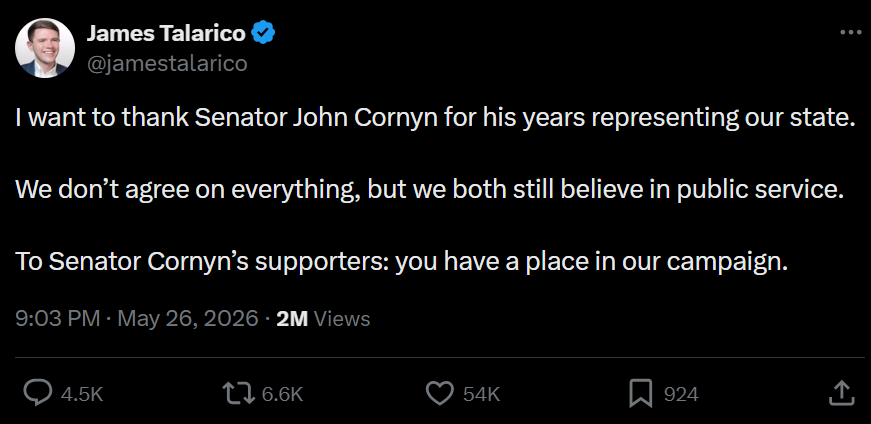
One tweet is not likely to move the needle for many voters, but this kind of across-the-aisle messaging is the right choice. This bipartisan strategy may have backfired for the left in 2024, when Democrats received internal flak for trying to appeal to traditional Republicans with campaign appearances from Liz Cheney, but that certainly should not be taken as a cautionary tale for James Talarico. Unlike Harris, who ran a national campaign, Talarico is running for Senate in a red state. Winning a Republican electorate means winning Republican votes. Opting to attract conservative voters rather than simply energizing the left wing of the Democratic base is not a choice in Texas, it is a necessity.
Where Talarico runs into danger of repeating the past mistakes of Democrats is his rhetoric on Paxton. After posting the above tweet, Talarico released a video in which he calls Paxton “the most corrupt politician in America.” He then announced a tour of rallies titled “The People vs. Ken Paxton Tour,” invoking the language of court cases in a clear attempt to remind voters of Ken Paxton’s legal troubles. Talarico, like many Democrats before him trying to navigate this populist era, is painting his race as a morally significant standoff between good and evil rather than as a politically significant standoff between left and right. A morally charged framing may be the most accurate portrayal of what Texas’s Senate race has become, but that does not make the framing politically advantageous.
Democrats used this sort of virtue-signaling rhetoric against President Trump in 2024. They frequently invoked Trump’s status as a convicted felon and, as they had done in past election cycles, referred to their fight against Trump as “the most important election of our lifetime.” All Trump had to do to counter this was portray himself as a fighter against the political elite, and, disturbingly, that was enough for Republicans to shrug off Trump’s criminal status as a left-wing sham and it was enough for the country to re-elect him to the Presidency. If relying on Republican corruption was not enough for Democrats in 2024, why would it be enough for them in 2026? James Talarico’s messaging on Paxton carries the stench of Kamala Harris’s failure. However, Talarico is admittedly using this messaging in a different context. Ken Paxton’s crimes are closer to home, and therefore perhaps more real, for Texans than Donald Trump’s New York trial. Though, even this has its pitfalls for Talarico. If all of Texas knows that Paxton is corrupt, do the voters need the reminder? Texans do not need help deciding which candidate is more corrupt if they already have their answer. They need help deciding which candidate will make their lives easier. That should be the focus of Talarico’s message, rather than the virtue-signaling that destroyed Kamala Harris.