

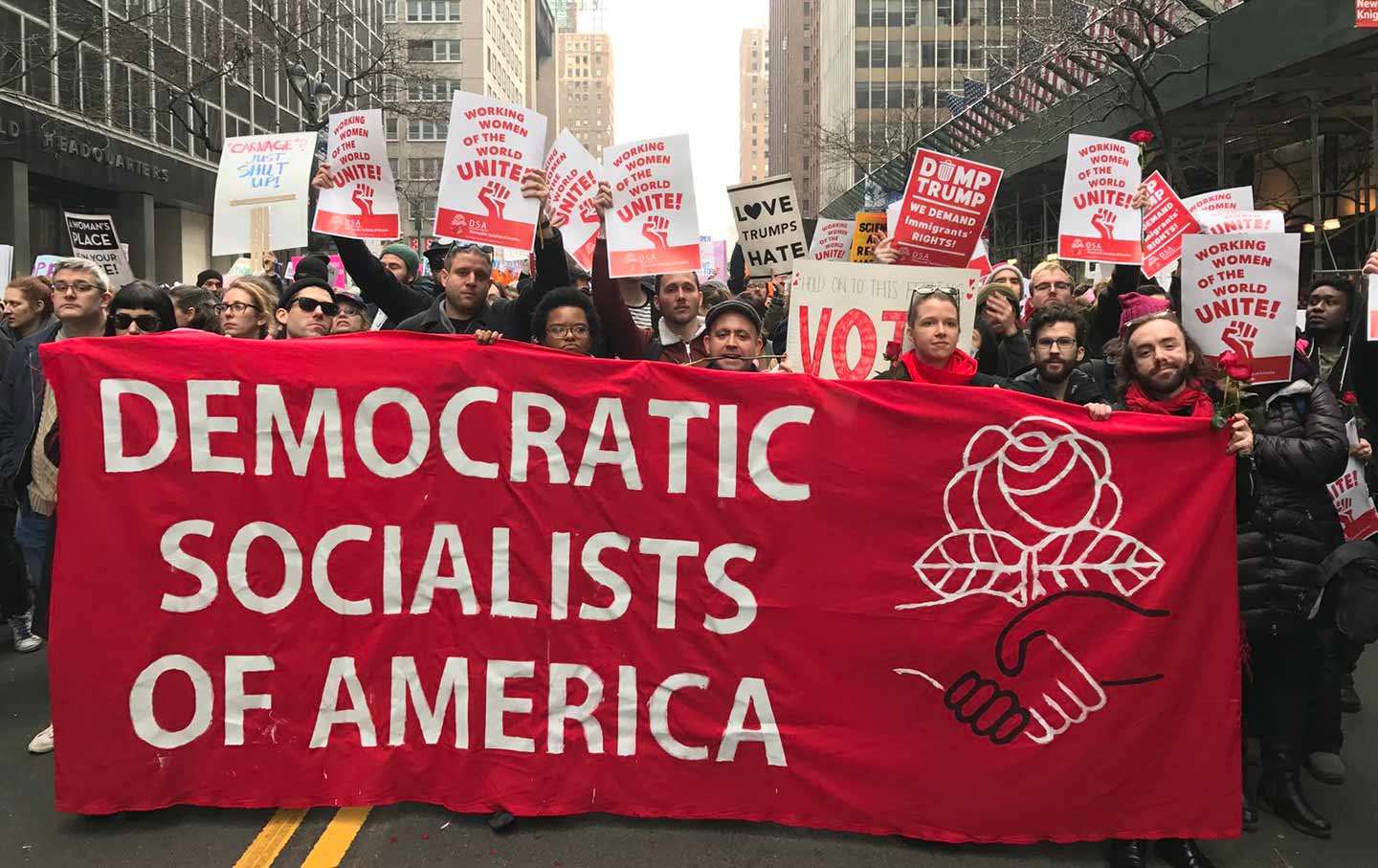
For decades, the Democratic Party positioned itself as the undisputed champion of the American working class. Today, that coalition is undergoing a profound structural fracture. Insurgent factions that once rode on the party’s coattails are now stepping into the driver’s seat, steering the party away from incremental reform and toward the removal of traditional Western systems.
Abdul el Sayed is another hopeful nominee for the DSA after winning the 2026 August primaries in Michigan. Democrats have been giving radicals a seat at their table over the years, and are now forced to confront more like an infiltration than an alliance. Even long established advocates for socialist policies, like Bernie Sanders, have admitted that Americans by and large do not support open borders or prison abolishment. Yet, the national DSA has openly doubled down on calls to abolish the Senate, the Supreme Court, free markets, and the criminal justice system.
While progressive apologists insist that this radicalism is a strategic exaggeration of reasonable reform by political opposition, the DSA is increasingly speaking for itself. When pressed on national television about the party’s role as a criminal justice platform, DSA Program Committee Co-Chair Frances Gill notably deflected. Meanwhile, mainstream boundaries continue to blur: Senate Democrats recently walked out of a formal hearing on the Muslim Brotherhood, and El-Sayed has campaigned alongside commentator Hasan Piker, whose history of incendiary, anti-Western rhetoric is well-documented. What was once the fringe has officially entered the mainstream, propelled under the banner of the working class.
One might expect DSA wins to be accredited to the votes of such communities. But the people voting socialism into office are overwhelmingly white and college-educated. In fact, minorities and the working class are notably resistant to radical policies in their state. El-Sayed won over the highest income county in the state while his main opponent, democrat candidate Haley Stevens, earned favor with the lowest income county. El-Sayed was disproportionately popular in counties in which over 30% of residents were college educated, while Stevens was the favorite in counties with less than 30% of adults holding college degrees. While El-Sayed secured Dearborn, a predominantly Muslim county, he underperformed in African American communities and working class demographics—groups that also preferred Stevens.
Though the DSA has risen through the political ranks by pledging allegiance to the historically underprivileged, El-Sayed reflects yet another preference of the white, educated class. Turns out, the average American doesn’t want to see western tradition uprooted entirely. Zohran Mamdani, DSA aligned mayor of New York City, stepped out of the Big Apple to find that his popularity didn’t extend to the rest of America. Mamdani was filmed getting booed off stage at an appearance in Staten Island. Much like El-Sayed, his office was largely handed to him by white young adults with college degrees.
Socialism didn’t just burst onto the scene: Democrats have been gradually pushing policies further to the left, promising the disenfranchised a real-life utopia. Using “free” handouts as a strategic distraction, the DSA has been slowly chipping away at the base of traditional liberalism. White college students have become leading defenders of socialist agendas, insisting that it prioritizes the lower class, relieves financial burdens, and knocks down the powerful to make room for the underdog. But the supposed victims in need of DSA rescue are the ones voting the other way.
Why would the greatest socialist support come from the highest income, the most educated, and the least historically marginalized? One theory could be that the working class possesses an understanding that higher education no longer teaches: how the world actually works. Having time for ideas is an intellectual luxury—so is self-reflection. It is the same reason that the most developed nations have the greatest interest in mental health and humanistic theory. Rather than a matter of intelligence or capability, concern for the abstract is fostered only when immediate needs are met. There is nothing wrong with philosophical curiosity—in fact, it is quite valuable—but only insofar as it is grounded in a set of objective truths.
Universities embraced a post-modern curriculum in the late 20th century, encouraging young minds to see reality as relative. Barring exceptions, the young, white collegiate were conditioned to see academia as the path to success, forming intellectual bubbles that they hoped would change both the past and the future. History, to take one traditional discipline, was no longer a record of ideas tried and tested, but a biased narrative penned by the powerful. Distrust of classic fields like mathematics, language, and literature is an outgrowth of a world in which there is no fact independent from power. But if you don’t know what something means, how can you possibly assess if it’s true?
Pew’s recent “Outsider left” profile noted that working-class leftists, and heavily non-white, shared skepticism of the overall political system, but leaned far more socially conservative to moderate. This phenomenon has been so widely documented that it is often referred to as “the diploma divide” in political science. Further qualifiers appear in available research, as students enrolled in the humanities and social sciences are significantly more likely to be radicalized than those in STEM fields. Researchers in political science, psychology, and sociology have sought extensively to explain this pattern, but have yet to agree on causation.
Given that children raised by degree-holding parents and higher income households are more likely to go on to college, it is worth exploring whether the “diploma divide” reflects differences in real-word versus ideological exposure. The working class has generally spent more of their lifetime participating in the job market and taking on day to day tasks. On the other hand, white collegiates often delay practical experience, dedicating formative years to thinking about societal systems rather than operating within them.
Education at its best is when ideas meet reality, testing not just which ideas sound sensical, but which ones prove to be effective. Socialism attracts an elite who lack proper grounding. Free healthcare, free education, and free public transport lure a frustrated citizenry like an overextended line of credit: it offers immediate relief while quietly compounding a deficit that must eventually be paid.
For all of history, socialism has expanded government authority with the promise of prosperity. Time and time again, the public has witnessed the deception of charismatic politicians. Under a capitalist democracy, the inevitable letdown of empty promises does not compromise the rights of citizens. Individuals outside of the intellectual gates might have a better view of what those consequences will be.