

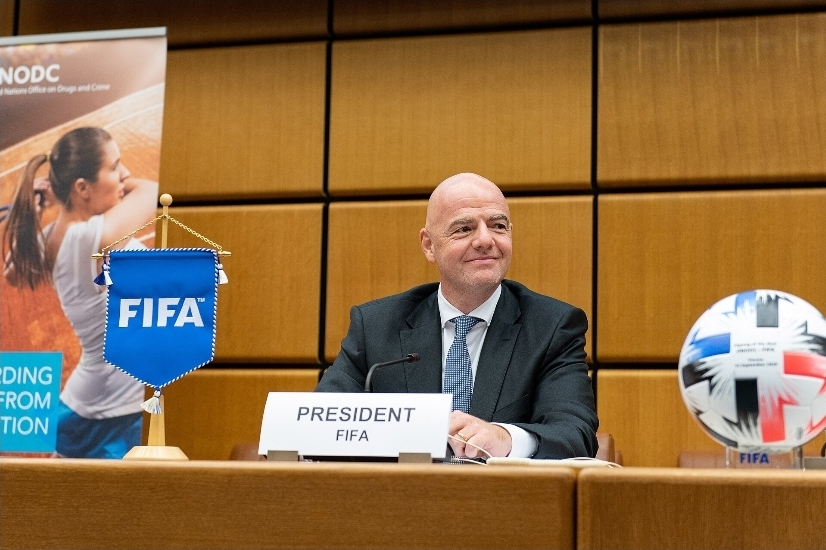
Gianni Infantino has faced widespread calls to resign amidst his controversial proposals for the future of the FIFA World Cup. United Nations Office on Drugs and Crime
In preparation for the 2030 World Cup, FIFA President Gianni Infantino has explored several proposals to commemorate the championship’s centennial. These included an expansion to 64 teams for the tournament and the hosting of three matches in South America away from the main host countries. But most controversially, he proposed to sell stakes in a for-profit operational subsidiary for the World Cup, which received massive backlash from continental and national soccer federations. FIFA, already sitting on billions of dollars in reserves, clearly was in no danger of becoming financially insolvent, so any transfer of logistics was largely unnecessary at best. And at worst, there was little transparency in the planning of this deal as FIFA did not name which organizations or investors would be involved, thus raising questions about whether the World Cup would be handled competently in the future. After threats of boycotting World Cups by many European and North American national teams, Infantino scrapped the proposal, but calls for his resignation continue.
An investigation into Infantino’s history in sports management reveals that merely firing him from FIFA would be too little and too late of a punishment. Even before taking his current position at FIFA, while working for the Union of European Football Associations (UEFA), he had covered up contracts assigning broadcasting rights to corporations involved in a massive fraud scandal. He has also refused to condemn ruthless dictators in Russia and Qatar, and continues to do so by handing Saudi Arabia the 2034 World Cup hosting rights despite the country’s mistreatment of migrant workers at the stadium sites. Additionally, Infantino fired several of FIFA’s independent ethics committee members, shutting down numerous corruption investigations, which should cast doubts on the organization’s transparency for as long as he is in power. But a closer look at FIFA reveals a structural guarantee of continued corruption independent of Infantino’s removal.
No other sports league or regulatory body is as plagued with corruption as FIFA. This is largely due to FIFA’s unique status under Swiss law, which classifies it as a non-commercial association on equal status with an amateur soccer club. This frees the organization from much regulatory oversight and having to perform rigorous accounting of its finances and meetings. Its transparency is further hindered by being largely tax exempt and thus skipping audits from the Swiss government. And, as it is an international organization with 211 members representing the world’s sovereign states and dependent territories, its one-nation, one-vote system only dilutes the power of major countries that are better equipped to host and have greater relevancy in major global tournaments. Considering that their populations are lower than many stadiums’ seating capacities, it is unfair to give the Faroe Islands or Bermuda the same voting power as Germany or Brazil. The latter’s teams have experience in hosting and winning multiple world championships. And, they contain a significant share of the world’s active players and fans of the sport. Most importantly, the best way to celebrate the tournament’s centennial in 2030 would be to ensure long-overdue reforms of the organization—not to give the hosting rights of the final to whichever country helps Infantino stay in power.