
Most coverage of the economic data will lead with the unemployment rate. It is the wrong number to lead with, and the recent July report already showed why.
In July, nonfarm payroll employment fell by 23,000, according to the BLS (Bureau of Labor Statistics). The BLS also reported the unemployment rate at 4.1 percent, with the number of unemployed people sitting at 6.9 million. A 4.1% unemployment rate is not particularly high, and not a cause for concern. It indicates a relatively stable job market, but one that has a soft underbelly. We look one layer deeper, and the picture changes.
A new report by Gad Levanon, Chief Economist at the Burning Glass Institute, finds that the economic picture is more mixed.
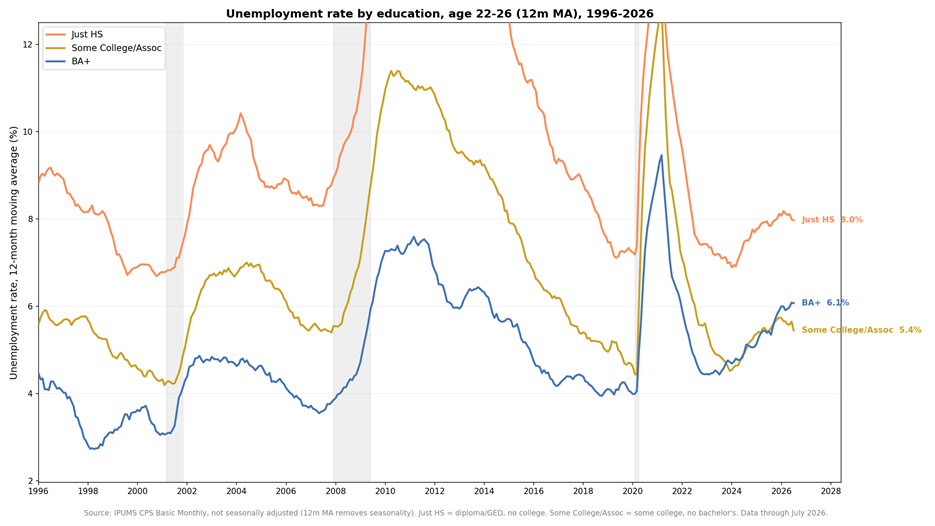
He finds that for young people, those aged 22-26, the unemployment rate has been steadily rising since 2022. Notably, the AI LLM boom began in 2022, with the rise of OpenAI. For those with a Bachelor’s degree or higher, the unemployment rate is 6.1%, much higher than the national unemployment rate of 4.1%. We see similar rises for all education levels, including for those with some college experience, or those with just a high school diploma.
However, it is more effective to compare these unemployment rates – specifically within each group – relative to previous years. How does the current unemployment rate for those with a Bachelor’s degree or more (BA+) compare to the unemployment rate for the same group in the past?
Another chart, from Levanon’s same report, outlines a stark picture:
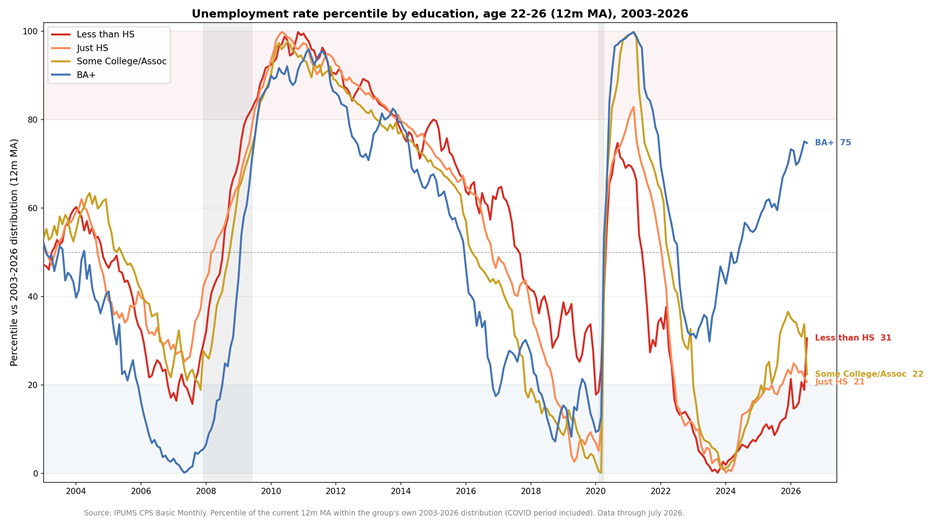
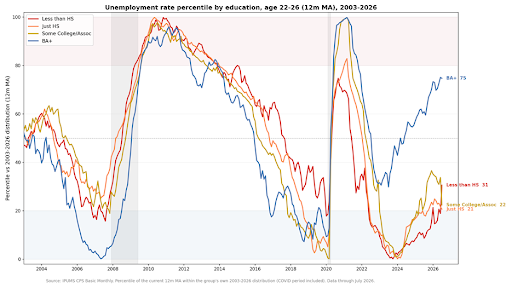
Here we can see each group’s current rate relative to its own unemployment-rate history since 2003, expressed as a percentile. Those with a BA or more are in the 75th percentile in 2026, meaning graduates face conditions that are worse than in roughly three-quarters of the past twenty years. Every other education group sits between the 21st and 31st percentile, closer to the best conditions they have seen in that span. This divergence is interesting because, prior to 2022, all four educational groups moved together.
But since 2022, young people aged 22-26 face a relative unemployment rate that is starkly worse than that of those with different levels of education.
An explainer for this, as Levanon’s report notes, could well be the impact of AI on white-collar, entry-level jobs. The very skills that AI is good at, such as coding, data analysis, and basic research, are being automated. This means that “entry-level” roles are becoming more scarce, while the roles that recent graduates compete for are those that require additional skills beyond that. Thus, there may be a disconnect between the skills colleges provide students and what skills employers look for, especially given the very rapid development of AI since 2022.
The second driver, which Levanon cites and I agree with, is the increased supply of college graduates. Over time, the scarcity of college graduates has declined, meaning more people with Bachelor’s degrees and Master’s degrees are competing for the same job. This saturation creates a more competitive environment for this cohort of job seekers. This alone does not explain the divergence between job seekers with higher educational attainment versus those with less educational attainment.
However, what seems to be happening in the current economy is a skills mismatch. Employment is largely stable for those who are hired, and employment opportunities are there for those who partake in jobs that do not require degrees. Yet, for young people seeking “high-skilled” jobs that match their higher educational attainment, there is a jobs shortage.
None of this appears in the numbers that lead the standard economic statistics, such as the unemployment rate. This is because an unemployment rate is an average, which hides this kind of divergence. Young workers who earned a college degree or more, and borrowed to do it, are in the worst quarter of their own record over the last 2 decades. The economy is not failing, in the large macroeconomic picture. It is, however, failing for a certain subset, which could have long-term implications for the future of the American workforce.