

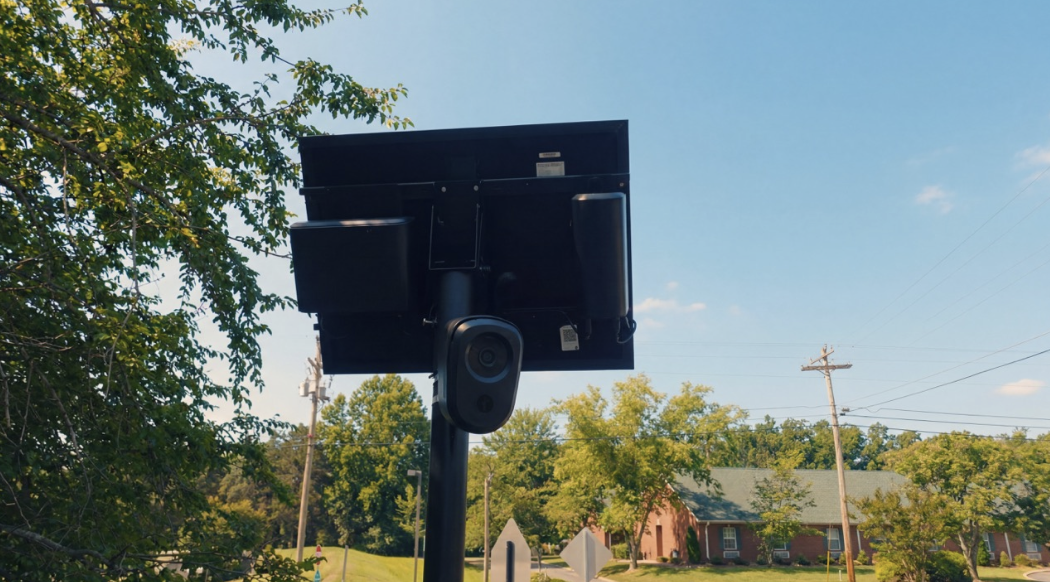
Flock Cameras have popped up on roads all across American communities. Wikimedia Commons

The frequency of Flock Inc.’s cameras in American cities has grown exponentially since the tech giant’s founding in 2017. But unlike most traffic cameras, they record far more than just a vehicle’s license plate. Flock cameras with integrated AI are largely placed on the sides of roads, performing billions of vehicle scans on a monthly basis. Flock claims to record the license plates and models of these vehicles, storing the information in a massive database, in order to help police resolve traffic violations and escaped criminals. However, this vast database of vehicles consists very sparsely of criminals or rowdy drivers, contains frequent mistakes in matching license plates to the correct state, and, most controversially, is subject to minimal regulation when it is shared with law enforcement agencies, as reported by the ACLU. Year after year, Americans have traded more of their privacy and liberties with the goal of purchasing more security, but the result has been a permanent loss of both.
Shortly after the terrorist attacks of September 11th, 2001, fears of more terrorism prompted the swift passage of the USA PATRIOT Act. But the law’s violation of the constitution has diminished any patriotism it has inspired. It allows the FBI to seize personal data including phone records and internet searches of an individual without a prior court order, and requires private banks and financial institutions to perform intrusive surveillance on their own customers’ transactions. Despite criticism of the law as a violation of the fourth amendment, it has set a dangerous precedent for expanded tyranny, especially during the Covid-19 pandemic. Draconian lockdowns that banned people from most activities outside their homes were not only economically devastating to small businesses, but required an even larger surveillance state. With a nationwide network of Flock’s surveillance cameras, enforcing this tyranny would only become easier due to their ability to track the movement of vehicles and match them to their drivers. And, during the next major crisis that is used as an excuse to curtail our liberties, governments will surely use this new technology to enforce their tyranny.
As a result, a bipartisan push to restrict the growth has reached both halls of congress. Representatives Thomas Massie (Republican, Kentucky) and Ro Khanna (Democratic, California) have both prepared legislation to end government contracts with Flock. Similarly, as public backlash against Flock cameras has skyrocketed last month, numerous cities are now pausing the construction of or altogether ending their contracts with Flock. But merely halting new governmental tyranny is just the first step to restoring respect for our Constitution and Bill of Rights that our Founding Fathers envisioned.
4 Comments
There are definitely some surveillance issues that are extremely scary with Flock. I do think it could be used as some sort of public good, like most traffic and security cameras can, but it seems Flock’s system needs to be refined in order to actually work as intended. If not, it can be exploited by our government, private companies, and bad actors to harm citizens rather than protect them.
I think a common ground between conservatives and liberals is this want for less government surveillance, and I’m happy there’s a move to stop government contracting with Flock. I will say there’s a hot take by Alex I read saying they are quietly replacing Flock with other lesser known surveillance cameras in order to get less drawback from the public, so that’s something to think about.
This article is very insightful on the current and future impact of this level of public surveillance. I think it’s essential to consider the possibilities of what could happen if this surveillance were to expand, especially since laws are subject to change and it’s difficult to predict what will be considered legal and illegal in the coming years. Will Flock camera footage from the past be able to prosecute future crimes? Just something to think about. Very well written!
I live in West Los Angeles, in a fairly upscale neighborhood. People here are genuinely supportive of the Flock cameras, and local police are quick to say the cameras have helped track down criminals who later faced arrest. Support for Flock came under question when rumors started floating around that Flock data was being shared with ICE, which was using license plate data to track down illegal immigrants. I think we are still learning here, and any system designed and operated by humans will be subject to abuse. I think, for a few years, we should try and get the most out of this technology, and employing better controls as needed. I don’t think we’re yet at a place where we want to say “Flock is all good” or “Flock is all bad.” Maybe, in time, we can make it “pretty good,” where the goods outweigh the bads.