

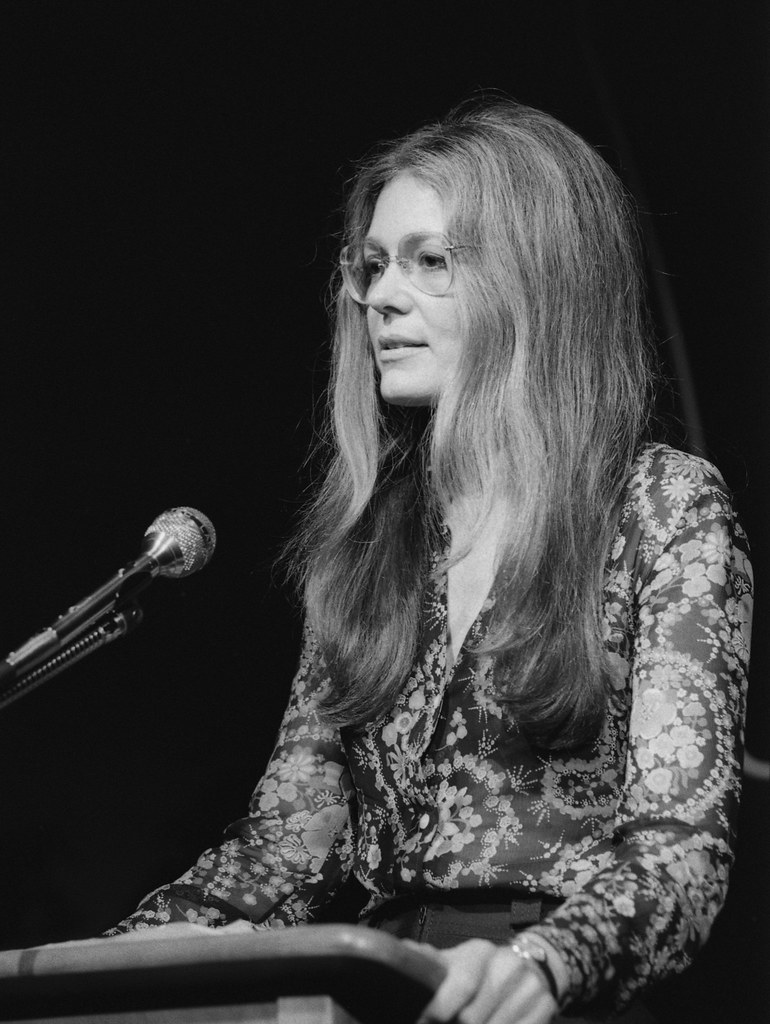
This was an awful time for feminist leader Gloria Steinem to die.
As Steinem herself said, modern women’s rights issues feel “both new and angering and ancient”
Steinem worked for years as a journalist and activist covering women’s issues, particularly reproductive rights. She founded multiple media and activist organizations that advocated for women, which eventually led to her earning the Presidential Medal of Freedom in 2013.
Steinem was born in 1934 in Toledo, Ohio. After her parents divorced when she was 10, the responsibility fell on her to take care of her mentally ill mother. After high school, Steinem attended Smith College to study government. She graduated in 1956 and earned the Chester Bowles Fellowship, which allowed her to spend two years studying and researching in India.
After her time in India, she landed in New York City, where she worked as a freelance journalist. In 1963, she went undercover as a playboy bunny and exposed what it was truly like to work at Hugh Hefner’s Playboy Club.
After that story’s success, she struggled to find serious work. Editors relegated her to the women’s pages, refusing to let her publish political pieces.
“I could not have made a bigger mistake,” said Steinem to the Associated Press. “It was personally and professionally a disaster. In the short term it was much harder to get serious assignments, and in the long term it’s been used to ridicule me.”
In protest, she helped found New York magazine. There, she could edit and write about whatever political topics she wanted. In 1969, she publicly spoke out about an abortion she had in London when she was 22, and encouraged abortion legalization. According to the National Women’s Hall of Fame, after that statement she became an in-demand journalist and media guest.
In 1971, she started Ms. Magazine, which encouraged discussions about women’s rights rather than the vapid housekeeping topics found in other women’s magazines of the time. During this period, Steinem also helped found the National Women’s Political Caucus, which encouraged women’s involvement in public office, and Voters for Choice, a pro-choice political action committee.
Her actions, along with the work of thousands of other women, led to the eventual passage of Roe V. Wade, which established women’s legal right to an abortion nationally.
It was a huge win for second-wave feminists, which made it all the more devastating when the decision was overturned on June 24th, 2022. Since that moment, 25 states have put in place strict abortion restrictions, with 11 of those placing total bans. Around 25 million women live in these states and are impacted by these restrictions.
25% of women in the United States access abortion care in their lifetime, according to the American Journal of Public Health. Abortion is healthcare.
“It’s obviously ridiculous to say somebody is ‘pro-abortion,’” said Steinem. “Nobody wakes up in the morning and says, ‘I think I’ll have an abortion. It’s a pleasurable experience.’ The question is not pro-abortion or anti-abortion; the question is who makes the decision: a woman and her physician, or the government,” said Steinem.
Abortion is a personal decision that should be left to the individual. A recent study even found that nearly all women who have an abortion report five years later that it was the right decision.
“Obviously, without the right of women and men to make decisions about our own bodies, there is no democracy,” said Stienam.
And that’s the responsibility of all Americans: to regulate our government so we secure our civil liberties and freedoms. Though Steinem dedicated her life to protecting these liberties, it is now our responsibility to protect what so many women fought for. She may have gone silent, but it’s time we get louder.
Acknowledgement: The opinions expressed in this article are those of the individual author, not necessarily Our National Conversation as a whole.
1 Comment
A beautiful take on the life and legacy of Gloria Steinem. While she is no longer with us, hopefully we can continue the important work of advocating for abortion and women’s rights everywhere. Let her legacy be a reminder of what we’re capable of when we care deeply about a cause.