

The male loneliness epidemic is a phrase that refers to the social isolation crisis among young adult men: fewer close friendships, higher rates of suicide, and a desperate craving for intimacy. Much of the public conversation frames finding a girlfriend as the only cure. We rarely ask: why do many lonely men feel entitled to women? And why does pop culture keep propelling the idea that young men – with a bit of pushing and shoving – can get the girl? We constantly see films and books where the male doesn’t take no for an answer and constantly lurks around in a woman’s life, disguised as “yearning,” all while ignoring how debilitating that persistence feels like from the other side.
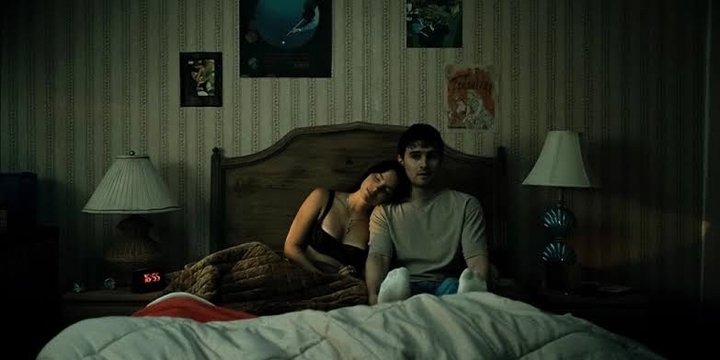
In particular, the film Obsession (2026), an indie psychological horror, observes Bear (Michael Johnson), an awkward music store employee, as he navigates his feelings for his childhood best friend Nikki (Inda Navarette). Beneath the ordinary appeal of Bear, he proves to be a “dangerous incel who thinks he’s a nice guy.”
*Spoilers ahead*
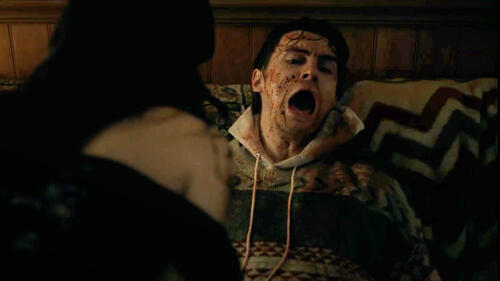
Bear buys a mysterious item, the One Wish Willow, and desperately wishes for his longtime friend Nikki to love him “more than anyone else in the world.” The wish manifests as Nikki losing access to her own bodily autonomy and free will. A sinister force takes over following the wish, and a double of Nikki becomes obsessed with Bear, just as he wished for, even if he did not mean for it to go this far. Nikki forces herself into Bear’s life and watches over his every move. What started as a story about unrequited love slowly spirals out of control into manipulation, violence, etc. At first, Bear selfishly chooses to stay with Nikki, as this new Nikki loves him entirely. Realizing his mistake, Bear calls the number listed on the One Wish Willow, and an entity informs him that there are no reversals. The curse can only be broken if Bear (the wisher) dies. Throughout the film, Bear realizes that the real Nikki is trapped – she is in hell while her double is next to Bear – but he continues to prove himself as a selfish man and chooses his own pleasure from being “loved” while she suffers indefinitely in his place. Why should the woman have to face the consequences of a man’s faults?
The nice guy archetype perpetuates the belief that the girl is a “prize to be won,” reducing a woman to just an object they can toy around with and obtain. The archetype translates in the film as sexual assault: Bear treats Nikki’s body, her possessed one, as a reward – he has sex with Nikki’s possessed body despite knowing that the real Nikki does not consent. Bear’s face remains unseen, while Nikki’s remains blank, staring off and completely unengaged, emphasizing her dissociation and unwillingness, and his anonymity as the perpetrator. Although Obsession is a work of fiction, the film speaks to reality. One instance of this is the fate of 23-year-old Khesani Maseko from South Africa, who took her own life after being raped. This illustrates how a woman takes the fall due to a man’s actions, time and time again.
Obsession sparked widespread discussions upon its release. Viewers noted that watching it is unsettling, particularly for women, because it reflects the real-life dangers of men who feel entitled to a woman’s body, time, and affection. While most critics recognize the movie as a critique of rape culture and modern male entitlement, certain segments of viewers have shockingly misread the film, blaming the female character for her erratic, possessed behavior rather than pinpointing the issue with the man who stole her autonomy in the first place.
Obsession (2026) is an important social and political film. As the audience, we should think of the male loneliness epidemic as a self-inflicted issue. If there is one thing to take away from the movie, it is realizing that a man’s loneliness, even the nice guy’s, does not entitle him to a woman’s life.
Acknowledgement: The opinions expressed in this article are those of the individual author, not necessarily Our National Conversation as a whole
1 Comment
this could of been summed up “I hate men” the end.