

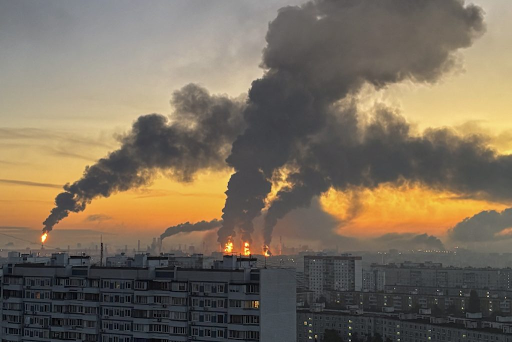
On September 13, a Russian drone struck a passenger train near the Polish border, minutes after a delegation of senior Western officials – among them former British Prime Minister Boris Johnson and former Swedish Prime Minister Carl Bildt – had passed through the station. Two days later, NATO fighter jets shot down a drone that entered Lithuanian airspace overnight. While officials are investigating the origins of this drone, they have also said that these drones were carrying explosives, and that this was the first interception of this kind done in Lithuania’s history. Lithuania, a small nation in eastern Europe, borders Kaliningrad, a Russian exclave, and is thus potentially vulnerable to Russian military action.
Then, on September 17th, Polish Prime Minister Donald Tusk warned parliament that Russia is planning strikes on NATO countries, especially those who have provided support to Ukraine amidst the Ukraine-Russia war. “According to intelligence assessments, Russia’s plan … includes hybrid drone and missile strikes against countries supporting Ukraine, including Poland,” Tusk said. Russia may not invade, but it is building the apparatus for an escalation, testing the line that NATO holds.
The Potential Threat
The most telling evidence of potential escalation comes from looking at how European nations are responding.
Germany, for example, is preparing its hospitals for a potential Russian attack on NATO, according to Bloomberg. In a report that modeled possible scenarios, the German army estimated that the hospitals could receive as many as 1,000 wounded service members a day.
Furthermore, on Thursday, September 17th, Finnish President Alexander Stubb told his country it was “worth mentally preparing for something to happen”, including a potential escalation of Russian military action. It is worth noting that Finland borders Russia, a border that spans 1340 kilometers (833 miles), making it the largest border shared between the Russians and a NATO member.
French President Emmanuel Macron, on September 18th, summoned party leaders and France’s 2027 presidential candidates for an emergency meeting to discuss the Ukraine-Russia war, the Iran war, and the oil crisis.
European leaders are using their position in the public’s eye to sound the alarm. This does not mean that an attack on Europe and NATO-aligned countries is imminent, but it does point towards a priming effect, where the public is made aware of what could well be an escalation. This could also be a strategy for Europe to deter Russian action, sending the signal to Moscow that any attempt to cross into NATO territory, or probe it with drone attacks, will be met with force.
A Drone War Preceding Something Larger?
Russia’s strategy of escalation is to take small steps to blur the lines of what is considered acceptable. Drone strikes in Poland, drone activity in Lithuania, and probing of airspace, through what are called “hybrid” attacks, allow Russia to enter a grey zone. Escalate in seemingly subtle yet deniable ways, and Europe can – in the name of restraint – decide not to act on it. This probing method is a tool that is used to test a target before pushing forward with a deeper, large-scale invasion. Europe is responding by emphasizing preparation, trying to project unity, and signaling to the Russians the cost of any Russian invasion of NATO-aligned countries.
Is a Russian invasion a plausible threat in the near future? We do not know, but the signals are not encouraging. Ukraine has also escalated, launching hundreds of drones at Moscow on Sunday, September 20th; the attack targeted oil refineries and killed 3 people. This is part of a broader Ukrainian drone campaign to weaken Russia’s oil production, a key part of Moscow’s plan to keep Russia afloat amidst the war:
Russian crude oil throughput, 2024-2027
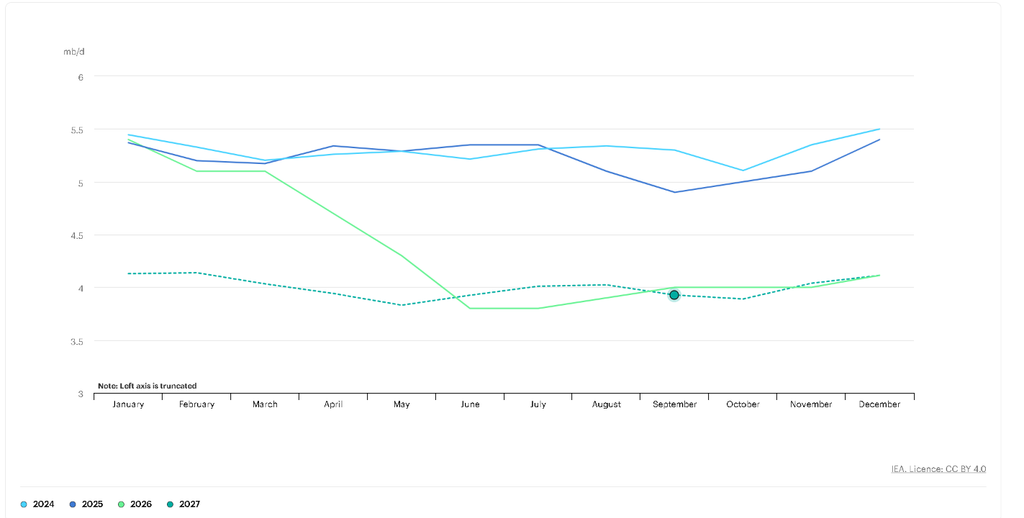
Ukraine has effectively been able to hang on in this war, with Western support. And as their technology has improved, their drone attacks on Russian oil infrastructure have proven to be more effective and sustained. Russia, therefore, has been struggling to maintain crude oil output, as we can see a sharp drop starting in June of 2026.
Thus, we are seeing escalation on both sides. Ukraine is conducting more effective attacks on Moscow, and Russia is moving to use drone attacks on Ukraine-allied NATO nations.
The Lesson Of 2022
The question remains, however, whether the recent alarm is part of a broader unease that the war will escalate beyond Russia and Ukraine. Would Russia be willing enough to do a ground invasion on the eastern front, thereby directly involving NATO countries like France and Germany in a hot war?
It seems implausible, but then again, before 2022, Russia’s invasion of Ukraine seemed implausible, even as Western intel found Russian troop buildup across the Ukraine-Russia border. This intel, which was made public, preceded the invasion of Ukraine, which happened days later. Interestingly, at the time, the U.S. struggled to convince allies about the threat, who openly doubted that Putin was seriously preparing an invasion. Zelensky himself spent months dismissing the warnings, publicly urging Ukrainians to stay calm rather than stock up, and insisting he did not believe a major war was coming that year.
The disbelief seemed psychological. Analysts could not fathom that Russia, in the 21st-century world order, would rationally commit to a large-scale, land invasion of Ukraine. I shared that skepticism at the time, thinking it would be an absolutely foolish move on Moscow’s part, given Russia’s investments in weakening Ukraine through other means, such as funding rebels in eastern Ukraine.
The world would be wrong to underestimate Russia’s brazenness again. In the same way that a Russian invasion of Latvia or Poland seems unthinkable and irrational, the same logic was used to dismiss claims of a Russian invasion of Ukraine. If NATO is well prepared, it will learn from these mistakes. Perhaps that is why Europe is ringing the alarm bells.
There is, however, the potential risk of overcorrection. Baltic states, including Estonia’s Secretary General, have tried to de-escalate claims about an imminent invasion to dampen any panic. This is an interesting role reversal, because it is usually these states that are among the first to sound the alarm, as they are most affected by Russian action. If panic devolves into aggressive rhetoric from Europe, aiming to deter Russia, Russia might take this as a signal that NATO is considering a “pre-emptive” strike; if that is how Moscow reads the situation, then this may make a Russian invasion more likely, not less.
Therefore, as tensions rise, it will be important to see how Europe, and the West writ large, balances rhetoric meant for deterrence with rhetoric that can escalate the situation. The paradox, as often occurs in war, is that the more you prepare for it, the more it may signal aggression to the other side and vice versa. This is all the more reason to get the balance right; learn from 2022, but do not overcorrect.