

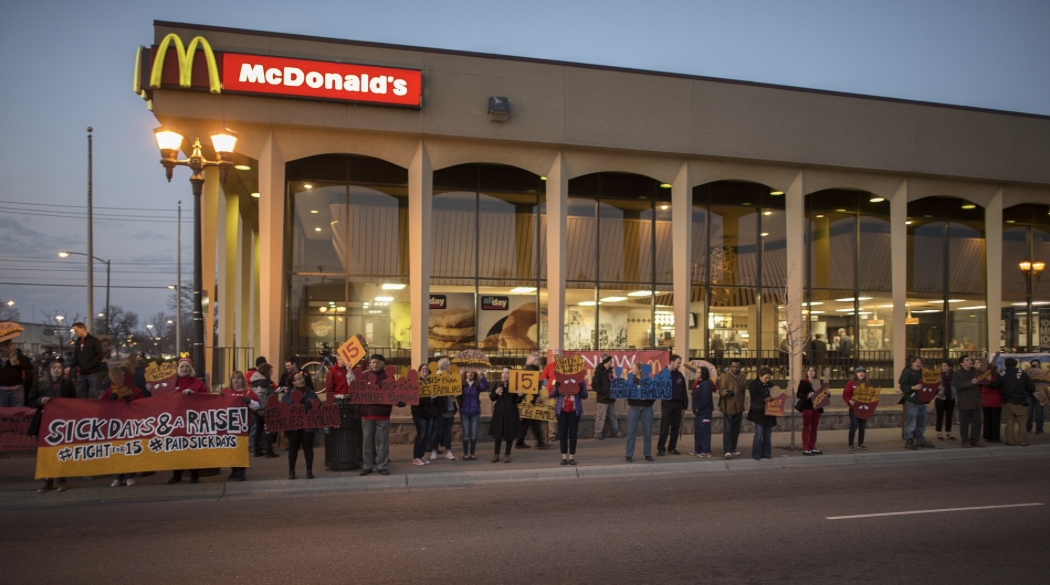
Striking McDonald’s Workers Support a Long-Overdue Hike in the Federal Minimum Wage
Adjusted for inflation, $7.25 in the year 2009 had the purchasing power of over $11 in 2026. The cost of living has surged in the past seventeen years across America, but the increase in minimum wages has been less steady. After the last hike in the federal minimum wage occurred in 2009, many states have not codified a pay over $7.25 per hour for their working populations. These states, like Texas, Tennessee, and Wyoming, are strongholds for the GOP on an overwhelming level. But, a closer inspection at public opinion of similar states reveals that raising the minimum wage is far from only being supported by communists. Alaska, Florida, Missouri, and Nebraska, which Trump won during the last three Presidential Elections, have shown their approval for steep minimum wage hikes in the same time period, despite pushback from the very same politicians that their voters elected, such as Ron DeSantis. Many conservative politicians argue that the rise will hurt small businesses and sacrifice entry-level job growth. But is the market truly free enough to fix America’s wages?
Starting from a microeconomic analysis, one would assume that minimum wage laws would either unlock no additional societal welfare or create deadweight loss. But this does not apply to the uncompetitive labor markets that many small towns face. Numerous small towns in America have seen their labor markets dominated by dollar stores belonging to national chains, driving local grocers out of business in the long-run after engulfing consumers in cheap imports. As a result, demand for labor is consolidated among fewer employers who can use their market power to set wages below what a competitive market of a big city would tolerate. This phenomenon, known as monopsony, can lead to deadweight loss if left unregulated. Independent grocery stores have suffered significant declines in employment and sales to chains like Dollar General and Dollar Tree, which also limits the ability of consumers’ preferences to influence the market. And, the profits that these chains earn rarely benefit the remote communities that they infiltrate—in contrast to the small businesses that they displaced.
Looking at the broader picture, an increased long-term output from present redistribution of income is not merely hypothetical. Belgium’s wage-indexing model that references inflation to determine mandated raises has resulted in exceptional wage growth compared to most of the European Union whose wages stagnate. Furthermore, job loss, if it occurs, tends to be marginal from the hikes in the minimum wage. These hikes have been far from extreme or sudden when adjusting for inflation, so an increase of just a few dollars per hour is long overdue. In addition, the velocity of money, calculated by the frequency of trades of a unit of currency, is an important factor in stimulating the economy. Economists have regularly confirmed that velocity of a marginal dollar earned is highest among lower-income earners, as the richest tend to use their additional earnings to save or invest in stocks, whereas the poor are most likely to spend new income on consumer goods to meet their most urgent needs. This concept gives light to a study conducted between communities in Pennsylvania and New Jersey when only the latter raised its minimum wage in 1992, which saw no decrease in the Garden State’s restaurant employment, in part due to consumers having more income to dispose of. At a time when income inequality is reaching record highs across the world, politicians must start listening to the will of their voters in order to ensure a more competitive and diverse economy.