

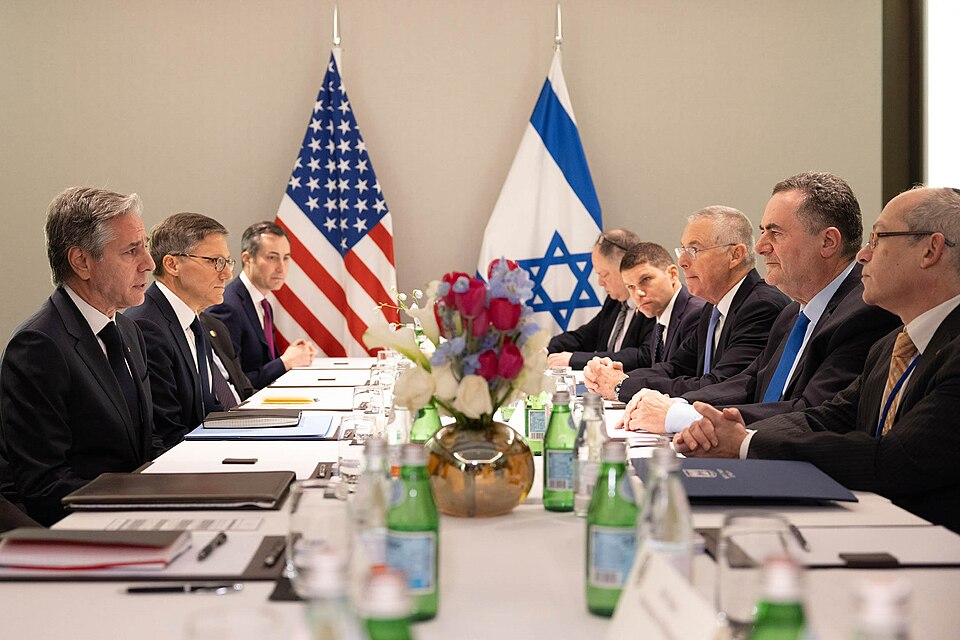
Israel does not need American taxpayers to fund its military. Washington should end the annual subsidy and treat Israel as it is: a capable, wealthy partner that can pay for its own defense interests. The United States should shift from annual aid to a transaction-based cooperation, where the government can regulate Israel’s military and defense expenditure in the U.S. case-by-case. Each purchase by Israel would face congressional review, end-use monitoring and human rights assessments. Moving from a $3.8 billion annual package to case-by-case decisions forces policymakers to evaluate the transfer of defense technologies carefully.
Israel today is not a fragile state dependent on outside support. It is a high-income economy, as stated by the World Bank, with a sophisticated defense sector and one of the most advanced militaries in the world. Its military spending reached roughly $48 billion in 2025, according to SIPRI, about 6.5% of its GDP. American aid, by contrast, covers only 16% of Israel’s defense budget.
Useful? Yes. Necessary? No.
There is already a system in place in the U.S. for arms transfers and defense spending: Foreign Military Sales and Direct Commercial Sales. Together, they move about $115 billion a year in defense exports. Israel can continue to use this system, but on its own dime. It would still be able to purchase F-35s, precision munitions and missile defense systems from American manufacturers. Instead of American taxpayers subsidizing Israel’s expenditures in the U.S., Israel would pay for them itself. This approach preserves the U.S.-Israel security partnership while eliminating the special treatment embedded in the current aid structure.
In addition, most of the U.S. military aid from the $3.8 billion to Israel is spent in the United States. Technically, the current arrangement functions as a subsidy for American defense production.
Some critics argue that ending the $3.8 billion grant does not actually fix anything. Even if the U.S. stops giving aid, it still approves arms sales, regulates how weapons are used, and shares responsibility for their consequences. Others argue that the annual aid gives the United States leverage over Israeli policy decisions and signals a strong commitment to a key ally. These concerns are serious. But the United States cannot fully detach itself from how its weapons are used under any system. Arms exports remain tightly controlled under U.S. law. No American company can export even a missile component without a license from the State Department, and recipients must obtain written U.S. government authorization before using or
transferring that equipment. Legal scholars also note that, under international law, supplier states bear responsibility for war crimes, in certain cases. Converting our current annual grant system into case-by-case transactions would increase scrutiny from the public and strengthen U.S. accountability in the Israel-Gaza war.
Phasing out the annual subsidy would recognize Israel’s self-sufficiency while ensuring that a modern alliance should be built on cooperation and accountability, not on handouts.
Acknowledgement: The opinions expressed in this article are those of the individual author, not necessarily Our National Conversation as a whole