

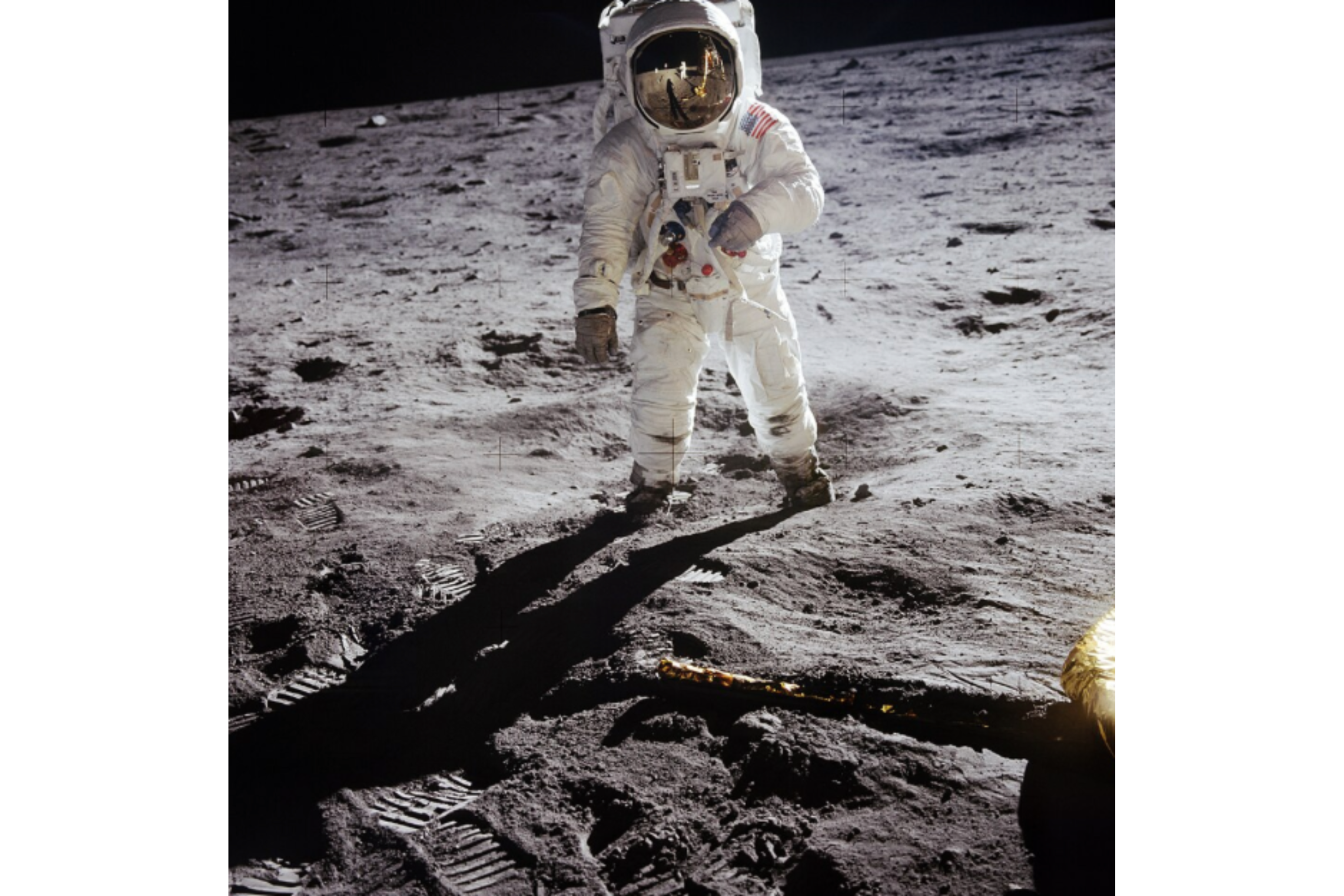
Conspiracy theories alleging that the Moon landings from NASA’s Apollo program were fake have virtually no evidence to back them up.
For the first time since 1972, NASA’s Artemis program saw a successful return of humans to the Moon and is poised to return to land on it in 2028. The vast majority of Americans believe that the original Apollo missions were worth the costs, and have long desired a return to the Moon’s surface. The Moon landings are widely regarded as one of the greatest breakthroughs in science—albeit with significant opposition. Specifically, a small but very vocal share of people, even in the United States, allege that they were fake. These conspiracy theories have been backed up with virtually no evidence, but belief in them nevertheless continues to grow.
A look at the Apollo program in an international context is helpful in squashing these allegations’ credibility. During the height of the Cold War in the 1960s and 1970s, the United States and Soviet Union sought prestige for their economic systems via accomplishments in space exploration. The Soviet Union successfully conducted the first unmanned and manned missions into low-Earth orbit. President John F. Kennedy used this to urge the United States to be the first to send a man to the Moon. Although the Apollo mission was not without catastrophic failures, the Soviets acknowledged its success in accomplishing its goals in 1969. Proving the accomplishments of its primary nemesis fake would have severely improved the Soviet Union’s standing at such a pivotal moment in history. So, the fact that even the communist superpower refused to even try should be taken as a major concession gesture in the space race. And the Soviets were certainly keen on exposing American secrets: vast Soviet spy networks existed in the United States during the Cold War, which stole numerous American innovations in nuclear weapons, defense hardware, and even NASA’s space shuttles. Additionally, the space programs of Japan, India, and China have seemed to verify the presence of the Apollo missions’ abandoned landers on the Moon, giving Americans even more confidence in their country’s space exploration capabilities.
Many deniers of the Moon landings also allege that if they had taken place, it would not have been decades since Apollo 17 in 1972 before humanity returned to its nearest celestial neighbor. The reason for this dearth of Moon landings has not been a lack of available technology, but rather a lack of will to return, the enormous cost, and the need for improved safety measures. The Apollo program cost over $300 billion after adjustments for inflation and took place during the peak of NASA’s share of Federal spending. Even excluding the notorious Apollo 13, the program’s missions came close to catastrophic failure countless times due to faulty engineering, and these safety margins would never be allowed on a space mission today. Furthermore, improvements in unmanned space probes have replaced the need for human missions beyond low Earth orbit, and the Moon appears to be no exception. The Artemis program has taken these flaws with Apollo into account in order to be more cost effective, which Americans should see as an award for their patience since 1972.
Returning to the Moon is just the start of breaking new boundaries in space exploration. SpaceX, a private company, is also contributing to America’s manned space efforts. NASA hopes to establish a permanent base on the Moon by the end of the decade. Mars is the next frontier of human presence, and NASA is currently exploring the logistics of human missions there. Each of these will only gain the United States more respect, legitimacy, and cooperation as humanity strives towards the common goal of exploring our cosmic backyard—a determination that can be credited to the Moon landings.
Acknowledgement: The opinions expressed in this article are those of the individual author, not necessarily Our National Conversation as a whole.