

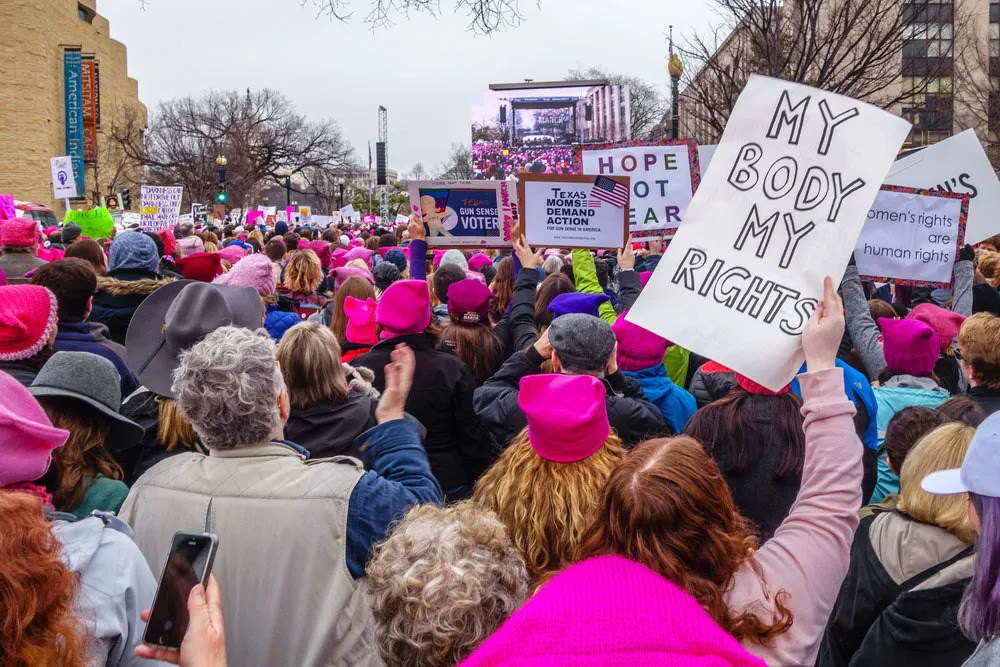
Have you heard liberal media say feminism is simply “believing in equal rights for women”? Most of us have, however, some of us may have been exposed to the opposite end of the spectrum that claims feminism is perverse. But in fact, both of these definitions may be true to an extent. There were indeed misandrist feminists, and there were indeed equality-oriented feminists. So should we identify with feminism? Well, that depends on your personal ability to outline the following and declare your own identification:
First Wave Feminism (Late 19th Century – 1920)
What does it mean to be a first wave feminist? First wave feminists’ primary goal was securing women the right to vote, but they were also involved in the abolitionist and temperance movements. However, as a part of the larger background, Mary Wollstonecraft is an important figure to understand. She believed that women should receive the same education as men, and that women being kept in the household without choice was negative.
The following are quotes from Mary Wollstonecraft:
“Make women rational creatures, and free citizens, and they will quickly become good wives; – that is, if men do not neglect the duties of husbands and fathers.”
“I do not wish women to have power over men; but over themselves.”
Other figures who were the main contributors to first wave feminism included Elizabeth Cady Stanton and Lucretia Mott. Here are quotes from them:
Elizabeth Cady Stanton:
“A woman will always be dependent until she holds a purse of her own.”
“The bible teaches that women brought sin and death into the world. I don’t believe that any man ever talked with God. The bible was written by man out of his love of domination.”
Lucretia Mott:
“In the marriage union, the independence of the husband and wife will be equal, their dependence mutual, and their obligations reciprocal.”
“It is not Christianity, but priestcraft that has subjected women as we find her.”
These figures could be considered more radical in their opinions, but you might argue that their quotes somewhat disagree. Stanton’s quotes demonstrate that she wanted women to be financially dependent from the ties of men, and believed that the Bible was a tie holding women down. Mott on the other hand is more conservative, simply wanting marriage to be equal, and stating the belief that human contributions such as that of priesthood were what made Christianity sexist in her eyes.
Second Wave Feminism (1960s – 1980s)
Second wave feminism drew from the early ideas of patriarchy to spark new movements such as the sexual revolution and women in the workplace. Betty Friedan also created a mass message of the movement with her book “The Feminine Mystique”. Her book was inspired by an earlier piece by Simone de Beauvoir, “The Second Sex”. The following are quotes from Friedan and Beauvoir.
Betty Friedan:
“There is absolutely no evidence that it is harmful to children if their mother’s health, well-being and autonomy and control of her own destiny is maximized by work outside the home. “
“Women who ‘adjust’ as housewives, who grow up wanting to be ‘just a housewife’, are in as much danger as the millions who walked to their own death in concentration camps…they are suffering a slow death in mind and spirit.”
Simone de Beauvoir:
“The tie that binds her to her oppressors is unlike any other. The division of the sexes is a biological given. Not a moment in human history.”
“One is not born, but rather becomes a woman.”
These quotes show that second wave feminists came forth with a goal to promote female independence and disconnection from the traditional family, starting with women having their own career goals, what many would call today ‘dreams’. Some of these feminists such as Friedan pushed the belief that women who did not seek more outside of their gender role were mentally and spiritually disembodying themselves. As it can be seen in Beauvoir’s first quote, these feminists identified history as systematically oppressing women and forcing dependency on men and believed that sexes should be divided fully.
Third Wave, Fourth Wave Feminism & Afterthoughts (1990s – 2010s, 2010s – Present)
The third wave combined punk culture, sexual harassment controversies, and a tricky, newly progressive, political climate into a conversation about modern women’s rights and freedoms. However, the third wave had not advanced as independently as the other movements, which came up with new, more radical, perspectives, and builds mainly upon the previous ideas. The newest idea was “intersectionality”, which explores how other identities interlap. This, along with older concepts has led discussion in Fourth Wave feminism, which prioritizes sexual rights, sexual harassment, and empowerment. Ultimately, the political climate in recent years has attributed a new liberalism to feminism, building an umbrella for the term. But we should understand differentiations between different figures across the waves.
So should one identify as a “feminist” if they do not align with all of the figures? Well, the figures had their own differences, so aligning fully would be impossible. But upon stating you are feminist, you should know how to clarify that term, and articulate your beliefs. Overall, it may be safer to align as a “women’s rights advocate” if you believe in equity, but not the complete destruction of households, male-led systems, and the church. Still, if more people knew the figures’ standing points they would not as blindly stand with or away from this movement.
Acknowledgement: The opinions expressed in this article are those of the individual author, not necessarily Our National Conversation as a whole.
