

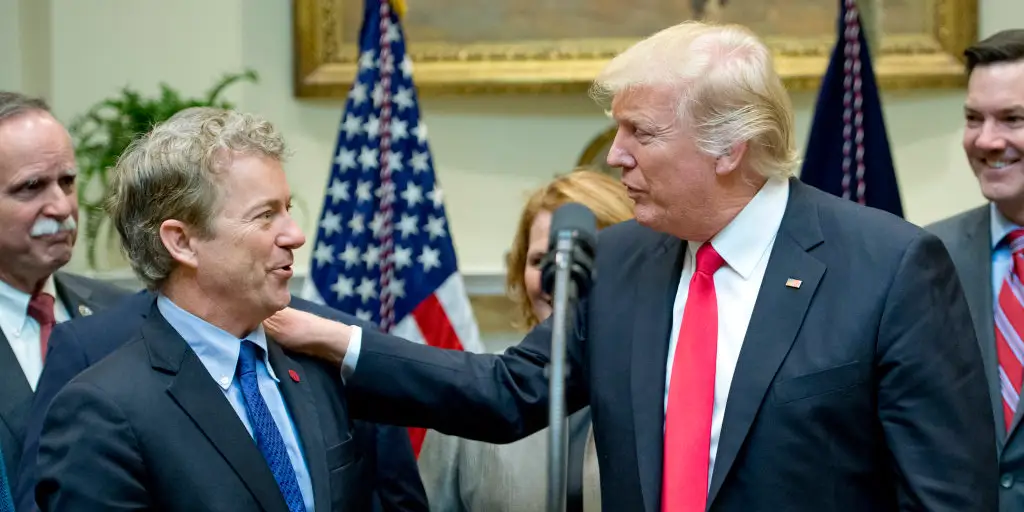
On Tuesday, June 23, the U.S. Senate passed a War Powers Resolution that could limit President Trump in Iran. The resolution passed with the help of 4 Republicans voting with Democrats. Among these 4 were 2 Senators who also voted against Trump’s One Big Beautiful Bill Act in 2025: Susan Collins (R-ME) and Dr. Rand Paul (R-KY). Thus, Collins and Paul are the only 2 Republicans to vote against the defining features of Trump’s foreign and domestic agendas. In an era where loyalty is key in the Republican Party, this is significant. Collins’ political motivations are easy to infer. She is a Republican Senator running for re-election in Maine, a state which Trump lost by about 7% in 2024. Thus, she has been distancing herself from Trump throughout his second term in order to be free from his agenda in her 2026 race. Further, however short political memories may be among American voters, politics is a game of identity. Collins voted to convict Trump on articles of impeachment in 2021 and proceeded to work with President Biden on his infrastructure effort. She has made a name for herself as an independent Republican. Giving that reputation up would not only put her at an electoral disadvantage in a light blue state, but such a concession would also erase her claim to fame.
Rand Paul is much harder to pin down because he represents Kentucky, a state that Trump won by 30%. He, unlike Collins, is not up for re-election this year, making Trump’s support in this moment unnecessary. However, Paul only has 2 years left in his Senate term, and he knows via the political downfall of colleagues like Senator Bill Cassidy that Trump holds grudges. Thus, getting off Trump’s naughty list will be harder for Paul in the leadup to 2028 than it was in the leadup to 2022, when he helped lead the charge against Trump’s impeachment and ultimately garnered the President’s endorsement. If Paul is hoping to veer towards Trump after the 2026 midterms, it may not work because of his vote against the OBBBA and his vote for the War Powers Resolution. And yet, he may need Trump’s support in 2028 if he wants to win a Senate primary in Kentucky. So what is his political motivation in distancing himself from Trump?
The President’s ill will would be a hurdle in a 2028 Senate primary, but it might be useful in a 2028 Presidential primary, something Rand Paul is candidly considering. There are two sorts of primary campaigns Paul could run:
- A campaign aimed at winning the nomination and eventually the Presidency
- A statement candidacy aimed at building a following within the party and or moving the party’s ideological goalposts
In both, distance from Trump will be a requirement. If Paul is serious about winning a Presidential nomination, then he will have to set himself apart from a Republican field filled with Trump’s cabinet officials like Marco Rubio and Trump-loyal Senators like Ted Cruz. Running on fidelity to Trump would not get Paul anywhere, especially when his claim to that fidelity is comparatively weak to other Presidential contenders. If Paul is simply aiming to make a statement, then there would be no statement to make from someone who is just echoing the President and his supporters, making political uniqueness important. However, unless Paul is planning to retire after a statement campaign, he would not be able to take any hostility towards Trump too far. In 2016, Paul made a statement, realized he could not win a Presidential primary, and dropped out to run for re-election in the Senate. If he wants to do the same thing in 2028, then he still has to have enough political capital to run for Senate after a Presidential campaign, capital that will not exist if he makes a pure enemy out of Donald Trump. Thus, a statement campaign would be a very difficult line to walk, but it would nevertheless require some degree of distance from Trump that he is currently trying to establish.
Rand Paul may not be trying to play politics. Lawmakers are human, and he may just be voting against Trump when Trump doesn’t align with his principles. However, if he is playing politics with these votes, then he is playing Presidential politics, where he stands to benefit from being independent of Trump. Paul said that his chance of running was “50/50,” but if his political posturing tells us anything, the question is not whether or not he will run, but whether or not he will be serious about winning when he does run. Take it to the bank: Rand Paul is soft-launching a bid for President of the United States.
Acknowledgement: The opinions expressed in this article are those of the individual author, not necessarily Our National Conversation as a whole